

- EV
- ELECTRIC VEHICLES
- E20
- ETHANOL BLENDING
- CNG
- HYBRID VEHICLES
- EV SALES
- EV ADOPTION
- AUTOMOTIVE INDUSTRY
- FADA
E20 Concerns Accelerate India’s Shift To Alternative Powertrains
- By Gaurav Nandi
- September 09, 2026
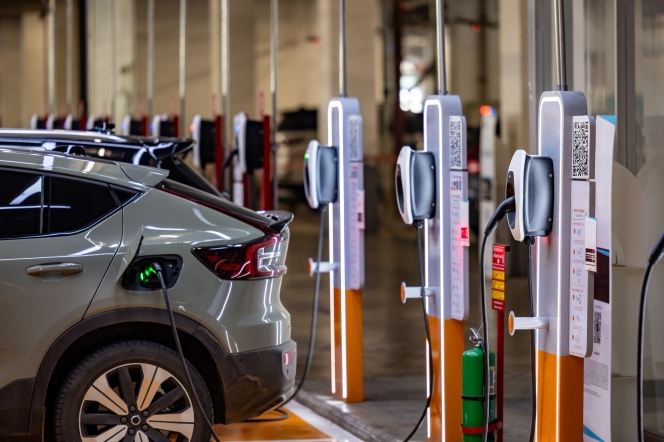
India's vehicle market is showing signs of a broader powertrain shift with consumers increasingly looking beyond conventional petrol vehicles towards CNG, hybrids and electric vehicles.
While electric mobility continues to gain ground, the latest retail data from the Federation of Automobile Dealers Associations (FADA) suggest that concerns around the transition to E20 fuel are emerging as one of the factors influencing consumer choices.
FADA's July and August 2026 data show the pace of change. In July, electric vehicle retail sales surged 66.2 percent year-on-year to 3,27,901 units, taking EV penetration to around 12.7 percent of total vehicle retail. Electric two-wheelers crossed the two-lakh mark for the first time with 2,04,362 units sold, giving EVs an 11.2 percent share of two-wheeler retail.
Electric passenger vehicles also recorded strong growth with sales rising 83.1 percent year-on-year to 32,928 units and EVs accounting for 7.9 percent of passenger-vehicle retail.
More significant, however, was the broader change in the passenger-vehicle powertrain mix. CNG, hybrids and EVs together accounted for 40.59 percent of PV retail in July, narrowing the gap with petrol or ethanol vehicles, which had a 41.68 percent share. CNG alone accounted for 24.67 percent, hybrids 8.02 percent and EVs 7.90 percent.
FADA attributed part of this shift to consumer hesitation around the E20 transition, alongside running-cost considerations.
The trend became even more pronounced in August. EV retail stood at 2,98,448 units, representing 52.9 percent year-on-year growth, while overall EV penetration increased to 12.3 percent compared with 9.5 percent a year earlier.
Electric two-wheelers remained the principal driver with 1,83,204 units sold during the month. Their penetration reached 10.68 percent, taking the segment decisively beyond the 10 percent mark.
The three-wheeler segment is even further along in electrification with EVs accounting for 65.3 percent of retail sales in August. Electric passenger-vehicle sales increased 51.89 percent year-on-year to 30,696 units, giving EVs a 7.6 percent share of the passenger-vehicle market. Electric commercial vehicles recorded the sharpest growth with 4,702 units, up 188.3 percent year-on-year.
The August numbers also produced a significant milestone for the wider alternative-powertrain market. CNG, LPG, hybrids and EVs together accounted for 41.95 percent of passenger-vehicle retail, overtaking petrol or ethanol at 40.85 percent.
That milestone, however, should not be interpreted as EVs overtaking petrol. EVs alone accounted for only 7.63 percent of PV retail. The data instead indicate that consumers are increasingly spreading their choices across several alternatives to conventional petrol.
E20 adds another layer to the decision
The E20 transition has become part of that consumer calculus. India's move towards petrol containing up to 20 percent ethanol has raised questions among some consumers about vehicle compatibility, fuel economy and long-term ownership costs, particularly for older vehicles.
FADA president Sai Giridhar has pointed to E20-related hesitation alongside running-cost economics as factors contributing to the shift towards alternative powertrains. The association's data, however, do not establish E20 as the sole cause of the increase in EV adoption.
Instead, the evidence points towards several forces operating simultaneously including higher fuel costs, improving EV range, expanding charging infrastructure, greater availability of electric models and growing awareness of the economics of electric ownership.
Alluding to the same, Bengaluru-based ReadyAssist Chief Executive Officer Vimal Singh noted that the growth in EV sales also means that India's mobility ecosystem needs to evolve alongside the vehicles themselves.
“India’s EV transition is gaining significant momentum with the latest FADA retail data showing 2,98,448 electric vehicles sold in August 2026, marking a 52.9 percent year-on-year growth and taking overall EV penetration to 12.3 percent, up from 9.5 percent a year ago. Electric two-wheelers have also crossed the 10 percent mark accounting for 10.68 percent of two-wheeler retail,” he noted.
Singh said the next stage of EV adoption would require greater attention to the ownership ecosystem including charging, connectivity and roadside assistance.
“As electric mobility continues to grow, the focus is also expanding towards building a strong ecosystem that supports consumers throughout their ownership journey. Alongside advances in vehicle technology, charging infrastructure and connectivity, dependable roadside support can play an important role in giving customers greater confidence on everyday journeys,” Singh stated.
He added that technology-enabled roadside assistance, remote diagnostics and trained EV service networks could become increasingly important as the electric vehicle population expands.
“The next phase of India’s EV journey will benefit from closer collaboration between OEMs, roadside assistance providers, charging networks, insurers and other mobility platforms,” he added.
Commercial mobility dimension
The shift is also becoming visible beyond private vehicles. Tata Motors Commercial Vehicles stated in a release that it has sold more than 17,000 electric small commercial vehicles, while receiving 900-plus e-truck orders.
Its electric-bus fleet stands at around 3,800 buses operating across 10 cities, which have cumulatively covered more than 59 crore kilometres. The company also said that 32 depots have been electrified.
Its electric commercial-vehicle portfolio spans last-mile logistics, freight and mass mobility. The company's e-SCV portfolio includes the Intra EV Pickup, Ace Pro EV, Ace EV 1000 and Ace EV, while its electric truck range extends across 7-, 9- and 12-tonne configurations and includes the Prima E.55S and Prima E.28K tipper.
Tata Motors said its e-SCV sales doubled year-on-year in FY26. It has also built out an ecosystem around financing and charging with more than 28 EV-focused financing solutions and partnerships with charging-point operators. Its stated network includes more than 25,000 charging stations with an additional 1,300-plus stations planned as part of its FY27 expansion.
The commercial-vehicle experience illustrates why EV adoption cannot be measured purely by passenger-car sales. For high-utilisation fleets, fuel savings and predictable operating routes can make electrification economically attractive, while charging and service infrastructure become critical to keeping vehicles productive.
For India's automotive industry, the significance of the current shift may ultimately lie less in the immediate replacement of petrol vehicles and more in the fact that consumers now have an increasingly diverse set of powertrain choices.
Kinetic Watts And Volts Partners IDFC FIRST Bank For Retail Financing
- By MT Bureau
- October 06, 2026
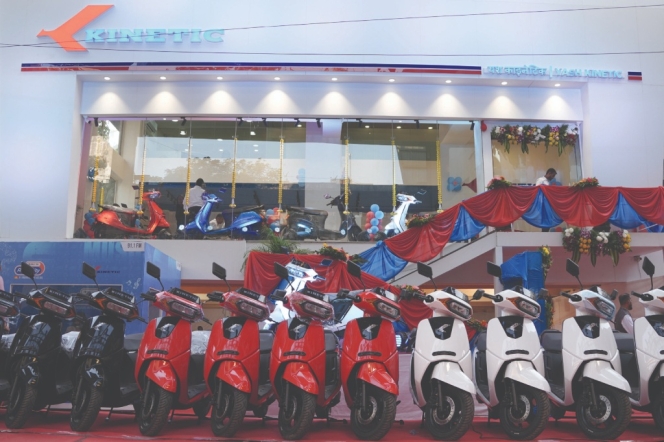
Pune-headquartered electric vehicle company Kinetic Watts and Volts, a subsidiary of Kinetic Engineering, has entered into a retail financing partnership with IDFC FIRST Bank to provide credit options across its dealership network.
The arrangement enables customers at Kinetic EV dealerships to access loan options, interest rates and instalment plans, subject to eligibility criteria. Ground teams from IDFC FIRST Bank will collaborate directly with dealership staff to process applications at the point of sale. The initiative coincides with the expansion of Kinetic EV’s retail footprint, which currently comprises over 65 operational sales, service and spare parts facilities in India.
Ajinkya Firodia, MD, Kinetic Watts and Volts, said, "For many customers, choosing an electric two-wheeler is not just about selecting the right product, but also about finding a purchase option that works for them. Our partnership with IDFC FIRST Bank gives customers greater choice at the point of purchase and strengthens the support available across our dealership network. With quick financing options, attractive EMI plans and exciting offers for eligible customers, we want to make the overall purchase journey simpler and more convenient. As we continue to expand our presence across markets, we look forward to making the journey towards electric mobility more accessible for more customers."
The tie-up leverages the bank's branch and operational network to support dealership sales in multiple regional markets. The companies are also developing customer schemes and promotional offers that will be announced at a later date.
Gaurav Syal, Business Head – 2W, IDFC FIRST Bank, said, "We are pleased to partner with Kinetic Watts and Volts as an OEM partner for two-wheeler retail finance. The electric two-wheeler segment is witnessing increasing customer interest, and our partnership with Kinetic EV will enable us to extend our financing solutions to a wider set of customers across its dealership network. Through our on-ground presence and customer-focused financing capabilities, we look forward to supporting the dealerships and contributing to a seamless vehicle purchase experience for customers."
TVS Motor Delivers Over 100 iQube MillionR Special Edition In Cuttack
- By MT Bureau
- October 05, 2026
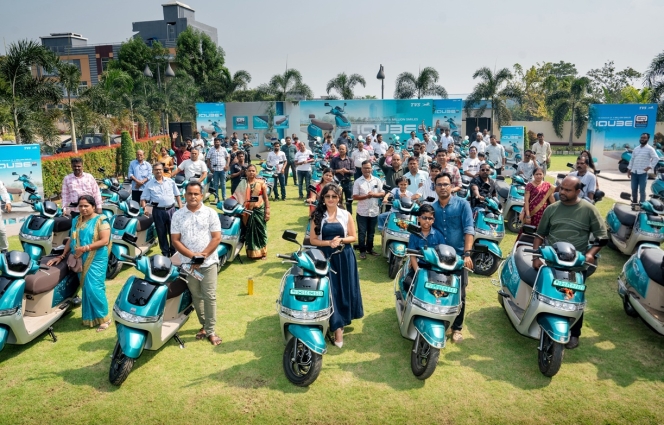
Chennai-headquartered two-wheeler and three-wheeler company TVS Motor Company conducted a single-day delivery event in Cuttack, Odisha, handing over more than 100 units of the TVS iQube MillionR Special Edition electric scooter to customers.
The MillionR Special Edition was launched on 25 August 2026 to mark the cumulative sales milestone of one million TVS iQube scooters. Based on the 3.5 kWh battery variant, the edition features an Aurora Green Dual Tone paint finish, custom seat upholstery and specific graphics alongside MillionR badging.
The e-scooter features a front utility storage compartment that expands overall storage capacity from 32 litres to 35.5 litres, an integrated USB Type-C charging port and over 118 connected features. The 3.5 kWh battery setup provides an Indian Driving Cycle (IDC) range of 145 km on a single charge.
In Odisha, the TVS iQube MillionR Special Edition is priced at INR 131,138 (effective ex-showroom). The standard TVS iQube range starts at INR 105,851 (effective ex-showroom), with Battery-as-a-Service (BaaS) option pricing starting at INR 59,999.
More Retail Inducts Montra Electric Eviator For Mid-Mile Logistics
- By MT Bureau
- October 01, 2026
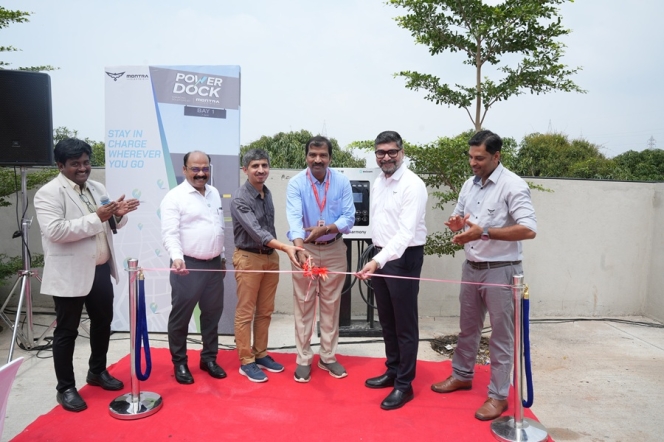
More Retail, a leading supermarket and hypermarket chain, has expanded its electric mid-mile logistics operations through the deployment of 110 Montra Electric Eviator electric small commercial vehicles across its distribution network, including 25 units in Bengaluru.
The company shared that electric commercial vehicles now account for 150 of its 600 total mid-mile logistics fleet. The 110 Montra Electric Eviator units operate across daily store replenishment and delivery routes, covering a combined minimum distance of 22,000 kilometres per day. The transition from internal combustion engine vehicles aims to lower operational energy expenses and vehicle maintenance requirements while providing driver ergonomics for city traffic conditions.
Saju Nair, CEO of the e-SCV Division, Montra Electric, said, "Electrification of commercial mobility will accelerate when it delivers measurable business value at scale. More Retail’s journey towards 100 percent electrification with our Eviator, is a strong example of that shift, from evaluating EVs as an alternative to deploying them as a core part of everyday logistics. As More Retail moves towards a fully electric mid-mile fleet, our focus is to enable that transition with vehicles and an ecosystem built around uptime, efficiency and long-term profitability."
Prasanna Hegde, National Transport Manager, More Retail, said, "Our mid-mile fleet keeps our stores stocked every day, so reliability comes first for us. The move from ICE vehicles to Montra Electric's Eviator e-SCVs has been smooth across our distribution network. The vehicles have already covered over 8.8 lakh kilometres on our routes, and our drivers have responded well to their comfort, instant torque and day-to-day dependability. Alongside lower operating costs, we are cutting emissions with every delivery run. With 150 of our 600 mid-mile vehicles now electric, we are well on our way to a fully electric fleet, and Montra Electric has been a trusted partner at every step."
The Montra Electric Eviator features a 10.3-foot loading deck and a payload capacity of up to 1,707 kg. The vehicles are integrated with telematics systems that monitor battery status, driver metrics, and route planning data to maintain fleet uptime between distribution centres and retail outlets.
- LG Energy Solution
- indiGOtech
- 46-series NCM cylindrical battery cell
- Flow Ride
- Flow Cargo
- Will Graylin
- Sunghwan Oh
LG Energy Solution Inks MoU With indiGOtech To Explore EV Battery Supply & Tech
- By MT Bureau
- October 01, 2026
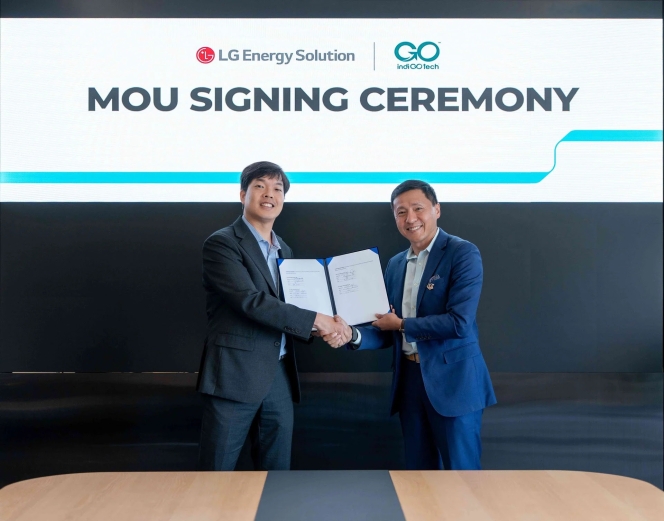
South Korean energy major LG Energy Solution has signed a non-binding memorandum of understanding (MoU) with United States-based commercial electric vehicle startup indiGOtech to explore battery supply and technological collaboration.
Under the MoU, the companies will work toward a final agreement for LG Energy Solution to supply 46-series NCM cylindrical battery cells from 2027 to 2030 for indiGOtech’s Flow Ride and Flow Cargo vehicles.
The partnership involves vehicle-battery integration, performance verification, driving range extension, and charging time reduction. The agreement expands LG Energy Solution's client base for its 46-series cylindrical batteries, following a reported 1.5-fold YoY increase in cylindrical battery shipments in the second quarter.
Headquartered in Woburn, Massachusetts, indiGOtech specialises in commercial van platforms for the North American market, integrating vehicles, charging infrastructure and digital services.
Will Graylin, Chairman and CEO, indiGOtech, said, "Urban ride hail and delivery must electrify and automate at scale, but today’s electric vehicles are not designed for purpose, and are severely limited by the local charging infrastructure – that’s why vast majority of rides and deliveries are still driven by gas vehicles. Working toward a long-term relationship with LG Energy Solution brings together advanced battery technology for durable economic advantage for vehicles, drivers and fleet operators."
Sunghwan Oh, Mobility & IT Battery Marketing Group Leader, LG Energy Solution, said, "Based on LG Energy Solution’s 46-series NCM cylindrical battery technology that boasts high energy density and rapid charging capabilities, we will closely collaborate with indiGOtech, which is successfully building the Transportation-as-a-Service (TaaS) ecosystem in the U.S. Leveraging this partnership, we plan to enter the diverse commercial vehicle market in the U.S., including logistics, last-mile delivery, and ride-hailing."
Comments (0)
ADD COMMENT