

- Abhijeet Dies & Tools
- INEVO
- Abhinevo Technologies
- Jayamurugan Thangavel
- Abhijeet Raut
- Abhijeet Dies & Tools
- INglass
- Roberto Fagarazzi
- Nikhil Raut
- Crescendo Worldwide
Abhijeet Dies & Tools and INEVO Form Joint Venture For Automotive Tooling
- By MT Bureau
- September 29, 2026
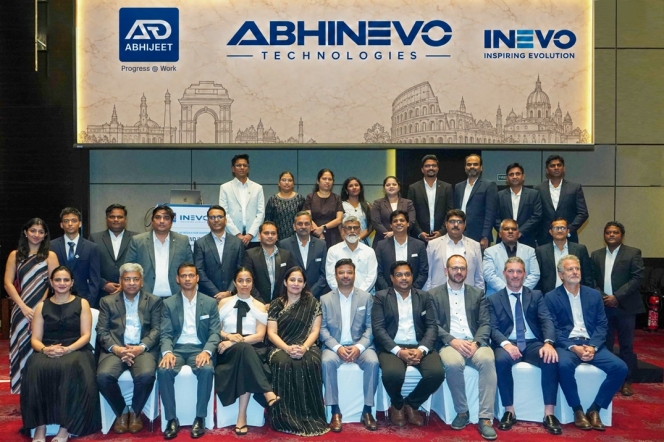
Maharashtra-based Abhijeet Dies & Tools and Italy's INEVO have signed an agreement establishing a joint venture entity, Abhinevo Technologies.
Headquartered in Pune, the new JV will develop, engineer, manufacture and commercialise moulds, tooling and manufacturing technology solutions for the automotive and plastics-processing sectors.
The agreement combines Abhijeet’s four decades of tooling and plastics manufacturing operations with INEVO’s European high-precision injection mould technologies. The new entity intends to localise manufacturing technologies in India across the value chain, covering product and process engineering, tool design, simulation, manufacturing, trials, validation and production support.
Jayamurugan Thangavel, CEO, Abhijeet Group, said, “This joint venture marks an important step towards technology-led manufacturing. By combining INEVO’s specialised European technology with Abhijeet’s engineering and manufacturing capabilities, we aim to build advanced capability in India and create a platform serving Indian and global customers.”
Abhijeet Raut, Director, Abhijeet Dies & Tools, said, “The real value of this partnership will be in taking advanced technologies from concept to industrialisation. Through Abhinevo, we aim to give customers access to sophisticated tooling and manufacturing solutions with closer engineering collaboration, faster development and globally benchmarked quality – converting technology into robust, repeatable and commercially viable manufacturing solutions.”
INEVO, spun off from the mould division of INglass in 2020, exports over 80 percent of its output globally, producing more than 100 injection tools per year. Its specialisation covers multi-material and multi-colour moulding, automotive lighting tooling, In-Mould Decoration (IMD), In-Mould Labelling (IML), injection on decorative and functional foils and surface technologies.
Roberto Fagarazzi, Managing Director – Sales, INEVO, said, “India is becoming increasingly important in the global automotive manufacturing landscape, and customers are looking for greater localisation without compromising technology, quality or manufacturing performance. We see a strong opportunity to bring INEVO’s experience in advanced moulds, multi-material technologies, smart surfaces and industrialisation closer to this market.”
“Abhijeet has a strong tooling and manufacturing foundation, engineering resources and an established automotive presence. The combination of INEVO’s specialised technology with Abhijeet’s manufacturing expertise creates a strong platform for long-term development. Our ambition is to develop solutions together in India, build local technical competence and progressively create opportunities that can serve customers both in India and internationally,” he added.
The initial technology scope for Abhinevo Technologies will encompass 2K and multi-component mould technology, polyurethane-based surface applications, IMD, IML, In-Mould Coating, film integration and process simulation. These processes target automotive interior and exterior components, functional panels, and smart surfaces for domestic automotive OEMs, Tier-1 suppliers and international export markets.
Nikhil Raut, Director, Abhijeet Dies & Tools, said, “This partnership is more than a business agreement. It brings together two companies, cultures and capabilities with a shared ambition to create something meaningful and long-lasting, built on trust, teamwork and mutual respect. The true success of Abhinevo will be measured by what our teams create together, the value we deliver to customers and the trust we build over the years ahead.”
Consultancy firm Crescendo Worldwide facilitated the partnership process, initiating partner identification in early 2025, which led to a Memorandum of Understanding in June 2025 prior to the final joint venture execution in September 2026.
ATA Appoints Mark Colson As Next President & CEO
- By MT Bureau
- October 23, 2026
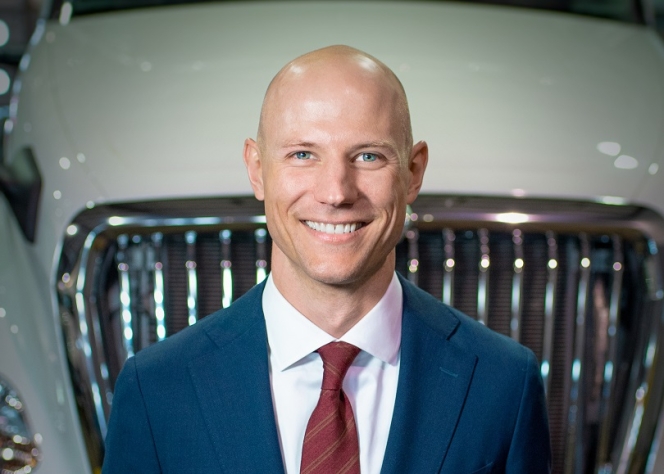
The American Trucking Associations (ATA) has named Mark Colson as its next President and CEO, with his appointment taking effect on 1 December 2026. Colson will become the 10th leader to hold the position since the organisation was founded in 1933.
Colson brings more than two decades of experience as a trucking association leader and advocate for motor carriers and industry professionals. He is expected to draw on that background to build lasting coalitions, recognise the contributions of trucking workers and unite the industry around a cause promoting the highest standards of professionalism.
Since 2019, Colson has led the Alabama Trucking Association as President and CEO, engaging with policymakers in Montgomery and Washington to advance industry priorities and highlight trucking's economic and supply chain significance. Previously, he held several leadership roles at the Business Council of Alabama, including Interim President, Senior Vice President of Governmental Affairs, and Chief of Staff, collaborating closely with the U.S. Chamber of Commerce and the National Association of Manufacturers.
Within the ATA Federation, Colson has served on the Strategic Priorities Committee and the Truck PAC Board of Directors, as well as the American Transportation Research Institute's Research Advisory Committee. In July 2026, his state association peers elected him Vice Chairman of the Trucking Association Executives Council. He also chaired the TAEC task force that produced the seven-point Trucking Resurgence action plan, released in December 2025 to address regulatory gaps exploited by noncompliant carriers and unqualified drivers. Colson is a Huntingdon College graduate, where he was inducted into the Athletic Hall of Fame for football, and holds an MBA from Troy University. He serves on Huntingdon College's Board of Trustees and Executive Committee.
Colson said, "This is a unique moment for ATA to make a renewed commitment to the trucking industry and the professionals who call our industry home. It's a commitment built first on earned trust, a sense of family and purpose, and an unrelenting passion to fight for the issues that matter most to trucking. The values that trucking leaders and professionals hold dear were instilled in me at an early age in my family's second-generation tyre shop, Blow-Out Tire Company, where I grew up changing truck tyres. They have followed me throughout my career fighting for the hard-working men and women throughout our industry, and it is a privilege to continue that fight alongside the team and members of ATA.
"State trucking associations and the dedicated staffs that support them are the boots on the ground when it comes to advancing and defending the trucking industry. It's been an honour to learn from my fellow state executives, and I'm excited to continue working with them to unleash the full strength of the Federation. We are on the verge of a trucking resurgence, but we must keep fighting and advocating as our industry leaders continue to climb out of one of the deepest and longest freight recessions in history. We must meet them where they are, listen to their concerns and do everything we can to help them and their people be successful."
Greg Hodgen, ATA Chairman and CEO of Groendyke Transport, said, "For more than 90 years, ATA's mission has been to give trucking a strong voice in the decisions that shape its future. Mark will build on that foundation, bringing fresh energy and a clear vision for advancing our industry's priorities and delivering even greater value for our members."
Derek Leathers, incoming ATA Chairman and Chairman and CEO of Werner Enterprises, said, "The decisions made in Washington don't stay in Washington. They affect how we operate, how we invest and how we serve our customers every day. Our industry needs a strong, unified voice at the table to make sure policymakers understand those realities and fight for policies that enable trucking to keep America moving."
Chris Maxwell, Chairman of TAEC and President and CEO of the Rhode Island Trucking Association, said, "Few trucking companies operate within the borders of just one state, which is why the ATA Federation matters so much. When bad ideas emerge in one state, they have an impact on motor carriers across the entire country. The partnership between ATA and the state associations is one of our industry's greatest strengths, and Mark understands firsthand what makes it so powerful."
BendPak To Roll Out Next-Gen Lifts Alongside Valor C10 Reveal At 2026 SEMA Show
- By MT Bureau
- October 22, 2026

BendPak will stage an expansive dual-location exhibit at the 2026 SEMA Show, headlined by an opening-day outdoor tailgate in the Silver Lot at Booth #80043 on 3 November, beginning at 1 p.m. The centrepiece of that event is the global debut of the company’s Valor C10 custom truck, a build that merges classic C10 styling with contemporary engineering and supercharged performance. A live DJ, refreshments, giveaways and a roster of prominent automotive influencers will round out the tailgate atmosphere.
Beyond the truck reveal, BendPak is using both official SEMA locations to introduce a broad slate of lifting and garage equipment spanning its Ranger, QuickJack, Cool Boss, APEX, JackPak, MaxJax and Ergochair brands. Visitors to the Silver Lot display can examine the Valor C10 alongside the new products, while the Upper South Hall Booth #36129 inside the Las Vegas Convention Center offers hands-on demonstrations of next-generation shop solutions.
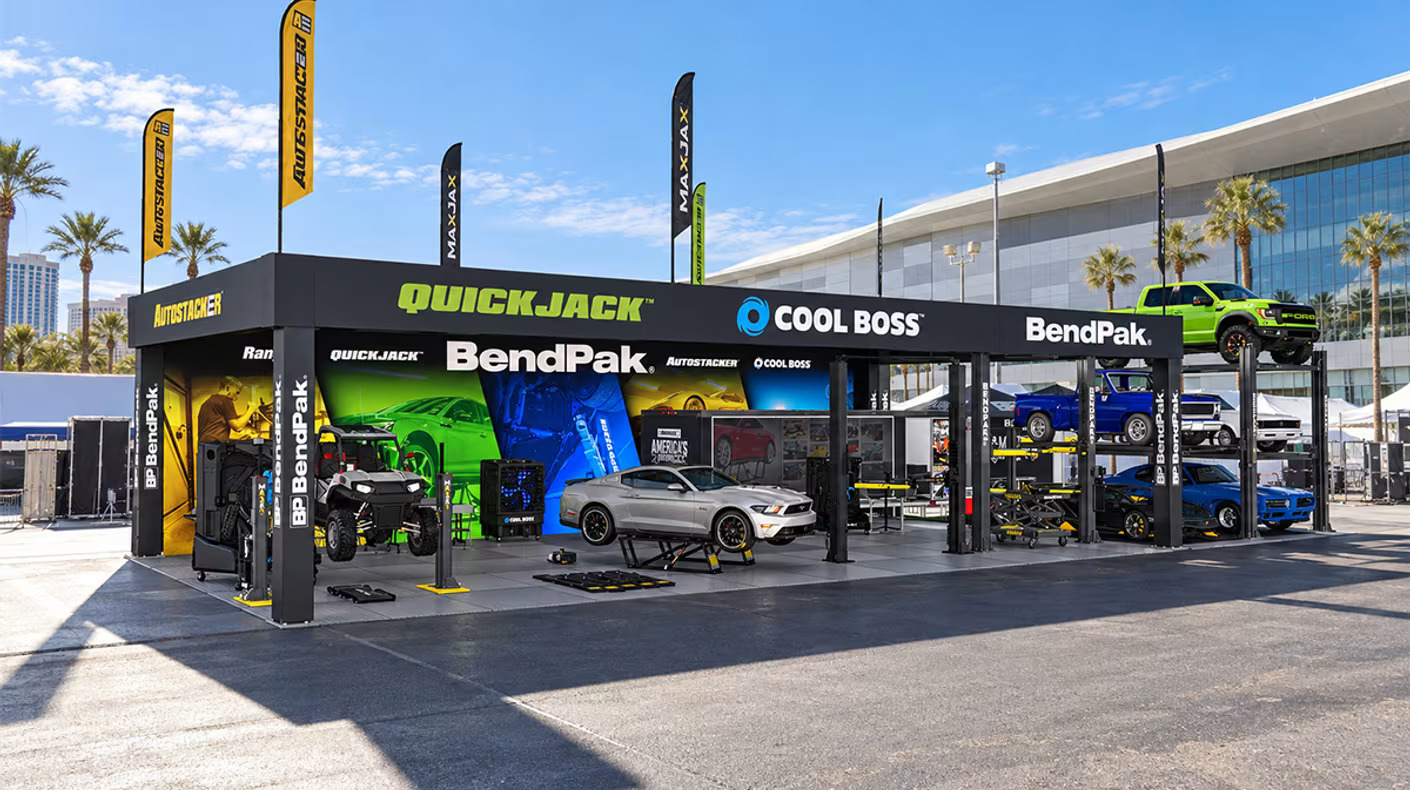
Among the outdoor highlights are the MaxJax MAX7 two-post lift, which now incorporates BendPak’s proprietary Automatic Swing Arm Restraint System and three additional inches of lifting height, along with MaxJax accessories such as a portable mounting base that eliminates the need for permanent anchors and a turf kit for lawn equipment. A preview of the forthcoming Mobi-EVS2600, the latest addition to BendPak’s EV battery pack and powertrain lift table line, will also be available.
The indoor showcase centres on the OctaFlex 12DPS, described as the only eight-arm two-post lift in the world, designed to streamline cab-off repairs, EV battery replacement and other demanding jobs and now shipping. BendPak is also presenting its APEX range of affordable, no-frills car lifts, ramps and wheel service equipment, together with Vortex bead seaters that simplify tyre bead seating even on changers lacking a built-in system.
Several products will appear at both locations. New BMW-specific AutoPucks join existing universal, Tesla and Corvette jack pad adapters engineered to engage OEM-recommended lifting points. QuickJack caster kits, the first OEM versions designed to ease movement and precise positioning of QuickJack lifts beneath vehicles, will also be displayed. SEMA-only pricing and ordering incentives on BendPak lifts and garage equipment are available throughout the week.
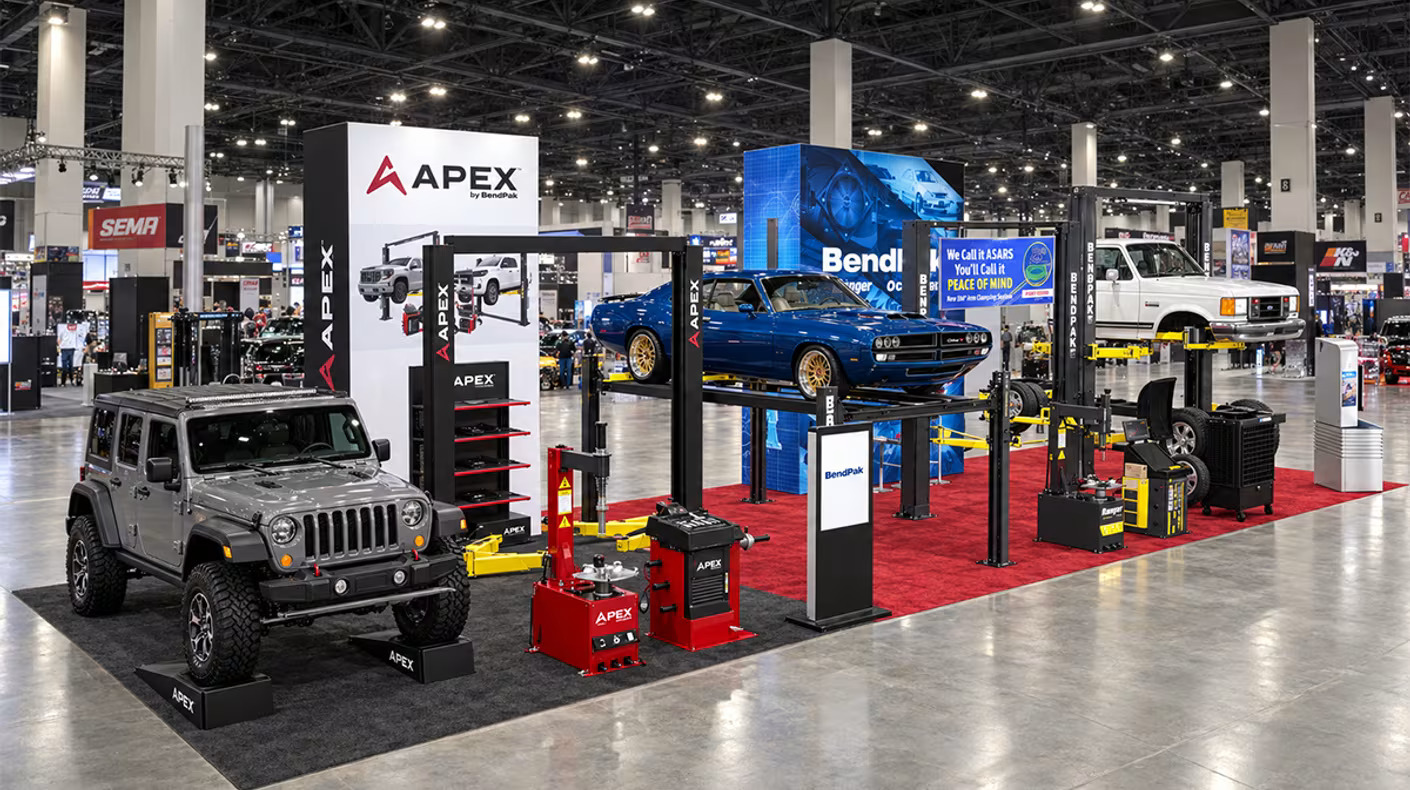
BendPak equipment will additionally support partner displays, custom builds and feature vehicles elsewhere on the show floor, including at Battle of the Builders and the SEMA FutureTech Studio. The SEMA Show runs 3–6 November at the Las Vegas Convention Center, with the traditionally trade-only event opening to the public on 6 November.
Jeff Kritzer, President and CEO, BendPak, said, “Everyone on our team is a car and truck enthusiast, so when it came time to debut the Valor C10, we knew we had to drop the tailgate, put on some music and hang out with the community that inspires us. SEMA is all about spotlighting the coolest builds, but it’s also about equipping the shops that bring them to life. Alongside the truck, we’re bringing a massive lineup of new gear across both booths. For us, this week is about celebrating where custom car and truck culture is right now and showing where we’re taking equipment engineering next.”
- Kia India
- Automotive Skills Development Council
- ASDC
- Don Bosco Industrial Training Institute
- CSR
- Federation of Automobile Dealers Associations
- FADA India
- Atul Sood
Kia India and ASDC Launch Automotive Skill Development Centre In Mumbai
- By MT Bureau
- October 21, 2026
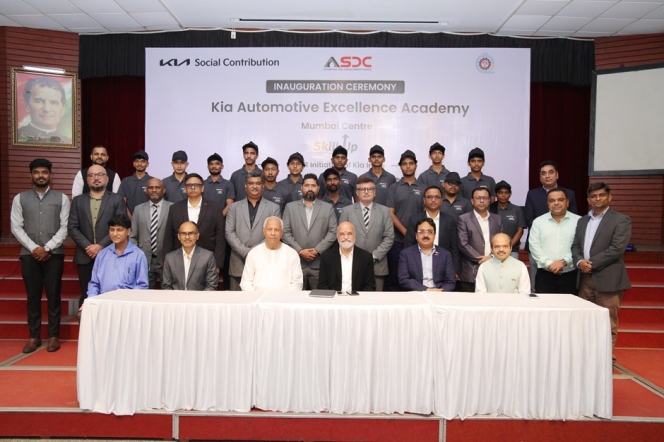
Kia India, one of the leading passenger vehicle manufacturers, has partnered with the Automotive Skills Development Council (ASDC) to open an automotive skill development centre at Don Bosco Industrial Training Institute in Kurla, Mumbai.
The initiative forms part of a four-centre regional programme spanning Mumbai, Faridabad, Bengaluru and Kolkata to train 360 candidates under corporate social responsibility (CSR) operations.
The Mumbai facility will provide training for 150 candidates across three job roles, covering four-wheeler service technology, service advisory and sales. The curriculum combines classroom instruction, practical training and workplace exposure delivered without financial cost to participants. Additional partners including the Federation of Automobile Dealers Associations (FADA) support the initiative to align workforce capabilities with dealership and retail requirements.
Atul Sood, Senior Vice-President of Sales and Marketing, Kia India, said, "At Kia India, we view skill development as an important enabler of inclusive growth and long-term industry advancement. Our partnership with ASDC is aimed at creating meaningful pathways for young people by providing access to structured, industry-relevant training without any financial burden. By integrating classroom instruction with practical learning and workplace exposure, the programme will help candidates develop capabilities aligned with the evolving needs of the automotive sector. The initiative reflects our commitment to creating sustainable value for communities while contributing to a stronger and future-ready mobility ecosystem."
- Porsche AG
- Sportwagenschmiede 35
- Rimac
- Bugatti Rimac
- MHP
- Michael Leiters
- Porsche Engineering
- Porsche Digital
- Porsche Technologies
Porsche Unveils Sportwagenschmiede 35 Strategy Targeting EUR 45 Billion In Revenue
- By MT Bureau
- October 19, 2026
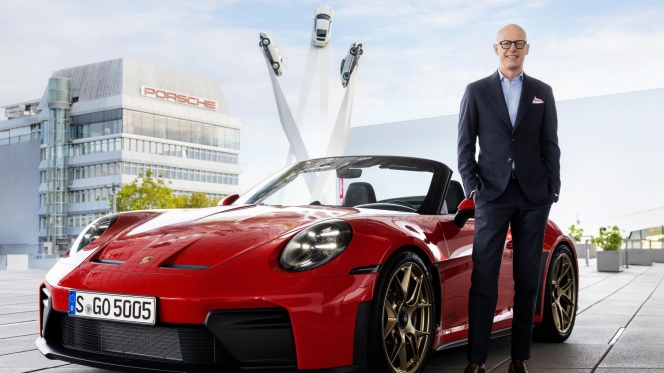
German premium luxury car brand Porsche AG has presented its medium-term corporate strategy, named Sportwagenschmiede 35, at its Capital Markets Day at the Weissach Development Centre. The strategy outlines operational restructuring, portfolio expansion and financial targets aimed at lowering the manufacturer's break-even point to below 200,000 vehicles annually.
The plan prioritises value creation over volume expansion by shifting the product lineup further toward high-margin vehicle segments. Porsche plans to reduce its overall model variant count by 20 percent while increasing the share of D and E segment vehicles in its portfolio by 45 percent.
The strategy includes plans for a mid-engined super sports car platform positioned above the 911 range, alongside potential additions to its SUV lineup. Product releases will include all-electric 718 Boxster and Cayman models scheduled for full-year market support in 2028, as well as a B-segment SUV featuring combustion and plug-in hybrid powertrains planned for production in 2028. Porsche is also expanding its individualisation operations under its Sonderwunsch programme, targeting a sixfold increase in customisation revenue.
Operationally, Porsche plans to lower development costs by up to 20 percent through modular development processes and shorter project timelines, while merging Porsche Engineering and Porsche Digital into a unified entity named Porsche Technologies. The company aims to reduce production personnel costs by up to 30 percent, cut sales and distribution expenses by 20 percent by restructuring its sales regions from five to four, and reduce material costs across new vehicle projects by 10 percent.
Management positions will be reduced by 40 percent, alongside an overall workforce reduction of 25 to 30 percent across direct and indirect functions. These measures follow existing agreements that include a reduction of 9,000 positions, alongside divested equity stakes in Rimac, Bugatti Rimac and MHP, as well as the planned closure of cell and e-bike development units.
Porsche has established its financial targets with the medium-term Group operating return on sales between 10 and 15 percent, with an Automotive net cash flow margin target of 9 to 12 percent. In the long term, Porsche targets a 15 percent operating return on sales and a 12 percent net cash flow margin, backed by projected Group revenue of EUR 41 billion to 45 billion.
Michael Leiters, Chairman of the Executive Board, Porsche AG, said, "We are pursuing a clear plan with our strategy Sportwagenschmiede '35. The ultimate goal is to further strengthen our unique sports car brand – across all model lines and with new, highly desirable models in particularly high-margin segments. Our strategy will lay the groundwork to make Porsche significantly more efficient, productive and profitable in three phases. At the moment, the main focus is on reducing costs and making the company more financially robust. We have already achieved some important milestones. Our strategy focuses very much on our medium-term ambition so that the measures and the associated results take effect as early as possible. The term 'Sportwagenschmiede' was deliberately chosen because it captures everything Porsche aims to stand for in the future: our aspiration to offer the sportiest vehicles in every segment, but also craftsmanship, down-to-earth thinking and entrepreneurial, business-focused action. Our goal is to be attractive to all stakeholders: our customers, our workforce, our partners and our investors."
Comments (0)
ADD COMMENT