

Envalior Launches EV Technology Centre Of Excellence At Pune Polytechnic
- By MT Bureau
- August 07, 2026
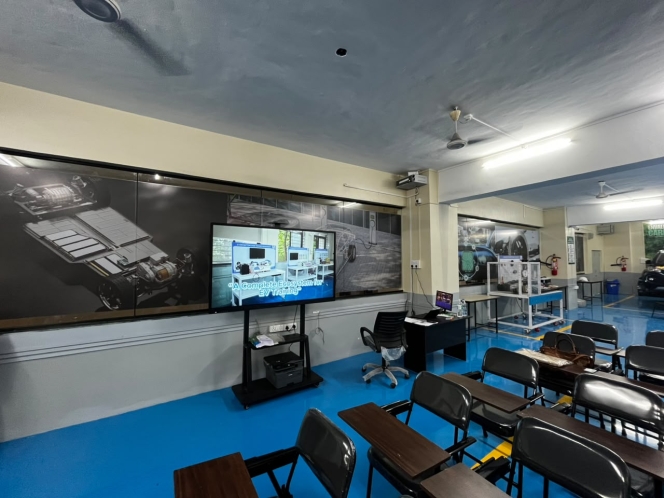
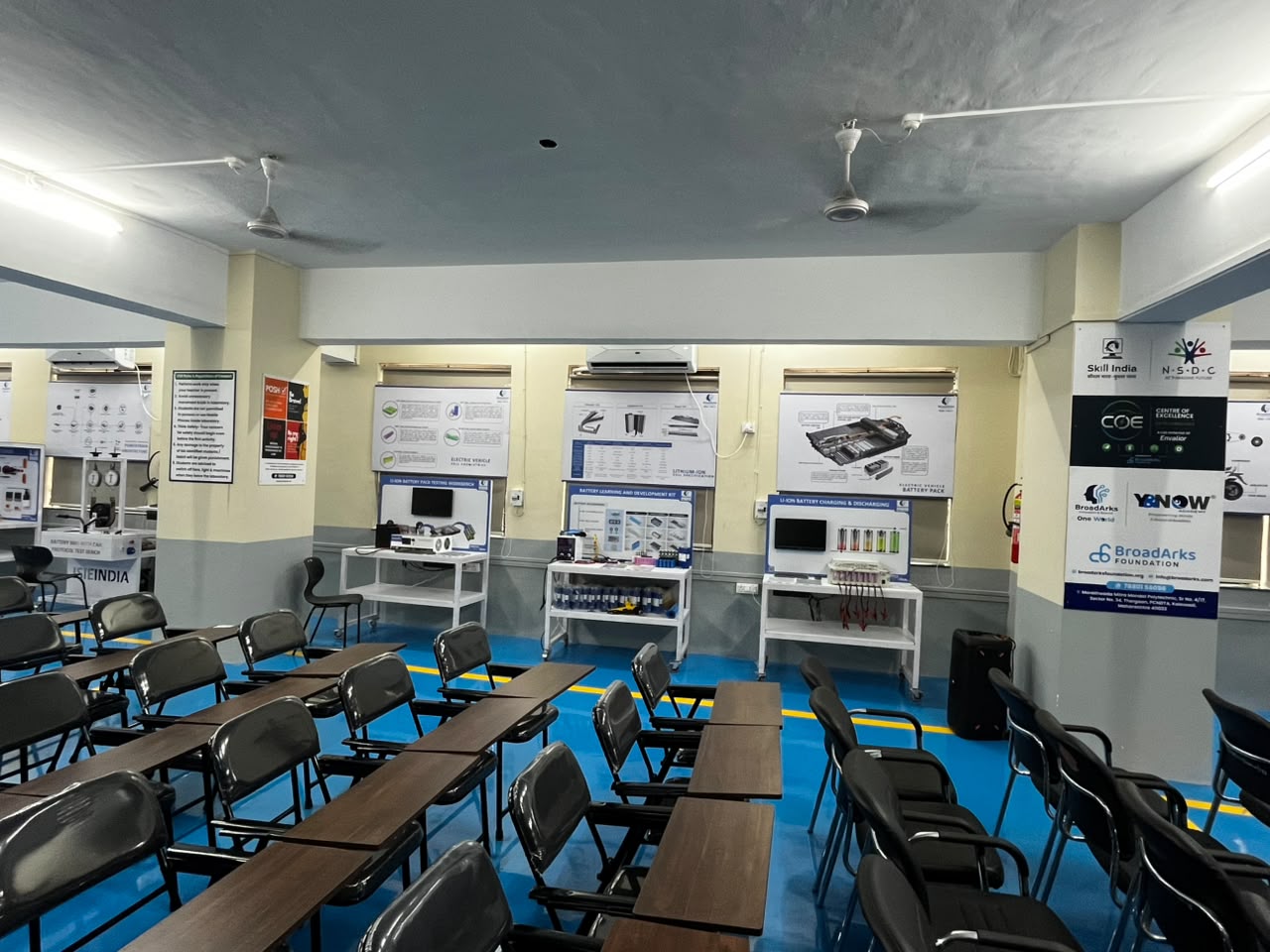
Envalior India Pvt. Ltd. has launched a specialised training hub focused on electric vehicle technology at MM Polytechnic in Pune, marking a significant step in aligning vocational education with the demands of the burgeoning EV sector. The Envalior Centre of Excellence, a product of the company’s CSR initiatives in partnership with the BroadArks Foundation, is intended to serve as a practical workshop where students can transition from theoretical knowledge to applied technical competence.
The facility was formally inaugurated by Christopher Stillings, Vice President –R&D, in the presence of Krijn Dijkstra, Nileshkumar Kukalyekar, Uday Shetty, Susmita Mishra, Hema Rani, Sainath Vaidya and Aniket Nirwan of Envalior, MM Polytechnic leadership and other dignitaries. By embedding this centre within a technical campus, the programme seeks to immerse learners in the realities of EV maintenance and repair, covering not just mechanical functions but also the intricate electrical and software-driven systems that define modern vehicles.
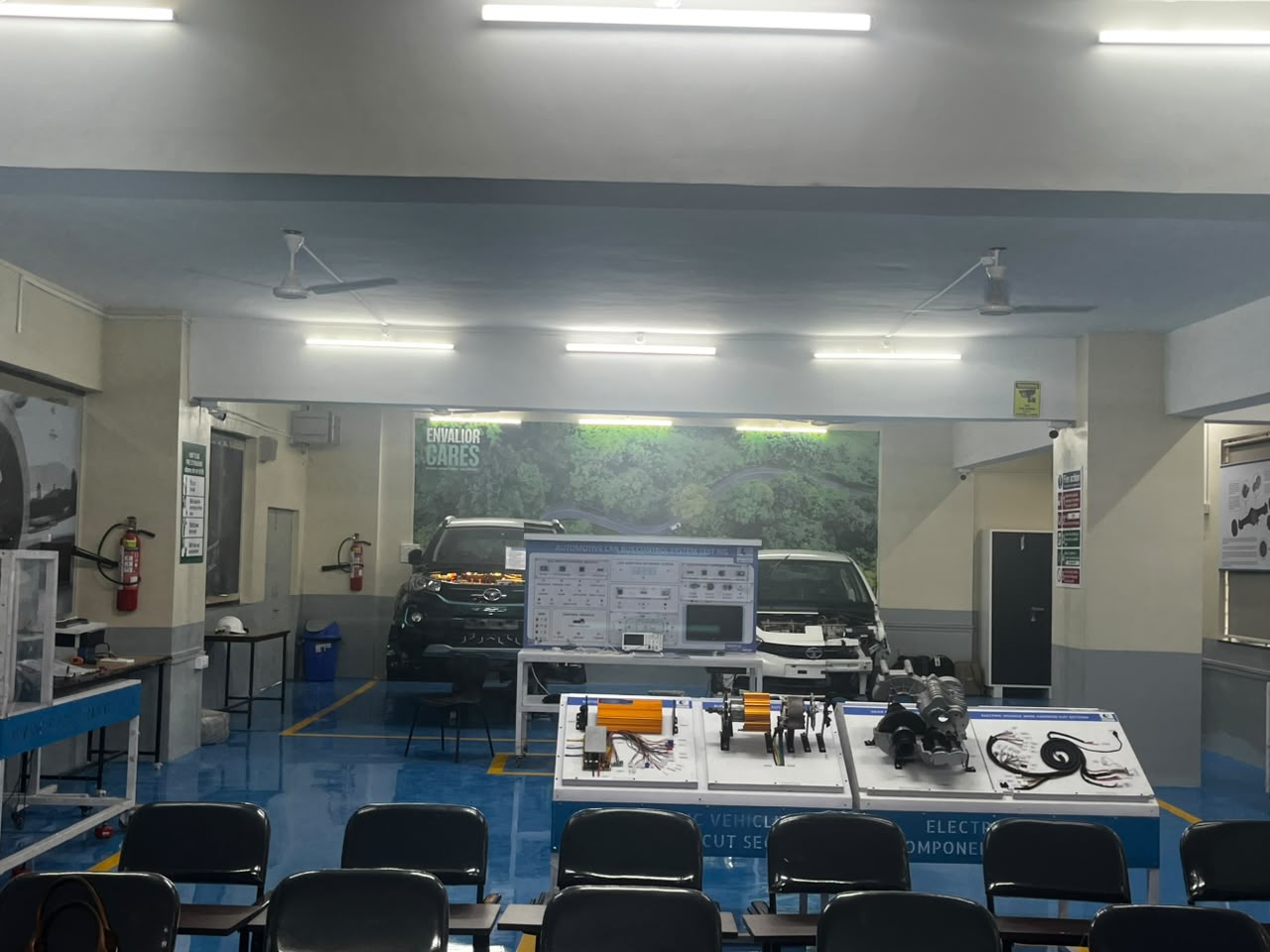
With an annual capacity to reach roughly 250 learners, the centre will cater to students from ITI and polytechnic backgrounds across multiple engineering streams. The coursework is divided into two progressive phases, starting with a foundational module that introduces participants to basic EV architecture, battery safety and routine service procedures. An advanced tier follows, offering deeper instruction on battery management systems, thermal controls, high-voltage safety protocols, motor controllers and complex diagnostic methods.
Beyond traditional lectures, the training environment incorporates interactive lab sessions with real vehicle components, diagnostic tools and industry-relevant projects, ensuring that participants acquire both safety awareness and problem-solving agility. The overarching goal is to produce graduates who are not merely familiar with EV theory but are confident in executing hands-on repairs and system evaluations. Through this scalable framework, Envalior is actively working to narrow the skills gap in India’s automotive sector, creating a direct pipeline of capable talent for the evolving mobility landscape.
Nileshkumar Kukalyekar, Business Director – South Asia, Middle East & Africa, Envalior, said, “The transition to electric mobility is creating a fundamental shift in the skills expected from the automotive workforce. For us, this Centre of Excellence is about ensuring that technical education keeps pace with that change. By giving students the opportunity to work directly with EV systems, understand advanced diagnostics and build capabilities through structured, certified training, we are helping create a stronger bridge between what young technicians learn and what the industry will increasingly expect from them. We see this as an investment not only in individual careers but in the technical talent that will support India’s mobility transition in the years ahead.”
Christophe Stillings, Vice President – R&D, Envalior, said, "At Envalior, we believe the future of mobility depends on developing industry-ready talent today. Through the Centre of Excellence, students will gain hands-on exposure to EV technologies, helping bridge the gap between academic learning and real-world industry requirements. By bringing together academia and industry expertise, we aim to equip the next generation of engineers with the practical skills, confidence and innovation mindset needed to succeed in a rapidly evolving automotive landscape."
Faiz Ahmad Succeeds Kumar Prabhas As New CEO Of Hinduja Tech
- By MT Bureau
- October 06, 2026
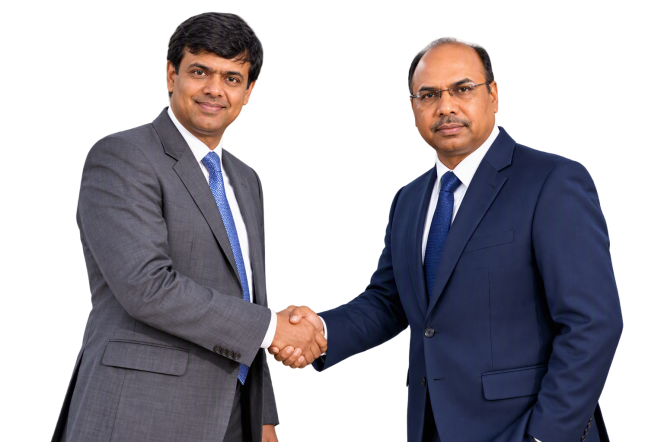
Hinduja Tech, the mobility-focused engineering and R&D technology subsidiary of Ashok Leyland, has announced the appointment of Faiz Ahmad as Chief Executive Officer, effective 1 November 2026.
The appointment follows the retirement of current Chief Executive Officer Kumar Prabhas, who concludes nine years in the role on 31 October 2026.
Ahmad has been part of the Hinduja Group ecosystem for nearly two decades and currently serves as Chief Operating Officer and Head of Vehicle Engineering & Development. During his tenure with the company, he has overseen operational functions, capability building and vehicle development units. Prabhas and Ahmad will execute a transition process throughout October.
During his nine years leading Hinduja Tech, Prabhas managed the company's international expansion, service portfolio diversification and the acquisitions of engineering firms DSD and Tecosim.
Dheeraj G. Hinduja said, “I would like to express my sincere appreciation to Kumar Prabhas for his dedicated leadership and valuable contribution to Hinduja Tech over the past nine years. His vision, commitment, and leadership have been instrumental in shaping the company's growth journey and building a strong foundation for the future. We thank him for his invaluable service and wish him a joyful, healthy, and fulfilling retirement."
"Faiz has been an integral part of our journey and embodies the values, customer focus, and innovative spirit that define Hinduja Tech. His deep industry knowledge, strategic perspective, and proven leadership capabilities make him exceptionally well-positioned to lead the organization into its next phase of growth. We are confident that under his leadership, Hinduja Tech will continue to strengthen its market position, deepen customer relationships, and accelerate innovation across its global operations," added Hinduja.
Faiz Ahmad said, “I am honoured to be entrusted with the responsibility of leading Hinduja Tech at this exciting stage of its growth journey. We have a strong foundation, talented teams, trusted customer relationships, and significant opportunities ahead. I look forward to working closely with our employees, customers, and partners to build on our successes, drive innovation, and deliver sustainable value for all stakeholders.”
Prabhakar Atla Succeeds Balaji Viswanathan As New CEO Of ALTEN India
- By MT Bureau
- October 06, 2026

ALTEN India, a global engineering and technology consulting group, has appointed Prabhakar Atla as its new Chief Executive Officer, effective 5 October 2026. He previously served as President and Chief Operating Officer at Cyient, succeeds Balaji Viswanathan as head of the company's Indian operations.
Atla brings three decades of industry experience to the role, having led global operations and business units across sectors including aerospace, communications, rail, energy and semiconductors. His previous assignments include roles in Europe, India, the United States, Japan, and Australia, as well as serving as President and Chief Financial Officer at Cyient prior to his appointment as Chief Operating Officer.
Pascal Amore, Group EVP, Head of APAC, ALTEN, said, "Prabhakar's depth of experience in engineering, IT and technology services, and his track record of leading large global organisations through transformation, make him the right leader for ALTEN next chapter in India. India is core to the ambitions of our 2030 strategic plan, and I am confident Prabhakar will strengthen our organisation, develop new capabilities and accelerate our growth across the country."
Prabhakar Atla said, "I am honoured to join ALTEN and lead its talented teams in India. ALTEN India has grown into a strategic capability hub for the Group, with deep engineering expertise and trusted client relationships. My ambition is clear: enable and empower India as the engine of ALTEN Group's transformation, powered by deep sector expertise, AI-led engineering and faster innovation for our clients."
The company currently employs more than 8,500 personnel across 13 centres in eight Indian cities. The unit provides engineering, digital transformation, semiconductor and artificial intelligence solutions to clients in the automotive, aerospace, defence, telecommunications, consumer technology, manufacturing, and life sciences sectors.
- AIC Pinnacle
- National Automotive Test Tracks
- NATRAX
- EKA
- Dr Avinash Thakur
- Dr Manish Jaiswal
- Dr Sudhir Mehta
- startup
AIC Pinnacle Partners NATRAX To Support Automotive And EV Startups
- By MT Bureau
- October 06, 2026
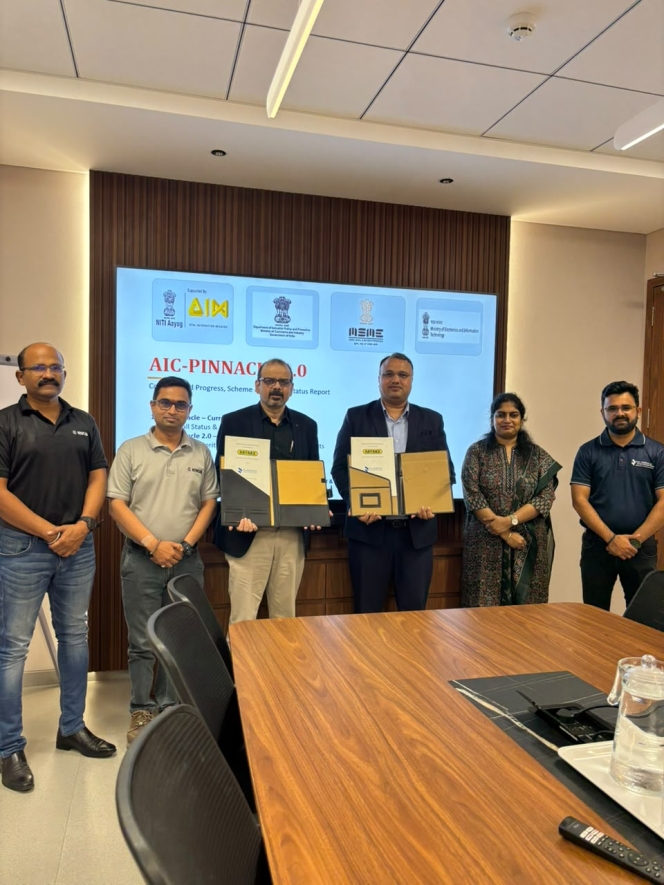
AIC Pinnacle Entrepreneurship Forum and the National Automotive Test Tracks (NATRAX) have signed a memorandum of understanding to support startups in the automotive, electric vehicle and connected mobility sectors.
The agreement was executed at EKA's vehicle manufacturing facility in Chakan by Dr Avinash Thakur, CEO, AIC Pinnacle and Dr Manish Jaiswal, Director, NATRAX.
The collaboration combines AIC Pinnacle’s business incubation and mentoring programs with the testing and certification infrastructure at NATRAX. The partnership aims to assist startups in progressing from prototypes to validated commercial products. Immediate initiatives include organising a startup hackathon and granting select cohort members access to the NATRAX testing tracks near Pithampur, Madhya Pradesh.
The signing event included representatives from EKA Mobility, AIC Pinnacle and NATRAX, such as EKA Mobility Chief Product Officer Zoeb Altafhussain Karampurwala, Chief Engineers Kaustubh Vasant Joshi and Pankaj Shivrudrappa Munoli, and R&D Team Lead Swapnil Anil Tambe, alongside AIC Pinnacle Senior Manager Shadab Hussain and NATRAX Group Lead Tulika Mazumdar.
"The partnership with NATRAX opens an important bridge between startups and the automotive testing and validation ecosystem. Our objective is to help promising innovations move beyond the incubation stage and gain access to the technical, industry and testing support required to develop market-ready solutions," said Dr. Thakur.
Dr Manish Jaiswal said the partnership would create opportunities for startups and innovators to access relevant testing, validation and ecosystem capabilities. "Such partnerships can contribute to accelerating the development and adoption of emerging mobility technologies," he said.
Dr Sudhir Mehta, Founder and Chairman, Pinnacle Industries and Group Companies, said, "Electric mobility will remain a key focus area for AIC Pinnacle in the coming period. This MoU strengthens that vision by giving startups direct access to the industry, strategic partners, academic institutions and government agencies they need to scale."
The initiative will establish networks between early-stage companies, industrial firms, academic institutions, and government agencies across Maharashtra and Madhya Pradesh. AIC Pinnacle operates as a non-profit incubator supported by NITI Aayog's Atal Innovation Mission, while NATRAX operates testing and certification facilities in Central India.
- India Auto Retail Sales
- September 2026
- Sai Giridhar
- FADA
- Federation of Automobile Dealers Association
Indian Auto Retails Reach Record 2.53 Million Units In September Ahead of Festive Season
- By MT Bureau
- October 06, 2026

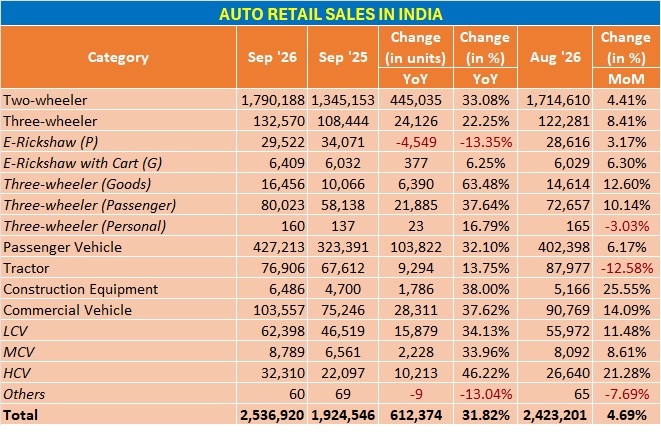
Indian vehicle retail sales reached a record 2,536,920 units in September 2026, marking a 31.82 percent YoY increase and a 4.69 percent sequential rise over August shows data released by the Federation of Automobile Dealers Associations (FADA).
Interestingly, in H1 (April–September) of FY2027, auto retail reached 15,512,319 units, a rise of 20.77 percent YoY.
In September 2026, growth was recorded across all major segments compared to the previous year. Two-wheeler sales rose 33.08 percent to 1,790,188 units, surpassing the pre-pandemic peak recorded in 2018 by 15.3 percent.
Passenger vehicle registrations increased 32.10 percent to 427,213 units and commercial vehicle registrations grew 37.62 percent to 103,557 units, crossing the 100,000 mark in September for the first time.
Three-wheeler sales climbed 22.25 percent to 132,570 units, with electric models accounting for 64.90 percent of the total.
Wheeled construction equipment sales increased 38 percent to 6,486 units. Tractor sales grew 13.75 percent YoY to 76,906 units, though registrations fell 12.58 percent compared to August due to a delayed festive calendar and uneven rainfall.
Total electric vehicle sales across all categories reached a monthly figure of approximately 334,000 units, bringing electric vehicle market penetration to roughly 13 percent.
In the two-wheeler space, electric vehicles accounted for 11.58 percent of new vehicle sales. In the passenger vehicle segment, petrol vehicles held a 41.27 percent market share, while alternative fuel vehicles accounted for 41 percent. The alternative fuel share comprised compressed natural gas at 23.11 percent, hybrid powertrains at 9.44 percent and electric vehicles at 8.45 percent.
Passenger vehicle dealer stock levels rose to between 43 and 45 days of sales, exceeding FADA’s recommended benchmark of 21 days.
Sai Giridhar, President, FADA, said, “September’26 was the best-ever September in Indian auto retail, with the industry registering 25,36,920 units, up 31.82 percent YoY and 4.69 percent MoM. I would, however, urge that this headline be read with discipline: the 31.82 percent is the most base-distorted print of the year – a mirror of last September, when buyers deferred purchases in the week before GST 2.0 took effect on 22 September 2025. The cleaner signals are three. It was the best-ever September across five of our six categories and, with it, the best-ever first half of any financial year at 1,55,12,319 units (+20.77 percent); retail rose 4.69 percent over August and even setting the distorted September aside, FY’27’s first five months grew about 17 percent, which is the truer underlying run-rate.”
Going forward, survey results from FADA indicate that 75.57 percent of automobile dealers expect sales growth in October, up from 67.09 percent in August. For the October–December quarter, 78.28 percent of dealers anticipate growth and 49.5 percent have revised their sales forecasts upward for the full financial year following the first-half results.
Comments (0)
ADD COMMENT