

- EKA Mobility
- VDL Groep
- Mitsui & Co
- NIIF India-Japan Fund
- Enam Holdings
- EKA 6S
- EKA 3S
- Marisa Gerards
- Dr Sudhir Mehta
EKA Mobility Rolls Out 1,000th Electric Small Commercial Vehicle From Pune Plant
- By MT Bureau
- June 05, 2026
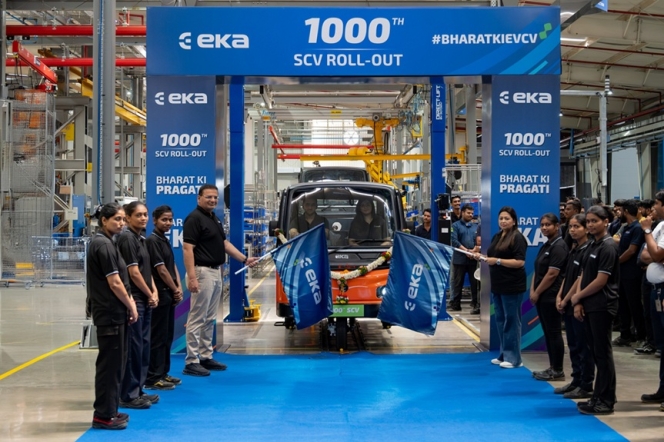
EKA Mobility, a leading Indian electric commercial vehicle manufacturer, has announced the rollout of its 1,000th small commercial vehicle (SCV) from its manufacturing facility in Chakan, Pune.
Backed by global and domestic investors – including VDL Groep (Netherlands), Mitsui & Co. (Japan), NIIF India-Japan Fund, and Enam Holdings – the company operates as a Champion OEM under the Government of India's Auto PLI Scheme.
To mark the milestone, EKA Mobility organised two high-profile vehicle handovers highlighting local community integration and international diplomatic ties:
- Local Delivery: The 1,000th vehicle, an EKA 6S, was officially presented to the Dagdusheth Halwai Ganpati Trust, one of Pune’s prominent charitable institutions. The EKA 6S is India's first steering-wheel passenger electric three-wheeler featuring a driver plus six-seater capacity configuration. The trust will deploy the EV within its community service and humanitarian operations.
- International Diplomatic Delivery: The company handed over an EKA 3S electric three-wheeler to Marisa Gerards, the Ambassador of the Kingdom of the Netherlands to India. The handover highlights EKA's bilateral connection with the Netherlands, which is home to its strategic engineering and industrial partner, VDL Groep.
The Chakan plant serves as EKA Mobility's primary industrial hub for SCV and truck production. It currently has an installed production capacity of 24,000 commercial vehicles per year. The site employs more than 1,000 people and features an on-site research and development centre staffed by over 400 engineers and designers.
Under its EvolutioNARI initiative, EKA Mobility has established an all-women-led assembly line specifically dedicated to its SCV production, focusing on diversity within the automotive manufacturing sector.
Furthermore, EKA Mobility is currently the only domestic OEM offering a full-stack commercial EV portfolio spanning three-wheelers, SCVs, buses and trucks. The company's assembly footprint is scaling across three distinct locations – Chakan, Pune, plant has an annual capacity to manufacture 24,000 SCVs and trucks. Koregaon, Pune, can manufacture 15,000 e-buses and upcoming Pithampur plant in Madhya Pradesh, which will have a combined manufacturing capacity of 4,000 buses.
Dr. Sudhir Mehta, Founder & Chairman, EKA Mobility, said, “The 1,000th SCV rolling off our Chakan facility is not merely a production number; it is proof of what Indian engineering, innovation, and determination can achieve. It reflects years of perseverance and a shared belief that India can emerge as a global leader in sustainable mobility through world-class products designed and manufactured at home. As we celebrate this achievement on World Environment Day, we are reminded that our purpose extends beyond manufacturing vehicles. We are building solutions that help businesses operate more sustainably, reduce environmental impact, improve everyday mobility, and contribute to a cleaner future for generations to come.”
JM Frictech India Invests INR 500 Million For 4th Manufacturing Facility In Chandigarh
- By MT Bureau
- October 09, 2026
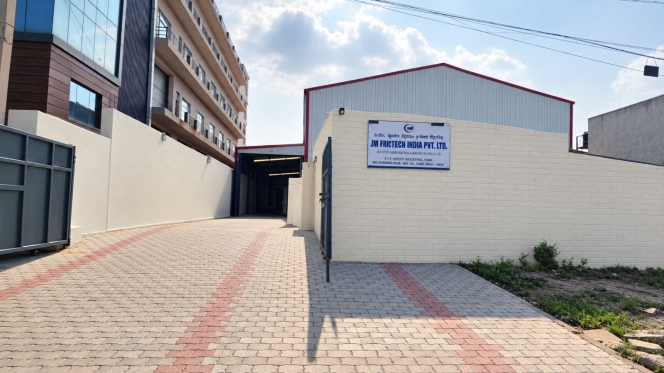
Auto component manufacturer JM Frictech India has invested around INR 500 million to establish its fourth manufacturing facility in Chandigarh. The investment expands the company's production footprint and logistics operations across Northern India.
The facility is being commissioned in phases, with initial operations dedicated to warehousing and distribution logistics.
Established in 2008 as a joint venture between NTC Engineering India and South Korea’s Jinmyung Frictech Company, the company produces approximately 12 million friction discs annually. The addition of the Chandigarh plant expands the company's manufacturing footprint to four facilities across India, supporting its strategy to localize components for agricultural and industrial off-highway equipment.
JM Frictech India plans to scale manufacturing activities at the site to achieve full operational capability within the next 6-8 months. The facility is structured to supply friction systems, wet brakes, wet clutches, hydraulic actuation systems, transmission aggregates and hydrostatic transmission components to original equipment manufacturers in the tractor, construction equipment and off-highway sectors.
E. Madhavan, Managing Director of JM Frictech India, said, "The investment in Chandigarh is an important part of our expansion strategy. It will strengthen our manufacturing presence in North India and enable us to be closer to our customers while creating capacity for future growth."
E3 Electric.Ai Commences Production Of Trion E-Scooter In Hyderabad
- By MT Bureau
- October 05, 2026
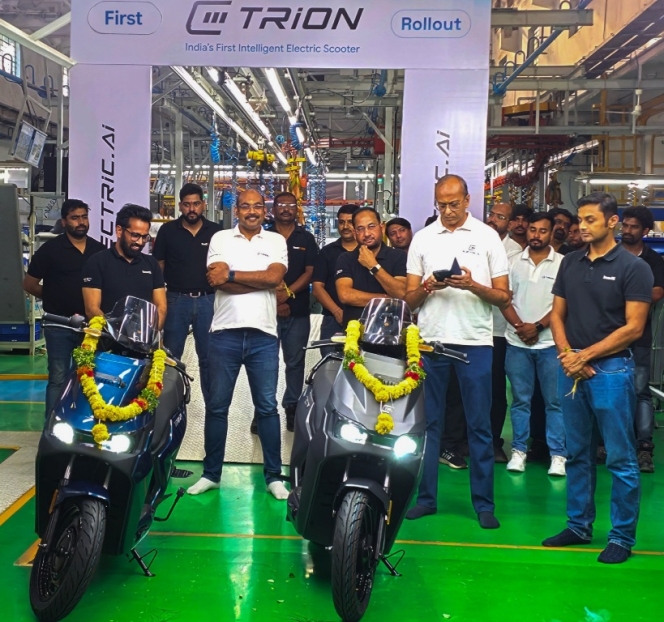
Bengaluru-based electric mobility startup E3 Electric.Ai has commenced production of its electric scooter, the E3 Trion, at its manufacturing facility in Hyderabad. Customer deliveries are scheduled to begin in batches from 7 October 2026, coinciding with the company's second anniversary.
The E3 Trion is offered in three variants – C1, C1X and C2 – designed for individual, family and commercial users. The variants will be delivered in phased schedules across six colour options: Nova Blue, Teal Blue, Graphite Grey, Misty Green, Solar Red and Luna White.
The e-scooter completed a testing and validation programme comprising over 550 Design Validation Plan tests, including chassis dynamometer power evaluation, range validation and brake-pressure sensor testing. Accelerated durability assessments were conducted on a Cam Drum Test Rig with a 205 kg payload, alongside water-wading tests at depths between 100 mm and 300 mm, rainstorm exposure and a 260-km mixed-terrain road test between Bengaluru and Hogenakkal.
Sanjeev P, Founder and CEO, E3 Electric.Ai, said, "This is a significant moment for everyone at E3, where engineering, testing and validation translate into a product that is ready to reach our customers. Our philosophy has been simple: build an intelligent, robust, electric scooter engineered for the real world. The rigorous validation programme, particularly our focus on durability across challenging conditions, has been central to that. With production now underway and deliveries beginning in batches from October 7, which also marks our second anniversary, we are proud to take the E3 Trion from the test track to the road and begin this journey with our first 100 customers."
The initial 100 buyers will receive an extended warranty covering the battery and primary components for eight years or 100,000 kilometres, along with one year of roadside assistance. The coverage package applies to the 2.3 kWh battery configuration on the C1 variant and the 3 kWh battery setup on the C1X and C2 variants.
BMW M Produces 1 Millionth Vehicle As Munich Plant Prepares For Electric M3
- By MT Bureau
- October 05, 2026
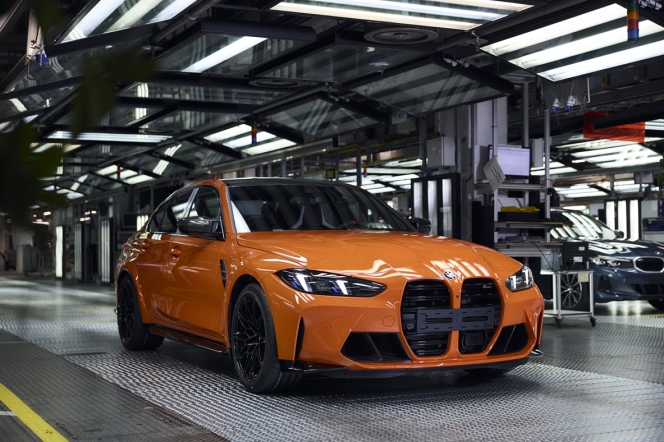
German automotive luxury brand BMW M has produced its one-millionth vehicle, a BMW M3 finished in BMW Individual Fire Orange III special paintwork, at the BMW Group Plant Munich. The milestone vehicle was presented by Peter Weber, head of BMW Group Plant Munich, to Franciscus van Meel, CEO of BMW M, during an official ceremony.
The production milestone marks over five decades of BMW M manufacturing. Moving forward, the Munich facility will produce the fully electric BMW M3 based on BMW M Neue Klasse technology, following the fully electric BMW i3 as the second Neue Klasse model manufactured at the site.
The Munich facility has produced the current generation of the BMW M3 since 2020. From 2027 onwards, the BMW Group will manufacture exclusively fully electric vehicles at the site. The company is investing approximately EUR 650 million to convert the Munich facility, incorporating a new body shop, vehicle assembly line, and logistics infrastructure across one-third of the total plant area.
Franciscus van Meel said, "BMW M combines road and racetrack capabilities with everyday practicality. The one-millionth BMW M vehicle shows that these values are still very much appreciated by our customers, 40 years after the market launch of the first BMW M3. This motivates us to continuously develop our BMW M high-performance vehicle portfolio based on BMW M Neue Klasse technology, including fully-electric models, in line with our core brand promise."
Peter Weber said, "The BMW M3 has close ties to the BMW Group’s main plant in Munich. We are delighted that we will also be producing the first fully-electric BMW M3 here in Munich. BMW M has a special emotional significance for our associates here – so we are especially proud to be actively shaping the future of this icon."

Ultium Cells To Upgrade US Facility For Prismatic LMR Battery Cell Production
- By MT Bureau
- September 30, 2026
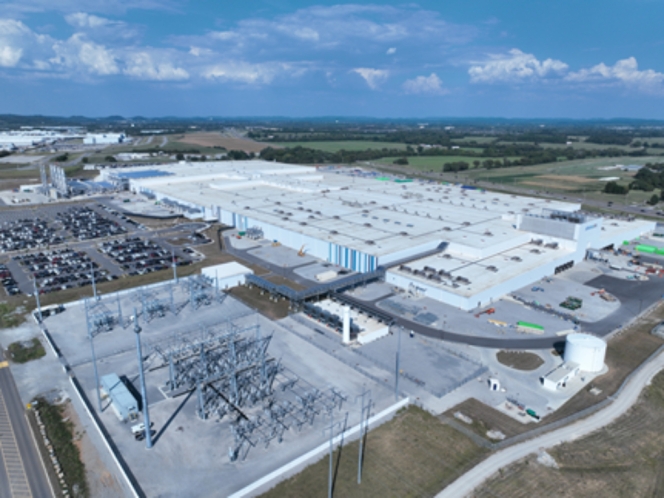
Ultium Cells, the joint venture between General Motors and LG Energy Solution, will upgrade its battery cell manufacturing plant in Spring Hill, Tennessee, United States, to produce lithium manganese rich (LMR) battery cells for General Motors electric vehicles.
The facility is scheduled to begin retooling later this year, with completion expected in 2028. The conversion will enable mass production of prismatic LMR cells, a chemistry which it claims offers up to 33 percent higher energy density than lithium iron phosphate (LFP) at a similar cost profile.
The project will create 500 positions, expanding the plant's existing workforce of 1,200 employees. The upgrade follows the start of LFP cell production for energy storage systems at the facility in June 2026, bringing cumulative investment across both projects to USD 1 billion by 2030.
The modification will allow Ultium Cells to manufacture high-nickel, LFP and LMR chemistries across pouch and prismatic form factors at the Tennessee site, supplying battery cells for General Motors' North American vehicle assembly plants and external stationary storage applications.
Kurt Kelty, Vice-President of Battery and Sustainability, GM, said, “Establishing LMR prismatic cell production at Ultium Cells in Spring Hill is a key step in GM’s strategy to match the right battery technology to customer needs and strengthen our leadership in domestic battery manufacturing and innovation. High-nickel batteries will continue to give customers the highest range in our portfolio, while adding LMR positions us to leapfrog today’s more affordable chemistries and deliver lower costs with better performance. This flexibility allows us to scale efficiently, reach more customers, and support GM’s long-term EV strategy and profitability journey.”
Tennessee Governor Bill Lee said, “Ultium Cells’ continued investment in Spring Hill underscores Tennessee’s role as a hub for advanced manufacturing and technological innovation. I thank Ultium Cells for their commitment to create new, high-quality jobs and to reinforce the strength of Tennessee’s manufacturing economy as we advance toward a future focused on clean, reliable energy.”
Injae Pahk, President, Ultium Cells, said, “This marks Ultium Cells’ second major investment in Spring Hill and reflects the company’s continued growth as a diversified battery cell manufacturer. By evolving production to meet changing market demands, Ultium Cells is reinforcing its long-term position as a key employer and technology leader in the U.S. battery cell sector.”
Comments (0)
ADD COMMENT