

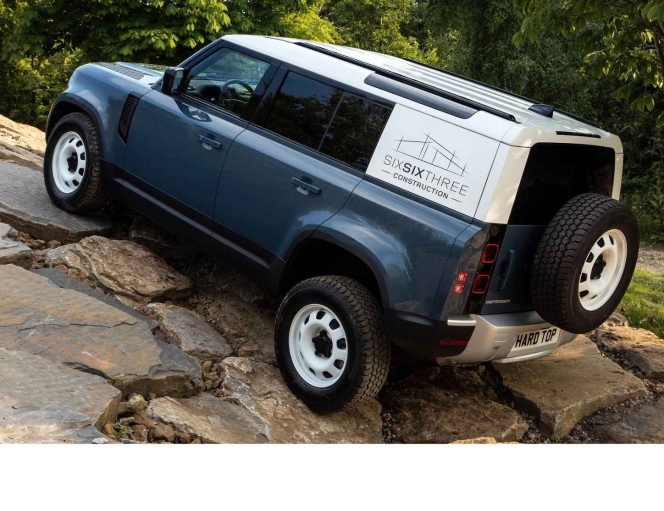
The new commercial Defender 90 and 110 models to be launched later this year will restore the Hard Top name to its rugged 4x4 family. It will combine all-terrain capability with 21st-century connectivity to give professionals a unique combination of cargo space, practicality and premium comfort.
The Hard Top name dates back to 1950, when the introduction of demountable Hard Tops gave early Series Land Rovers added security and protection from the elements. New Defender Hard Top continues this ethos, sharing its fixed metal roof and silhouette with the iconic original.
Land Rover has experienced unprecedented global demand for New Defender 90 and 110 since its successful world premiere last September and the new Hard Top models will be the next additions to the legendary bloodline.

Defender’s aluminium-intensive D7x body architecture is three times stiffer than the best body-on-frame designs. Sharing its strong body structure and next-generation Electrical Vehicle Architecture (EVA 2.0) with passenger models, the Defender Hard Top is being developed by Land Rover Special Vehicle Operations to deliver unrivalled durability, practicality and toughness.
Michael van der Sande, Managing Director, Land Rover Special Vehicle Operations, said: “We will maximise the functionality and usability of New Defender’s cargo area, with tough materials and clever storage solutions to ensure it surpasses the capability of any previous Defender Hard Top.”
The 90 and 110 Hard Tops will both feature independent coil-sprung suspension, with advanced electronic air suspension also available on the 110. Both set-ups will provide outstanding off-road geometry, with ground clearance of 291mm, while the 110 Hard Top will have approach, breakover and departure angles of up to 38, 28 and 40 degrees respectively (in Off-Road height). Full technical details will be confirmed later this year.
Nick Collins, Land Rover Vehicle Line Director, said: “New Defender 90 and 110 Hard Top will be the toughest, most capable and most connected commercial 4x4s we have ever produced. They have been engineered to meet global safety standards and deliver impressive long-haul comfort, giving businesses and professionals the best of all worlds.”
An impressive payload and towing capacity of up 3,500kg will combine to make New Defender the ultimate commercial 4x4. The flexible cabin has no second or third-row seats, but the optional front-row jump seat means it will still accommodate up to three people. Land Rover’s clever ClearSight Rear View mirror system preserves rearward visibility when the jump seat is occupied, or when the load space is full. It uses a live video feed from a rear-facing camera to give drivers an unobstructed view at all times.
New Defender Hard Top will be a world-class tow vehicle, with a raft of technologies to help hitch, drive and reverse safely while pulling a trailer. Land Rover’s intelligent Advanced Tow Assist system takes the stress out of difficult reversing manoeuvres by letting drivers steer trailers with their fingertips using a rotary controller on the centre console.
The maximum wading depth of 900mm is also supported by a new Wade programme in the Terrain Response 2 system, which ensures drivers can ford deep water with complete confidence – so important supplies will always get through. (MT)
Toyota Kirloskar Motor Launches Updated Glanza At INR 699,000
- By MT Bureau
- October 14, 2026
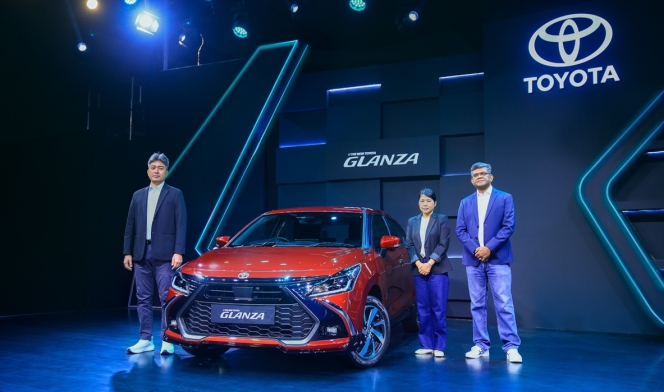
Toyota Kirloskar Motor has launched the updated Toyota Glanza hatchback in India, priced from INR 699,000 ex-showroom. The updated hatchback introduces revised exterior styling, including an updated front bumper, side skirts, a wide chrome grille bar and LED headlamp assemblies.
Under the bonnet, it transitions to a 1.2-litre three-cylinder Z12E petrol engine producing 61 kW of power and 112.4 Nm of torque, with claimed fuel efficiency figures of 23.80 kmpl for the manual transmission and 24.77 kmpl for the automated manual transmission (AMT) variant. The alternative CNG powertrain delivers 51.3 kW of power and 101.8 Nm of torque, and now incorporates an AMT option.
Tadashi Asazuma, Deputy Managing Director, Toyota Kirloskar Motor, said, "Ever since its launch in 2019, the Toyota Glanza has been a popular choice among customers seeking a stylish, feature-rich and dependable hatchback. The 2026 New Toyota Glanza builds on this strong legacy with a sharper and sportier design, a more premium cabin experience and advanced safety technologies making it an even more compelling choice for today's customers. The hatchback segment continues to be an important entry point for customers beginning their mobility journey, and the Glanza is thoughtfully designed to meet these aspirations with style, quality and peace of mind. As customer needs evolve, we remain committed to delivering ever-better cars and creating happiness for our customers."
Sabari Manohar, Executive Vice-President of Sales-Services-Used Car Business, Toyota Kirloskar Motor, said, "As customer expectations continue to evolve, the New Toyota Glanza introduces several meaningful enhancements across safety, convenience and connectivity. With the introduction of Level 2 Advanced Driver Assistance Systems (ADAS), featuring Adaptive Cruise Control, Lane Keeping Assist, Lane Departure Warning, Lane Departure Prevention, Autonomous Emergency Braking and High Beam Assist, the New Glanza offers a premium mobility experience. The addition of AMT in the CNG variants further enhances driving convenience, while ventilated front seats, wireless charging and refreshed styling add to its overall appeal."
The Glanza features level 2 Advanced Driver Assistance Systems, a 360-degree camera system, six airbags, ventilated front seating, wireless device charging, a head-up display and a 22.86 cm touchscreen display with connected car telemetry.
Bookings have opened for an initial amount of INR 11,000, with customer deliveries scheduled to begin in the first week of November. The Glanza can be had in seven paint options and comes with a standard 3-year or 100,000-kilometre warranty.
Hyundai Unveils India-Spec Bayon Ahead Of 26 October Launch
- By MT Bureau
- October 12, 2026
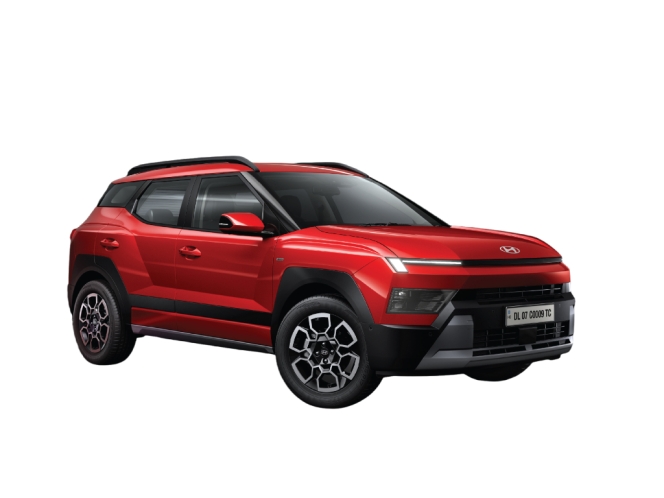
Hyundai Motor India, one of the leading passenger vehicle manufacturers, has revealed the India-spec Hyundai Bayon, with bookings opening across company dealerships and online sales channels ahead of its scheduled launch on 26 October 2026.
The SUV introduces software and connectivity features, including Hyundai Motor India's first generative artificial intelligence (AI) voice assistant incorporating technology from Perplexity and SoundHound AI.
The Bayon is powered by a four-cylinder 1.5-litre MPi petrol engine generating 115 PS of power and 144 Nm of torque. Transmission options include a six-speed manual transmission and an Intelligent Variable Transmission. It also integrates over 70 connected features via the Hyundai Bluelink platform, including remote vehicle controls, smartwatch integration, and location services.
Built on an NVIDIA-accelerated Connected Car Navigation Cockpit, it supports up to 19 over-the-air vehicle controller updates for remote software maintenance and features dual 12.3-inch curved panoramic displays. The infotainment architecture supports a multi-language user interface across 10 regional and two international languages, alongside over 500 offline embedded voice commands across six languages.
Tarun Garg, MD & CEO, Hyundai Motor India, said, "With Hyundai Bayon, we are introducing an Intelligent Utility Vehicle that places technology and convenience at the heart of the customer experience. Guided by the philosophy of ‘Intelligence That Moves,’ Bayon seamlessly integrates Artificial Intelligence, advanced connectivity and software-driven innovation to create a mobility experience that is intuitive, evolving and deeply personalised. Through segment-defining technologies & features such as HMIL's first-ever Generative AI Voice Assistant, NVIDIA-accelerated Connected Car Navigation Cockpit (ccNC), Vehicle Controller Over-the-Air (C-OTA) updates and Hyundai Bluelink connected features, Bayon represents the next generation of intelligent mobility for Indian customers."
- Stellantis
- Alfa Romeo
- Citroën
- DS Automobiles
- FIAT
- Opel
- Peugeot
- Paris Motor Show
- 2 CV
- Multiplay
- STX
- STLA One
- RCZ Vision
- DS F3VER
- Alfa Romeo Cuorerosso
- Gilles Vidal
- Antonio Filosa
- Emanuele Cappellano
- FaSTLAne 2030
Stellantis Unveils 6 Concept Vehicles Ahead Of Paris Motor Show
- By MT Bureau
- October 12, 2026
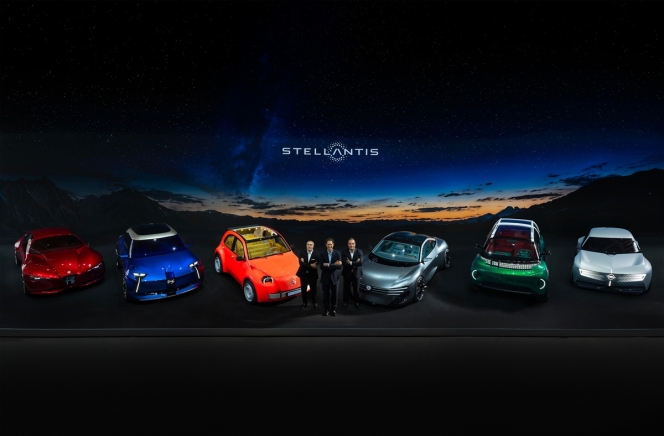
European auto major Stellantis hosted an executive preview event in Paris, introducing six concept vehicles across its brand portfolio ahead of the Paris Motor Show. The reveals span models from Alfa Romeo, Citroën, DS Automobiles, FIAT, Opel and Peugeot, forming part of a broader exhibition featuring over 60 vehicles and nine concept cars across eight corporate brands.
The introduced concepts reflect distinct engineering and design directions for each brand. The Alfa Romeo Cuorerosso concept presents a multi-energy architecture capable of accommodating models up to 4.7 metres in length, including a 2.9-litre V6 full-hybrid powertrain with all-wheel drive.
Citroën unveiled the 2 CV Concept, an electric vehicle targeted for European production at a EUR 15,000 price point. FIAT showcased the Multiplay, a configurable vehicle architecture combining pickup and utility vehicle traits inspired by the original Multipla design.
Opel presented the STX Concept, outlining design elements and lighting signatures for future estate models, while Peugeot revealed the RCZ Vision built on the STLA One platform and featuring steer-by-wire technology alongside updated cabin controls.
DS Automobiles displayed the DS F3VER concept, focusing on vehicle customisation and design parameters for future production models.
Gilles Vidal, Head of Design, Enlarged Europe at Stellantis, said, "With these six concept cars, we are expressing a shared conviction: the future of automotive design must be both bold and meaningful. Each concept explores new ways to enhance everyday experiences while reinforcing the unique identity of its brand. Together, they demonstrate how creativity, innovation and emotion can come together to make people fall in love with cars again."
Antonio Filosa, CEO, Stellantis, said, "This event brings our FaSTLAne 2030 strategy to life. It reflects the extraordinary effort of our teams and our commitment to shaping the future of mobility through iconic brands, compelling design and innovative technology, giving customers more choice and more reasons to be excited about what’s ahead."
Emanuele Cappellano, COO for Enlarged Europe, Stellantis, said, "Stellantis is deeply rooted in Europe and holds a leading position that will be strengthened by the success of all our brands. Stellantis wants to fully leverage the competitive advantage set by its iconic brands’ uniqueness, offering cars that are at once rooted in heritage and future-driven, based on robust know-how and distinguished by their unmatched design beauty, to shape the future of mobility with more than 50 products to be launched by 2030. These achievements, based on the execution of our strategic plan, will enable Stellantis to expand its market coverage in Enlarged Europe by 25 percent."
The concept unveils support Stellantis's broader product development roadmap, which targets the introduction of over 50 vehicle models by 2030 and a 25 percent expansion in European market coverage.
AVATR Announces European Expansion Strategy Starting With Norway And Spain Entry In 2027
- By MT Bureau
- October 12, 2026
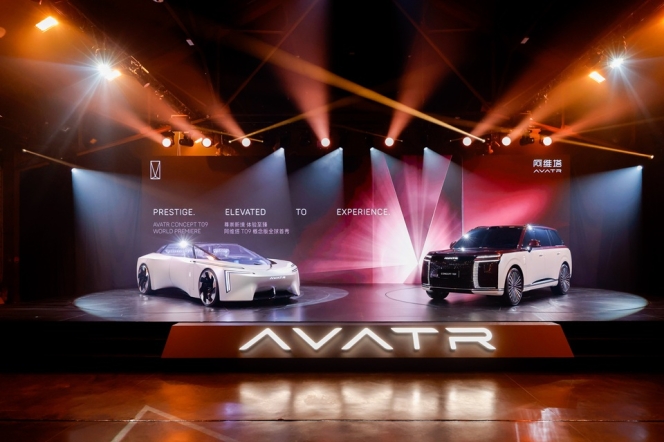
Chinese premium electric vehicle brand AVATR announced its entry into the European market at an event in Paris, marking the next phase of its global growth plan. The manufacturer will initiate European retail operations in 2027, launching first in Norway and Spain with the AVATR 06T and 07L models.
AVATR operates as a joint initiative combining vehicle manufacturing from Changan Automobile, battery technology from CATL and software engineering capabilities from a technology enterprise, with design operations split between hubs in Shanghai and Munich.
Over the next three years, AVATR plans to introduce six models in Europe across mid-size SUV, large SUV and shooting-brake body styles. The company currently operates in 70 countries and regions, with global sales exceeding 280,000 units. AVATR targets expansion into 110 countries and regions by 2030, projecting overseas sales to represent more than 50 per cent of its total volume.
Justin Li, Head of AVATR Overseas Business, said, "AVATR has been a global brand from the very beginning. Over the next three years, six models will be launched in Europe spanning mid‑size SUVs, large SUVs and shooting‑brake body styles. In 2027, Norway and Spain will serve as AVATR’s European launch markets, where the AVATR 06T and 07L will make their European debut, officially embarking on a new journey for AVATR in Europe."
To establish its European retail and service infrastructure, AVATR has partnered with Nordic automotive importer RSA in Norway. The collaboration will establish two flagship locations in Oslo alongside additional experience centres and regional distribution points across major Norwegian cities. The company is setting up a localised service network, factory training programs and a European spare-parts logistics framework to support maintenance, roadside assistance and battery recycling operations.
Comments (0)
ADD COMMENT