

Equipmake Launches ASIL-D Inverter For High-Performance EVs
- By MT Bureau
- October 22, 2020
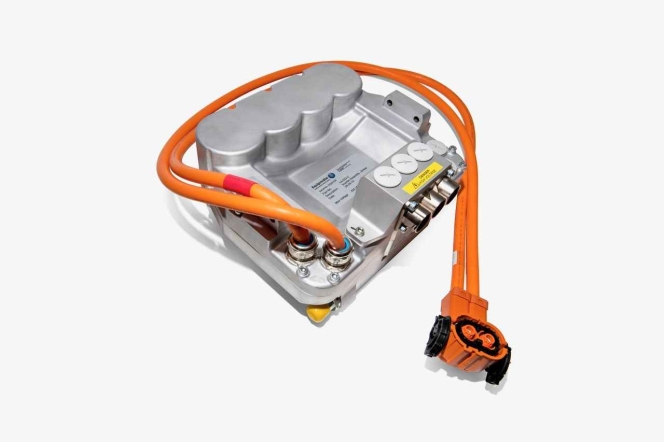
Electrification specialist, Equipmake, has launched an all-new inverter that combines off-the-shelf ASIL-D functional safety with exceptional power density. It made the unit unique as it becomes a cost-effective choice for manufacturers of low volume, high-performance electric vehicles such as hypercars and electrified classics.
Based in Norfolk, UK, Equipmake provides EV technology to automotive OEMs and specialist supercar makers, producing everything from industry-leading electric motors to power electronic systems, all the way up to complete EV drivetrains. It operates across marine, mining, off-highway, agriculture and aerospace.
Engineered and manufactured in the UK, Equipmake’s HPI-450 inverter boasts high power density of 30 kW/kg. Featuring Semikron IGBT modules, the HPI-450 inverter is capable of switching frequencies at up to 20 kHz.
Playing a crucial role in the EV powertrain, the inverter converts DC charge from the battery to AC charge to drive the electric motor. Also, timing switching changes to adjust the frequency of the AC charger to control the speed of the motor, much like fuel injection and ignition system does in a combustion engine.
With the growth in low volume production of electric sports cars, including all-new hypercars and electrified classic cars from OEMs and start-ups alike, Equipmake has developed the HPI-450 to address a major challenge faced by these manufacturers: equipping their vehicle with an inverter that has ASIL-D functional safety and high performance but comes in on budget too.
Ian Foley, Managing Director, Equipmake said: “Until now, high-performance inverters with ASIL-D functional safety have only really been available from Tier 1 suppliers to OEMs at considerable cost. That cost is not viable for low volume runs, so for a manufacturer of niche high-performance electric vehicles – and even an OEM looking to do a low volume run of EVs – sourcing the right inverter has been a challenge. Equipmake has solved this with the HPI-450, which not only has off-the-shelf ASIL-D status but outstanding power density, at a cost that is very competitive even at low volumes.” (MT)
- Detroit Engineered Products
- DEP
- DEP MeshWorks
- DEP AIWorks Platforms
- IntelliNXT Learning & Technologies
- IntelliNXT
- CAE
- Radha Krishnan
- Karaiadiselvan
DEP and IntelliNXT Partner To Build Computer-Aided Engineering Talent In India
- By MT Bureau
- November 26, 2026
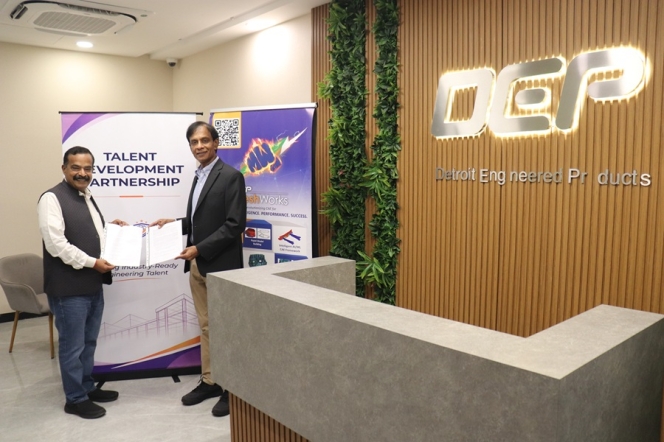
Detroit Engineered Products (DEP), developer of the DEP MeshWorks and DEP AIWorks platforms, has entered into a Talent Development Partnership with IntelliNXT Learning & Technologies (IntelliNXT) to build a pipeline of Computer-Aided Engineering (CAE) talent in India.
As per the agreement, IntelliNXT will design and deliver a training programme in association with DEP to develop participants' skills in CAE and DEP MeshWorks, a platform used by engineering teams to build element models from CAD data, parameterise them, and run optimisation studies.
Delivered through sessions, labs and projects, the curriculum will also introduce engineering workflows enabled by artificial intelligence (AI), an area where DEP AIWorks combines machine learning with simulation to shorten product development cycles. IntelliNXT will assess participants, certify graduates, and coordinate placement activities with DEP by recommending candidates based on assessment performance, streamlining recruitment and onboarding for the software developer.
Radha Krishnan, Founder & President, DEP, said, “Industry-ready engineers are the foundation of every successful CAE adoption. Partnering with IntelliNXT lets us bring DEP MeshWorks to a new generation of engineers in India and build a lasting talent pipeline.”
Karaiadiselvan, Chief Mentor, IntelliNXT Learning & Technologies, said, “Access to DEP MeshWorks lets us train our learners on a tool that industry actually uses, and helps companies find job-ready talent.”
- Hindustan Zinc
- Indian Institute of Technology Madras
- IIT Madras
- zinc-air battery
- Amarendu Prakash
- Praveen Chakravarthy
- Dr. Aravind Kmar Chandiran
- Prof Manu Santhanam
- Prrof. V Kamakoti
- HZL 2.0
Hindustan Zinc, IIT Madras Unveil Three-Wheeler Prototype With 1 kWh Zinc-Air Range Extender
- By MT Bureau
- November 26, 2026
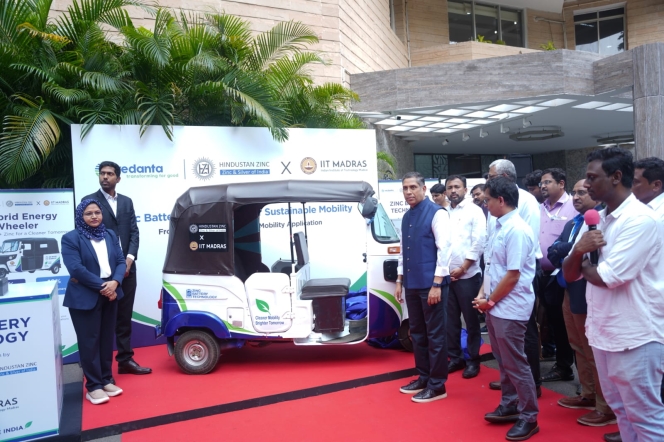
Hindustan Zinc, in collaboration with the Indian Institute of Technology Madras (IIT Madras), has unveiled a three-wheeler prototype fitted with an approximately 1 kWh zinc-air battery acting as a range extender.
The partners presented the prototype during the IIT Madras Energy Summit 2026 in the presence of Praveen Chakravarthy, Member of Parliament (Rajya Sabha), Amarendu Prakash, CEO and Whole-time Director, Hindustan Zinc, IIT Madras Dean (ICSR) Prof. Manu Santhanam and project lead Dr. Aravind Kumar Chandiran from the Department of Chemical Engineering.
Initiated in 2024, the research partnership has progressed from laboratory testing to vehicle demonstration under Hindustan Zinc's HZL 2.0 growth strategy. The vehicle utilises a dual-battery architecture in which the zinc-air unit supplies nearly 10 percent of the vehicle's energy requirements during operation, while a lithium-ion battery handles acceleration and power demands. Operating with a water-based electrolyte, zinc and oxygen from the air, the technology leverages India's zinc reserves to advance energy storage capabilities.
Amarendu Prakash said, “At Hindustan Zinc, we are constantly exploring opportunities to expand the applications of zinc and unlock greater value from this versatile metal. With zinc being abundantly available in India, there is an opportunity to explore indigenous energy storage solutions that can contribute to the vision of Viksit Bharat. Our collaboration with IIT Madras reflects our commitment to translating scientific research into practical applications, creating new demand avenues for zinc and strengthening its role in the global clean energy transition.”
Prof. V. Kamakoti, Director, IIT Madras, said, “Energy is the major focus of discussion globally, be it artificial intelligence, agriculture all the way to advanced manufacturing. Ensuring generation, storage and distribution of energy from different sources, specifically the renewable ones is the most important topic for research, development and commercialisation. Our collaboration with Hindustan Zinc is yet another important effort towards this goal.”
- XPENG
- Next Generation Pilot
- Tesla
- Autonomous Lab
- Paris Motor Show
- XPENG VLA 2.0
- United Nations Economic Commission for Europe
- He Xiaopeng
- Romain Caubet
XPENG Launches Public ADAS Test Rides In Paris Ahead Of 2027 Rollout
- By MT Bureau
- November 24, 2026
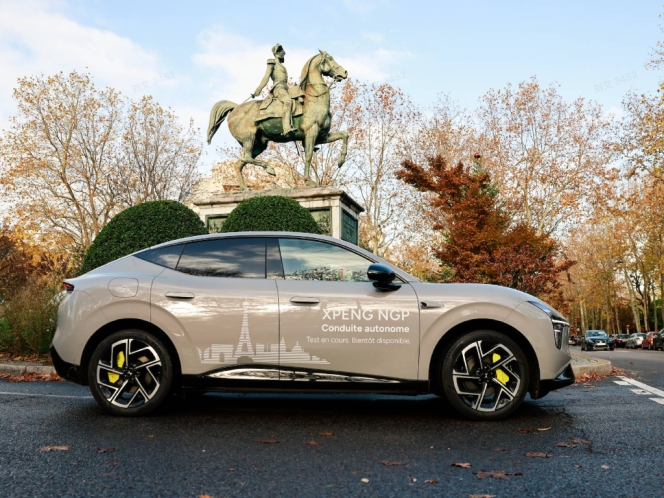
Chinese automotive and technology company XPENG has launched public test rides for its Next Generation Pilot (NGP) driver-assistance system at its retail store at 10 boulevard Gouvion-Saint-Cyr in Paris, becoming the first automaker from China to offer such trials from a retail location in Europe.
Following its participation alongside Tesla in the Autonomous Lab programme at the 2026 Paris Motor Show, the initiative allows customers to book drives in city traffic and intersections while the company conducts testing and localisation ahead of a rollout planned for 2027, subject to regulatory approvals and market readiness.
Powered by XPENG's VLA 2.0 architecture, the NGP system sits within a technology stack that includes Turing AI chips, world foundation models and integrated software and hardware across electric vehicles, robotaxis and robots. Alongside retail demonstrations, the Guangzhou-headquartered automaker participates in automated driving standards as OICA Secretary for the United Nations Economic Commission for Europe (UNECE) TF-ESRI taskforce.
He Xiaopeng, Chairman and CEO, XPENG, said, “Our mission is to bring Physical AI into everyday life and make advanced intelligent driving accessible to users worldwide. At the Paris Motor Show, many people asked when they could experience our technology themselves. Today, we are taking that next step. For us, this is not just about showcasing technology, but about understanding how people experience it in the real world. Backed by our full-stack R&D and continuous localisation efforts, we are committed to listening to European customers, adapting our technology to their needs, and working towards safer, smarter and more seamless mobility experiences. This is what ‘In Europe, For Europe, With Europe’ means to us.”
Romain Caubet, Country Manager, XPENG in France, said, “At the Paris Motor Show, we introduced European audiences to our advanced driving assistance technology through real-world demonstrations. Today, we are bringing that experience closer to customers through our Paris store. Paris offers a unique and challenging urban driving environment, making it an ideal location for people to experience the technology firsthand. We look forward to hearing their feedback as we continue to develop our intelligent driving experience for European customers.”
L&T Technology Services Launches SDVault.ai Toolchain For Software-Defined Vehicles
- By MT Bureau
- November 23, 2026
Bengaluru-headquartered engineering R&D company L&T Technology Services (LTTS) has introduced SDVault.ai, an engineering and assurance toolchain built on its EIOne platform to support automotive original equipment manufacturers and Tier-1 suppliers in developing, integrating and validating software-defined vehicles.
The platform is supported by 15 patent filings and operates across 12 engineering domains spanning requirements, system and electrical/electronic architecture, safety, cybersecurity, process assurance, software and code intelligence, verification, embedded debugging, virtual electronic control unit validation, trace and network analysis, root-cause intelligence and regression and release assurance.
Combining more than 250 artificial intelligence agents with rule-based automation, SDVault.ai connects requirements and architecture with code, tests, failures, actions and release evidence across the V-cycle while keeping engineers in control of decisions, verification and certification.
The platform can be deployed end-to-end or alongside existing toolchains within customer-controlled environments, with pilots demonstrating 30 to 40 per cent capacity for workload absorption and reducing tasks such as ticket triage from approximately four hours to 10 minutes.
Amit Chadha, CEO and MD, L&T Technology Services and NASSCOM Executive Council Member, said, “Software-defined vehicles are dramatically increasing the complexity of automotive engineering. AI can help, but in safety-critical engineering, AI alone is not enough. It requires deterministic engineering, domain knowledge, traceability and engineers firmly in control. SDVault.ai brings these together as Engineering Intelligence across the SDV V-cycle, connecting requirements, architecture, software, verification and evidence. It gives OEMs and Tier-1 suppliers a practical path to engineer more software, validate it with greater confidence and take more vehicle programs to production with the teams they already have.”
Comments (0)
ADD COMMENT