

- Ola Electric
- Bhavish Aggarwal
- Ola Shakti
- Battery Energy Storage System
- BESS
- 4680 Bharat Cell
- Electric Mobility
- Renewable Energy
- Home Energy Storage
- Clean Energy India
- Gigafactory
- Energy Independence
- Smart Home Technology
Ola Electric Enters Home Energy Market With First Residential Battery Storage System
- By MT Bureau
- October 16, 2025
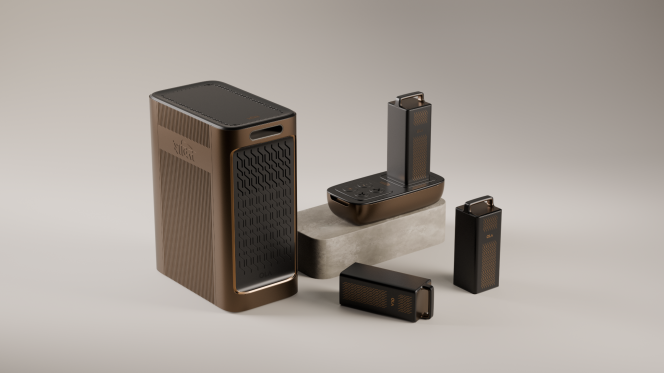
Ola Electric unveils the company’s first residential battery energy storage system designed and manufactured in India called Ola Shakti.
Ola Electric has moved beyond the automotive space with the launch of Ola Shakti, its first residential Battery Energy Storage System (BESS). The new product marks a major shift for the company as it aims to make electricity a portable, on-demand resource for Indian homes, farms and businesses.
With its entry into the BESS segment, Ola expects its annual battery consumption for energy storage to scale up to 5 GWh over the next few years. The launch marks the first step in Ola’s long-term energy storage vision from residential applications to grid-scale solutions, all built on the company’s 4680 Bharat Cell technology platform and produced at its Ola Gigafactory.
“India doesn't face energy shortage; it faces an energy storage opportunity. With Ola Shakti, we are turning that opportunity into energy independence. We have built world-class battery and cell technology for electric mobility. Ola Shakti extends that innovation to homes, helping them store and use clean energy intelligently. Ola Shakti is a natural next step for us as we leverage our existing 4680 cell technology, Gigafactory production capabilities and nationwide Ola network as a ready sales and distribution backbone, ensuring rapid scale without any incremental investment,” said Managing Director Bhavish Aggarwal.
Ola Shakti is India’s first fully indigenously designed, engineered and manufactured residential BESS built with advanced 4680 Bharat Cells and high-performance automotive battery packs. Its modular architecture allows flexible stacking and scalability, while a compact design supports quick home installation and easy servicing with accessible air filters.
The system offers automotive-grade safety, industry-leading efficiency of up to 98 percent and zero running or maintenance costs. Unlike traditional lead-acid inverters or diesel generators, Ola Shakti delivers instant 0-millisecond changeover, works across a 120V–290V input range to protect appliances from voltage fluctuations and features IP67-certified weather-proofing to withstand dust, water and monsoon conditions.
Powered by Ola’s in-house technology ecosystem, Shakti integrates intelligent energy management features that allow users to monitor battery performance and energy flow in real time. The system can learn consumption patterns to optimise usage, provide actionable insights to cut costs and enable features such as Time-of-Day (ToD) charge/discharge scheduling, smart back-up prioritisation, remote diagnostics, over-the-air software updates, modular expansion and online mode for continuous energy supply.The system can power air conditioners, refrigerators, induction cookers, farm pumps, and communication devices, with charging times as short as two hours and backup capacity of up to 1.5 hours at full load.
Ola Shakti will be introduced in four configurations at attractive introductory prices, catering to a wide range of household and small business needs. The entry-level model offering 1kW power with a 1.5kWh capacity is priced at INR 29,999, making it suitable for smaller homes or basic back-up requirements.
For users seeking higher capacity, Ola will offer a 1kW/3kWh version at INR 55,999, providing extended back-up and faster energy delivery. The mid-range 3kW/5.2kWh model, priced at INR 119,999, is designed for larger households and small commercial applications that demand sustained power for multiple appliances.
At the top end, the 6kW/9.1kWh configuration, priced at INR 159,999, offers robust performance capable of powering energy-intensive set-ups such as air conditioners, induction cookers, farm pumps and communication systems. Together, the four models position Ola Shakti as a versatile and scalable solution for India’s growing demand for reliable, clean home energy storage.
Ola Shakti will be available for purchase via the Ola Electric website and Ola stores nationwide with deliveries beginning on Makar Sankranti 2026. Reservations open today at INR 999, marking Ola’s first step toward making energy storage a mainstream consumer product in India.
Uber, JSW Motors Join Forces To Co-Develop And Deploy E-Cabs In India
- By MT Bureau
- May 21, 2026

Uber, one of India’s leading ridesharing apps, has inked a partnership with JSW Group to co-develop and deploy electric vehicles targeted for the Indian ride-hailing market.
The MoU signed between Parth Jindal of JSW Group and Dara Khosrowshahi, CEO of Uber, will see JSW Green Mobility, a wholly-owned subsidiary of JSW Group, deploy EV solutions at prices and performance expected in the cab segment in India.
The aim is to provide localised EV solutions across various categories on Uber, along with driving the adoption and utilisation of green vehicles.
Parth Jindal, said, “We are excited to collaborate with Uber to explore scalable EV mobility solutions aligned with national net-zero goals for India. By combining Uber’s platform scale and mobility insights with JSW’s growing automotive and clean mobility ambitions, we hope to contribute meaningfully to India’s EV ecosystem.”
Prabhjeet Singh, President, Uber India and South Asia, said, “India’s transition to electric mobility requires strong ecosystem partnerships across technology platforms, automakers, fleet operators, and infrastructure players. Through this collaboration with JSW Group, we aim to help accelerate the adoption of EVs on the Uber platform by exploring solutions purpose-built for the needs of Indian riders and drivers. This partnership also reflects our continued commitment to supporting the Government of India’s vision of advancing green and sustainable mobility at scale.”
Stellantis Announces E-Car Project For European Market
- By MT Bureau
- May 20, 2026
European automotive major Stellantis has announced a project to produce an electric vehicle, designated the E-Car, with production scheduled to begin in 2028. The manufacturing will take place at the Pomigliano d’Arco plant in Italy.
The term E-Car refers to European, Emotion, Electric and Environmental friendliness. The project aims to support the adoption of electric vehicles for city-centric mobility and intends to boost design and manufacturing jobs in Europe. The vehicle is designed to address the contraction of the small car segment in the region.
Antonio Filosa, CEO, Stellantis, said, “The E-Car is a concept that finds its natural match in the small car success that runs deep in our European Stellantis DNA. Our customers are calling for a revival of small, stylish vehicles, proudly produced in Europe, which are also affordable and environmentally friendly. Stellantis is answering their call with exciting new models for multiple brands. Production is expected to start in 2028 in our Pomigliano (Italy) plant.”
The selection of the Pomigliano plant aligns with its history of producing cars, such as the Fiat Panda. The E-Car models will utilise BEV technologies developed with partners to improve affordability and reduce time-to-market.
Skoda Unveils Entry-Level All-Electric City SUV Epiq
- By MT Bureau
- May 19, 2026
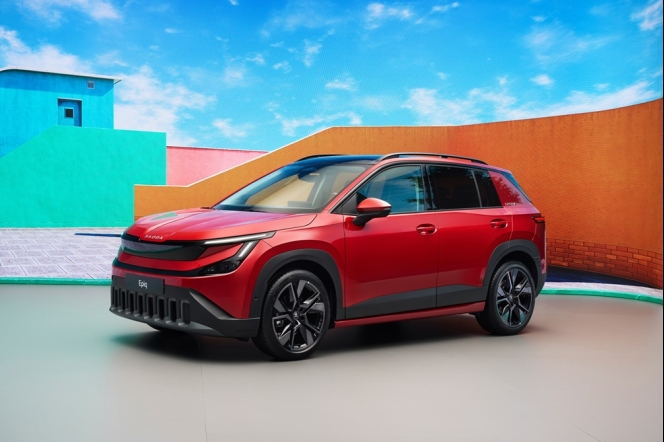
Czech automaker Skoda Auto has introduced the Skoda Epiq, its first entry-level city SUV crossover, which it claims achieves price parity with its internal combustion engine (ICE) counterpart, the Kamiq, in several European markets.
Built on the Volkswagen Group’s new MEB+ modular electric platform, the front-wheel-drive Epiq doubles Skoda's battery electric vehicle (BEV) lineup alongside the Enyaq, Elroq and upcoming Peaq.
The platform features two battery chemistries and three power outputs tailored for urban efficiency –
- Epiq 35 & 40: Features a 38.5 kWh Lithium Iron Phosphate (LFP) battery pack, producing 267 Nm of torque and a 310 km range. The entry-level Epiq 35 delivers 85 kW, while the Epiq 40 outputs 99 kW.
- Epiq 55: The range-topping variant utilises a 55 kWh Nickel Manganese Cobalt (NMC) battery pack, generating 155 kW of power and 290 Nm of torque for a 440 km range.
The Epiq 55 supports fast DC charging, replenishing the battery from 10 percent to 80 percent in 24 minutes. It also features bidirectional charging capabilities (V2L, V2H and V2G) and introduces full one-pedal driving in B mode. Mechanical disc brakes are fitted on both axles to limit rotor oxidation, as the front wheels handle all regenerative braking.
Measuring 4,171 mm long with a 2,601 mm wheelbase, the Epiq is the first production model to fully adopt Skoda’s ‘Modern Solid’ design language. The traditional front grille is replaced by a glossy black Tech-Deck Face concealing integrated sensors, framed by a new T-shaped LED light signature.
The crossover achieves a drag coefficient of 0.275. This aerodynamic profile is enabled by active cooling shutters, front-wheel Air Curtains, a fully enclosed smooth underbody pan and an extended roof spoiler.
Despite its compact exterior, the vehicle offers substantial storage, prioritising a 475-litre rear boot. This is supplemented by a 25-litre front luggage compartment (frunk) and 28 litres of cabin storage.
The cabin is completely animal-free, replacing leather with a durable synthetic material called Techtona. All textile seat fabrics are woven from 100 percent recycled polyester fibers (PES).
The digital core is powered by an Android-based infotainment system utilizing a 13-inch central display with third-party app hosting and a mobile digital key platform.
Safety hardware includes seven standard airbags (including a front-centre airbag) and advanced driver assistance features:
It gets Front Assist, Lane Assist, Side Assist with Rear Traffic Alert and an eye-tracking mirror camera for driver fatigue as standard. Customers will also have a choice for an Optional Crossroad Assist feature using front-corner radars, and Travel Assist 3.0 with proactive stop-light recognition, Trained Parking and Remote Park Assist.
Shortly after the initial market rollout, a limited Epiq First Edition will launch exclusively with the high-output 155 kW Epiq 55 powertrain. It is distinguished by a two-tone paint finish with a black roof, exclusive 20-inch alloy wheels, and Navajo Orange accents on the mirrors, bumpers, and side trim. The interior is upgraded with matching orange stitching, contrast safety belts, and aluminium sports pedals.
Klaus Zellmer, CEO of Skoda Auto, said, “The Epiq is our most approachable step into electric mobility – compact, confident, unmistakably Skoda, and designed to deliver exceptional value for money. It sets a clear benchmark for what an entry-level electric model should be: clean, purposeful design, intuitive user experience, and genuine everyday value. As our first series-production model to fully adopt the Modern Solid design language, the Epiq brings technologies from higher vehicle segments into an accessible package."
Martin Jahn, Skoda Auto Board Member for Sales and Marketing, added, “With the Epiq, we are addressing customers who are looking for a straightforward and attractive entry into electric mobility. The model combines compact dimensions with a surprisingly spacious interior, including a 475-litre luggage compartment, and a design focused on functionality. It delivers the quality and Simply Clever solutions our customers expect from Skoda, along with new features such as bidirectional charging."
Ultraviolette, Bolt.Earth Expand Type-6 DC Fast-Charging Infrastructure Across India
- By MT Bureau
- May 19, 2026
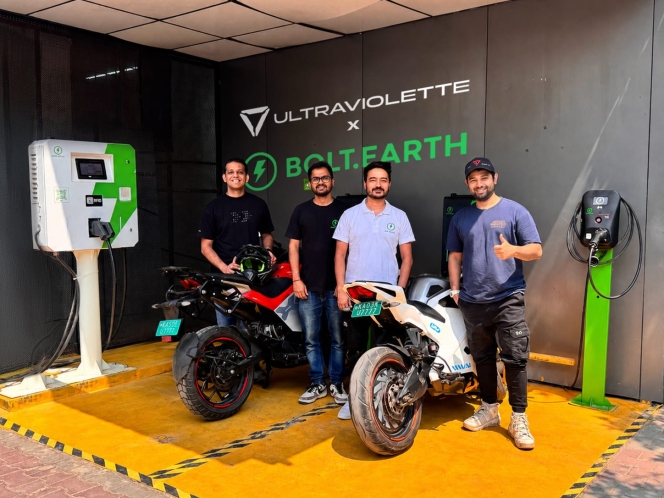
Bengaluru-based electric vehicle maker Ultraviolette Automotive and Bolt.Earth have announced that their interoperable Type-6 DC fast-charging network has surpassed 130 operational stations across 7 Indian states.
The current footprint more than doubles the initial deployment goal of 50 chargers established when the companies signed their strategic partnership in March 2026.
The accelerated infrastructure rollout is designed to support a growing performance electric motorcycle market and mitigate range anxiety. The active charging stations are distributed throughout Andhra Pradesh, Karnataka, Kerala, Maharashtra, Tamil Nadu, Telangana and West Bengal. As part of the network's next deployment phase, an additional 200 Type-6 DC fast chargers are scheduled to go live over the next two months.
The public charging network adheres to the IS 17017 Part 2 Section 6 standard, establishing native hardware compatibility for Ultraviolette's F77 and newly launched X-47 Crossover electric motorcycles without requiring external charging adapters. The physical infrastructure expansion relies on a dual-strategy approach, combining new installations of Type-6 DC fast chargers with targeted hardware upgrades to Bolt.Earth's existing charging points.
Niraj Rajmohan, Co-Founder & CTO, Ultraviolette, said, “Crossing 130+ Type-6 fast chargers ahead of schedule is in response to Ultraviolette’s expanding rider base and the broader growth of India’s electric two-wheeler market. The expansion also comes at a pivotal moment for India’s mobility sector. Recent crude-linked volatility has reinforced the need for more resilient, electricity-led mobility infrastructure. For electric mobility to scale meaningfully, charging infrastructure must evolve alongside vehicle technology with reliability, accessibility, and interoperability at its core. The rapid expansion of the Type-6 ecosystem marks an important step towards building a standardised and future-ready charging backbone for electric mobility.”
Mohit Yadav, Founder, Bolt.Earth, added, “Crossing 100 chargers within weeks of launch is more than a milestone for us, it reflects both the pace at which India’s EV ecosystem is evolving and our ability to scale interoperable infrastructure rapidly. With a roadmap to deploy 10,000 Type-6 Blaze DC chargers over the next two years, our focus remains on building one of India’s most reliable and accessible public fast-charging networks for electric two-wheelers.”
The network's software backend is integrated across both companies' digital applications. This allows riders to access real-time charger discovery, monitor active charging session telemetry, and process payments via integrated payment portals. Bolt.Earth has outlined a long-term commercial roadmap to deploy 10,000 Type-6 Blaze DC chargers over the next 24 months to support high-density urban transit routes and regional highway corridors.

Comments (0)
ADD COMMENT