

- IAC India
- Lumax Group
- IAC Group
- Mahindra
- VECV
- Maruti Suzuki India
- Skoda
- Volkswagen
- Stellantis
- Sunil Koparkar
IAC India Bets On Engineering Depth & Diversification, Targets 20% CAGR Growth Till FY2030
- By Nilesh Wadhwa
- February 28, 2026
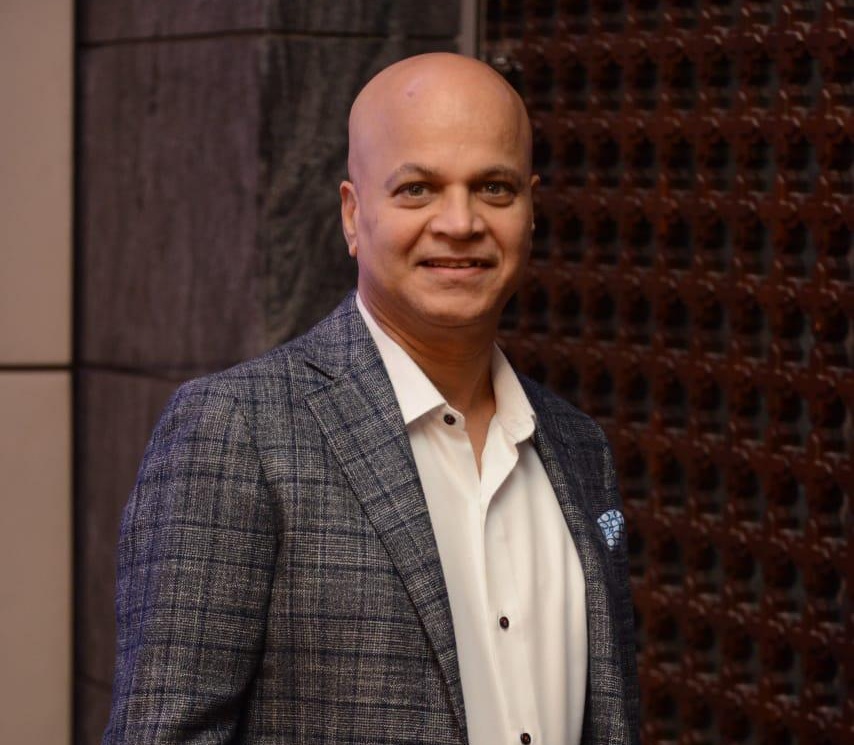
Sunil Koparkar, Managing Director, IAC India, outlines the company’s strategy to reduce customer concentration, expand exports and leverage group synergies following its integration with the Lumax Group.
As India’s automotive interior market evolves towards premiumisation, localisation and faster product cycles, IAC India, part of the Lumax Group, is repositioning itself beyond a single-customer dependency model – without diluting its core partnerships.
IAC India continues to derive a significant share of its revenue from Mahindra’s passenger vehicle business. While the concentration remains high, Koparkar is clear that diversification will be driven through growth rather than dilution.
“Mahindra will always be our primary customer. We have a very strong strategic partnership. But we are also working on expanding with other OEMs and in the commercial vehicle space. Our goal remains a 20 percent CAGR,” he says.
For FY2025, IAC India USD 140 million in revenue, and is targeting a 20 percent growth in FY2026. The company counts Mahindra as its primary customer with almost 78 percent of its business coming from them, while Maruti Suzuki India (12%), Volvo Eicher Commercial Vehicles (5%), Skoda-Volkswagen (3%) and Stellantis (1%) contribute towards the remaining business.
 What’s more, responding to the company’s expansion plans, Koparkar revealed, that IAC Group, in addition to introducing new products, is also in talks with new-age players who have just entered Indian market (and also planning too) for supplying products.
Currently, passenger vehicles account for roughly 90 percent of the business, with commercial vehicles forming the balance. Value-wise, Koparkar expects CV contribution to rise, even if percentage splits remain broadly similar due to the rapid growth of PV volumes.
Responding to a query on the potential growth from the CV segment, Koparkar said, “There is clear potential in CV interiors. As the CV market moves towards more comfortable cabins — with features like airbags, HVAC and infotainment — the opportunity for interior suppliers increases. Through Volvo Eicher, we have already helped drive that trend in India.”
When asked about the company’s expansion plans, Koparkar also stated that IAC Group is open to expanding to new regions as it aims to operate closer to its customers. One of the potential new projects for the company could very well be Chennai, as the company is in early talks with a new CV customer as well as VinFast.
Engineering as a Standalone Growth Lever
A key pillar of IAC India’s strategy is its expanding engineering capability. The company has been scaling up its R&D and product development team and increasingly positioning engineering services as a distinct revenue stream.
The company at present, employs over 300 engineers in India, which it aims to scale it upto 400-plus by next year and 500-plus in the coming few years.
Historically, the Indian Engineering Centre supported the global IAC Group. “We were primarily the IAC Group engineering development centre. We will continue to provide those services. But now, besides global support, we are also offering engineering services to local OEMs,” Koparkar explains.
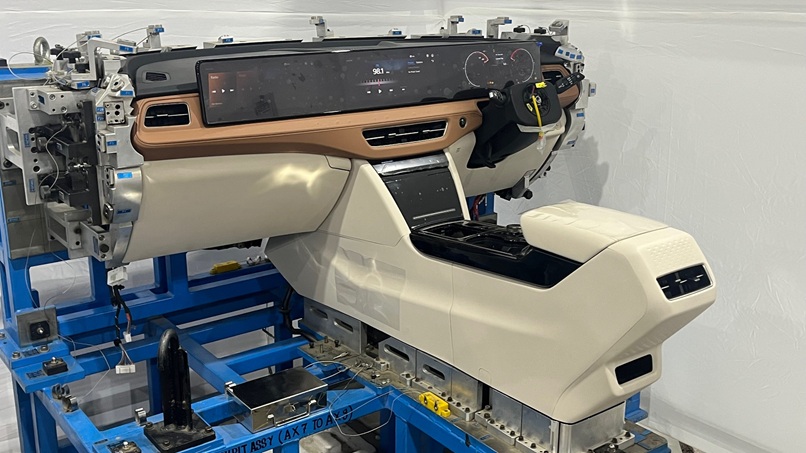
These services span studio collaboration, basic product design, CAE analysis and prototype development. In some cases, this can potentially evolve into full-scale supply programmes.
Importantly, innovation is now being formalised locally. “This year alone, we are in the process of filing about 30 patents,” he says. Earlier, intellectual property was subsumed under the global entity; now, filings are being initiated in India.
R&D investment remains aligned with group benchmarks at around 1.5–2 percent of revenue.
Exports: Measured Ambition
In terms of export potential, it currently contributes less than 5 percent towards the revenue, primarily through smaller kinematic parts. Direct exposure to the US market is negligible.
“Tariff-related uncertainty does not affect us because we do not export to the US,” Koparkar says. “Logistically, it does not make sense to ship our large interior parts there.”
Europe remains the primary export target. “The opportunity lies in leveraging our design capabilities and local development strengths. If logistics can be managed efficiently, there is room to grow.”
He also sees the Lumax Group’s aftermarket division as a future vehicle for export expansion.
Localisation and Supply Chain Resilience
On the localisation front, IAC India has made significant progress. “Last year was the first time we were able to localise over 99 percent of our tooling and development in India,” Koparkar states. Machinery on shop floors is largely localised, with only certain raw materials still imported.
The semiconductor crisis, he adds, had minimal direct impact. “We do not source electronics for our products — that is handled by the customer. However, from a development perspective, we are evaluating secondary substitutes for imported components, so we are prepared in case of disruptions.”
Premiumisation, Sustainability and AI
Premiumisation is currently the dominant interior trend. “Customers are moving away from basic plastics to more premium-feel interiors. Electronification is a big driver,” Koparkar says.
Sustainability, however, remains nascent in India. “There is no specific push for sustainable materials yet. What OEMs are looking for is lightweighting to meet upcoming CAFE norms. If a sustainable material delivers significant weight reduction, then it becomes serious.”
He points to jute, coir and bamboo fibres as potential alternatives but stresses that ecosystem-level collaboration is essential. “Unless a circular economy develops around us, sustainable materials will struggle to scale.”
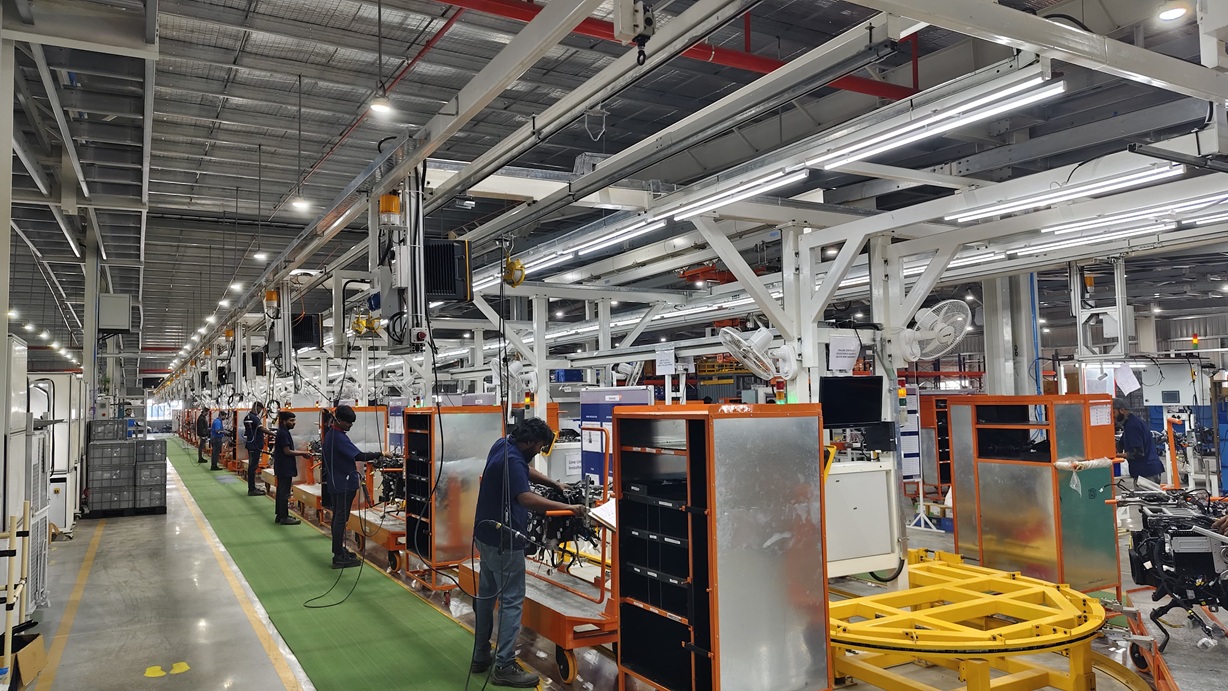
On automation, operations across IAC’s six plants are roughly a 50:50 mix of automated and manual processes, depending on volume justification. Cobots and semi-automation are used where full automation does not offer viable returns.
AI, meanwhile, is expected to influence design more than manufacturing. “We see AI helping us accumulate design learnings and reduce design cycle times. Its impact will be more visible in engineering services than on the shop floor.”
Faster Development Cycles
Product life cycles are shrinking rapidly. “It used to take five years to develop a car,” Koparkar reflects. “With the XUV700, we worked with the customer to shrink that to 42 months. EVs are being developed even faster.”
As development timelines compress and interiors become more technology-intensive, IAC India is betting on engineering depth, localisation strength and group synergies to sustain its 20 percent growth ambition – while steadily broadening its customer and geographic footprint
- Larsen & Toubro
- L&T
- TuTr Hyperloop
- IIT Madras
- S V Desai
- Prof. Satya Chakravarthy
- Dr Aravind S Bharadwaj
L&T Inks Agreement With TuTr Hyperloop To Develop Next-Generation Mobility Systems
- By MT Bureau
- October 14, 2026
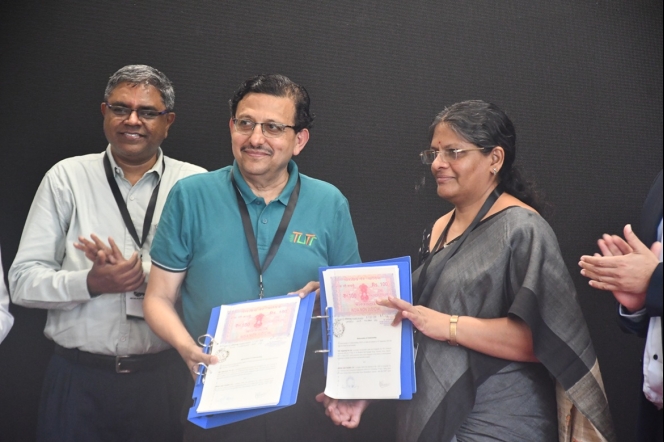
Larsen & Toubro (L&T) has signed a Memorandum of Understanding with TuTr Hyperloop, an IIT Madras-incubated deep-tech startup, to develop and deploy next-generation mobility infrastructure in India.
The agreement creates a framework for L&T and TuTr Hyperloop to collaborate on Linear Induction Motor-based propulsion systems, vacuum tube structures, pressure management systems, civil engineering works, electrical infrastructure, signalling and telecommunications integration.
Project-specific agreements will follow to define execution terms across freight logistics, port connectivity and industrial transit applications. The technical roadmap aims to progress from linear induction systems toward magnetic levitation and vacuum-based transportation networks.
The partnership combines L&T's engineering, procurement and construction capabilities with TuTr Hyperloop's electromagnetic propulsion research to assess commercial viability, conduct technical feasibility studies and engage prospective customers for hyperloop transit projects in India.
S V Desai, Whole-Time Director and Senior Executive VP of Infrastructure, L&T, said, "Hyperloop represents an exciting frontier in next-generation mobility, with the potential to redefine the movement of people and goods. Its innovative propulsion technology and low-friction environment enable faster transit, improved logistics efficiency, reduced energy consumption and lower emissions. Translating such technological innovation into practical deployment requires robust engineering, scalable infrastructure and close collaboration across the ecosystem. Our partnership with TuTr Hyperloop is a step in that direction."
Prof. Satya Chakravarthy, Professor, IIT Madras, said, "The transition of advanced mobility technologies from research and development to real-world deployment requires strong collaboration between academia, technology developers and industry. This partnership between TuTr Hyperloop and L&T brings together complementary strengths that can help address the engineering and infrastructure challenges involved in scaling next-generation transportation systems. It is an encouraging step towards translating indigenous innovation into practical, deployable solutions for India."
Dr Aravind S Bharadwaj, Co-Founder and CEO, TuTr Hyperloop, said, "At TuTr Hyperloop, our focus is on developing indigenous mobility technologies that can address real-world transportation and logistics challenges. Our collaboration with L&T brings together our capabilities in electromagnetic propulsion, advanced mobility systems and technology development with L&T’s extensive engineering and infrastructure execution expertise. Together, we aim to work on commercialisation these technologies."
Axalta Names Redefined As 2027 Global Automotive Colour Of The Year
- By MT Bureau
- October 14, 2026
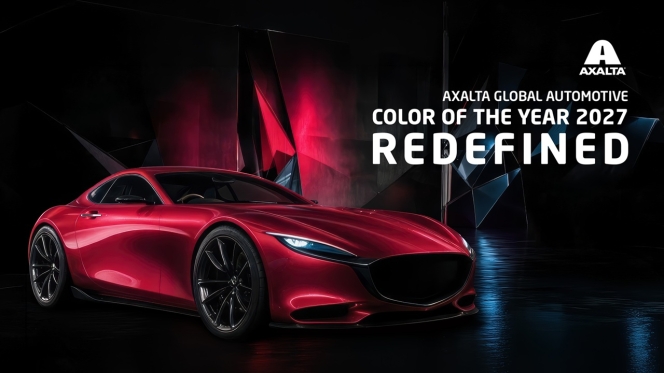
Coatings manufacturer Axalta Coating Systems has introduced Redefined, a ruby-red finish, as its 2027 Global Automotive Colour of the Year during the Automechanika exhibition in Frankfurt.
The finish incorporates pigment and effect technology designed to create depth and light reflection across vehicle body panels. Redefined marks an evolution of the red hue introduced with Radiant Red, Axalta's initial Colour of the Year selection 13 years ago. The development reflects market research into consumer preferences for vehicle personalisation and colour depth across global automotive markets.
Axalta's colour formulation teams utilise market trends and coating science to develop manufacturable formulations for global original equipment manufacturers and refinish networks. The 2027 selection is structured for application across multiple vehicle segments and production lines.
Matthew Boland, Vice-President of Global Refinish Technology, Axalta, said, "Redefined represents where we see automotive colour going, expressive and individual, but still refined and timeless. The deepness of the ruby tone combined with its luminosity and depth creates a colour that comes alive with the vehicle. It's a great example of how we can take a familiar colour and use the art and science of coatings to give it an entirely new perspective."
Hyundai Motor Group To Invest $15.5 Billion In India By 2032
- By MT Bureau
- October 13, 2026
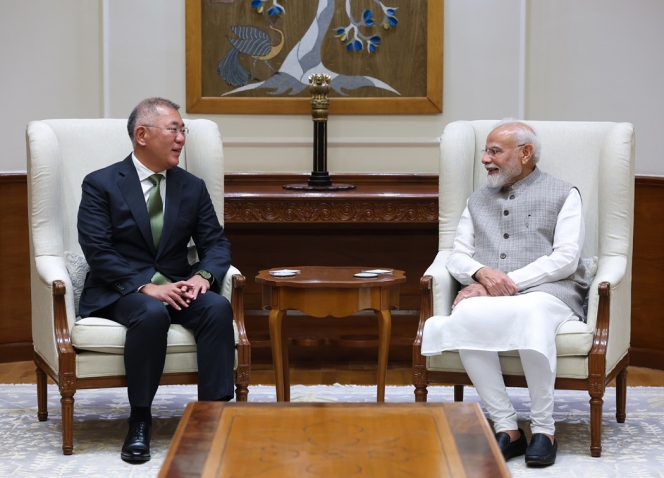
South Korean automotive major Hyundai Motor Group has announced a USD 15.5 billion investment plan for India from 2026 through 2032. The strategy was outlined during a meeting between Indian Prime Minister Narendra Modi and Hyundai Motor Group Executive Chair Euisun Chung at the Prime Minister’s Office in New Delhi.
To execute the 7-year plan, Hyundai Motor Group will establish a dedicated investment entity in India to manage capital allocation across manufacturing expansion, research and development, supply chain localisation and mobility services.
The investment includes an allocation of approximately USD 700 million to expand the Group's Indian R&D centre and build a vehicle testing track facility. Manufacturing expansion will focus on scaling production capacity across Hyundai Motor India and Kia India to support domestic sales and export operations.
At present, the Group maintains an annual production capacity exceeding 1.4 million vehicles in India across Hyundai facilities in Chennai (824,000 units) and Pune (170,000 units), alongside Kia India's Anantapur plant (431,000 units).
The investment strategy also targets local component sourcing, electric vehicle charging infrastructure, specialised vehicle financing, end-of-life vehicle recycling and startup investments across India's automotive sector.
"India remains one of Hyundai Motor Group’s most important and strategic markets globally. The past 30 years have been defined by our commitment to India. This investment reaffirms our commitment to India for the next 30 years and beyond. Through this investment, we will create more employment opportunities and work together with our partners and stakeholders to support India’s continued industrial development," said Chung.
- GreenCell Mobility
- Eversource Capital
- Impact Fund Denmark
- International Finance Corporation
- British International Investment
- Tata Capital
- Devndra Chawla
- Dhanpal Jhaveri
- Lars Bo Bertram
GreenCell Mobility Secures INR 3.3 Billion Investment From Impact Fund Denmark
- By MT Bureau
- October 13, 2026
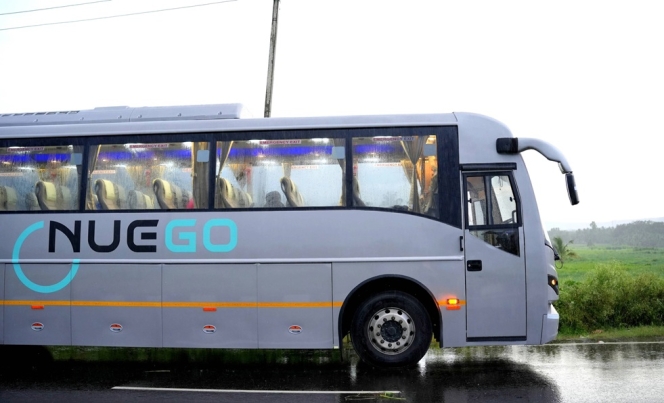
Electric bus operator GreenCell Mobility, a portfolio company of Eversource Capital, has secured an equity investment of INR 3.3 billion from Impact Fund Denmark. The capital will support the deployment of approximately 4,500 electric buses, bringing GreenCell's total fleet to over 5,000 e-buses across 105 cities in India.
The funding supports GreenCell Mobility's expanding order book across intra-city municipal transport and intercity routes. The platform operates as an original equipment manufacturer-agnostic operator, managing bus procurement, depot charging infrastructure and fleet maintenance contracts under public-private partnerships and private operations.
The investment joins existing institutional backers of GreenCell, including the International Finance Corporation, British International Investment and Tata Capital, as the company expands its operational footprint across urban transport corridors in India.
Dhanpal Jhaveri, CEO, Eversource Capital, said, "Electric public mobility is moving from an emerging opportunity to an investable infrastructure asset class in India. GreenCell was created with that conviction – to build the operating capabilities and institutional scale needed to build an enduring business. The equity investment from IFD demonstrates the depth of long-term institutional capital now backing GreenCell Mobility. The next phase is about putting that capital to work with discipline – expanding the business, deepening its capabilities and creating long-term value as India transitions to electric mobility."
Devndra Chawla, MD and CEO, GreenCell Mobility, said, "We welcome IFD as a shareholder and value the continued confidence of Eversource, IFC, BII and Tata Capital as we take GreenCell forward. We have established a strong presence across both intra-city and intercity transportation, with the operating experience to manage increasingly large and complex deployment. Our focus is on executing our order book with rigour, strengthening service delivery and ensuring that the organisation keeps pace with the size and complexity of our operations. This equity investment gives us greater headroom to accelerate our plans while maintaining the standards of reliability, efficiency and customer experience that are fundamental to our business."
Lars Bo Bertram, CEO of Impact Fund Denmark, said, "India is a central market for Impact Fund Denmark. GreenCell is a strong investment opportunity in a rapidly growing market, while also addressing one of India’s major challenges air pollution. Scaling electric transportation can contribute to cleaner cities and accelerate India’s green transition."
Comments (0)
ADD COMMENT