

IDFC FIRST Bank Launches Accelerator Programme With BITS Pilani For Climate And Health Startups
- By MT Bureau
- September 03, 2026

IDFC FIRST Bank has launched an accelerator programme in collaboration with the Pilani Innovation & Entrepreneurship Development Society (PIEDS) at BITS Pilani. This initiative operates under the IGNITE startup incubation programme, which is managed by the bank’s CSR division, FIRST IMPACT. The partnership is designed to foster enterprises that address critical health and environmental challenges.
The programme will provide catalytic grants, incubation, acceleration, mentorship and ecosystem connections to nurture purpose-driven ventures. It aims to strengthen business and investment readiness while promoting sustainable, high-impact solutions. Eight startups from across India have been selected to participate, focusing on climate technology, carbon reduction and removal, AI and machine learning-based healthcare diagnostics, medical devices and assistive technologies.
These selected startups will receive mentorship, business guidance, access to industry experts and investors and performance-linked grants of up to INR 2,500,000 each. The initiative seeks to scale innovative solutions for carbon sustainability and healthcare accessibility. It is also expected to contribute to employment generation and broader sustainable development goals within the country.
Saptarshi Bapari, Head, Investor Relations and ESG, said, “India is witnessing a remarkable wave of entrepreneurship, with innovators building solutions that are shaping a more sustainable, inclusive and resilient future. What many early-stage startups need is the right support at the right time to turn promising ideas into scalable solutions that can create meaningful impact. Through the IGNITE Social Incubation Program, we are supporting startups working in healthcare and climate sustainability, two areas that are critical to the well-being of our communities and the future of our planet. Our partnership with BITS Pilani combines funding, mentorship and access to a strong innovation ecosystem, helping entrepreneurs accelerate their growth and bring their ideas to life. We hope this initiative empowers founders to scale their solutions, reach more people and create lasting positive impact at scale.”
Prof V Ramgopal Rao, Vice-Chancellor, BITS Pilani, said, “BITS Pilani has spent five decades building an entrepreneurial ecosystem, with impact across all sectors and geographies. We are excited to launch IGNITE to deliver measured community impact across Health and Climate – partnering with IDFC FIRST Bank allows us to apply that discipline to two sectors where India's need is most urgent.”
Intangles Study Exposes Risky Driving Behaviour Across 598 Indian School Buses
- By MT Bureau
- October 16, 2026
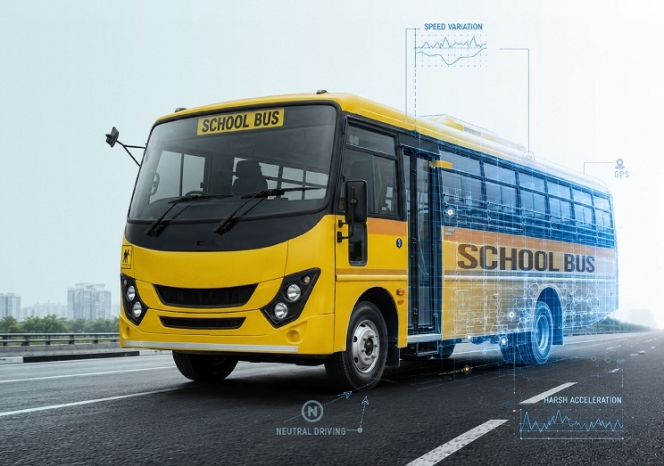
A recent study by Intangles, a global AI-powered prescriptive analytics firm focused on commercial fleets and mobility analytics, examined school bus safety across India and found that one in five of the vehicles analysed had recorded at least one over-speeding incident. The research covered 598 school buses in 61 cities over a six-month period during 2026, forming part of the company’s Interesting Angles Episode 2 report titled Beyond the Rulebook. More than 75,000 flagged driving events were assessed across four behaviours: over-speeding, hard braking, harsh acceleration and coasting.
Regional contrasts proved striking. In Delhi, four out of five buses analysed logged over-speeding incidents, compared with the national ratio of one in five. Maharashtra also raised concerns, with harsh acceleration events occurring at six times the national average. The report further identified 116 buses that triggered over-speeding alerts every two to three days, averaging roughly 79 kmph during those instances, well above prescribed limits. Such findings underscore the value of continuous driving behaviour monitoring alongside mandatory speed governors and standard GPS tracking.
Hard braking proved the most common flagged behaviour, representing 81.5 percent of all safety events. Each bus averaged 126 flagged events over six months, including about 103 hard braking incidents, or nearly one every two school days. The study described a ‘Bell Effect’, where hard braking rose sharply between 7 AM and 8 AM across regions, coinciding with the morning commute. While no direct cause was established, the pattern suggests operational pressures such as congestion, tight schedules and the race to reach school on time may contribute.
Comparisons between school and city buses revealed sharp differences. Harsh acceleration stood at 4.6 percent versus 1.8 percent, hard braking at 81.5 percent versus 38.9 percent and coasting at 2.9 percent versus 0.4 percent, amounting to fourfold, threefold and ninefold gaps, respectively. In Maharashtra, harsh acceleration made up 30 percent of flagged events against a 5 percent national average, while Pune recorded 42 percent compared with Mumbai’s 15 percent, indicating that congestion alone may not explain aggressive acceleration.
The findings arrive as school transportation safety rules evolve. Maharashtra’s July 2026 regulations introduce seat belts, CCTV, live video access, GPS tracking, panic buttons, digital attendance and state monitoring integration. Nationally, Advanced Driver Assistance Systems are being phased into new buses and trucks between 2026 and 2028. Yet with older vehicles still operating, the study stresses strengthening safety practices within existing fleets.
Intangles maintains that driving behaviour monitoring, real-world trip data, cameras and structured driver coaching can help schools and operators spot unsafe patterns and take corrective action. Integrating these tools with existing requirements may improve accountability and visibility in daily school transportation. The analysis used proprietary algorithms to assess event frequency, timing and geography, and its findings reflect observed behaviour within the study sample.
Anup Patil, CEO, Intangles, said, "School bus safety is often measured by whether a vehicle meets prescribed regulations, from speed governors and GPS tracking to onboard safety equipment. But compliance does not necessarily tell us how safely a child is being driven. Our analysis found recurring instances of speeding and hard braking across school buses, with some of these behaviours occurring repeatedly during routine journeys. What is equally important is understanding the conditions in which these incidents occur.”
Vikram Melapudi, Chief AI Scientist, Intangles, said, “Schools and safety officers need greater visibility into real world driving behaviour so they can identify recurring risks, address unsafe practices and strengthen driver accountability. The focus must shift from simply checking whether a bus is compliant to continuously assessing how safely it is being operated."
Stellantis Reaffirms India Plans With INR 40 Billion Investment, 12 Product Launches
- By MT Bureau
- October 15, 2026
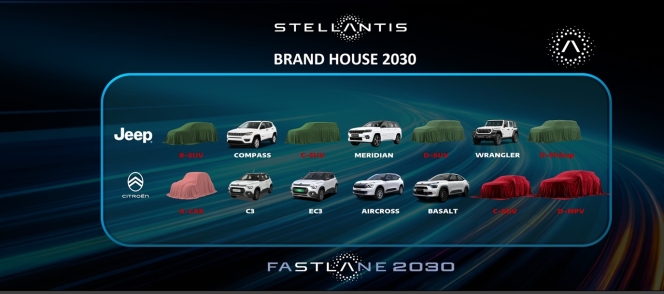
European automotive group Stellantis has announced an investment of approximately INR 40 billion (EUR 400 million) to scale its Indian operations under its FaSTLAne 2030 strategy. The commitment brings the manufacturer's cumulative capital deployment in India to INR 150 billion by 2030.
The roadmap outlines 12 vehicle introductions over the next three years across its Jeep and Citroen brands, comprising 7 new models and 5 major product upgrades. The releases will span the B, C and D SUV segments, alongside a multi-purpose vehicle, an A-segment car and a pickup truck.
The initial product under the expanded plan is scheduled for commercial launch in Q2 of 2027. Powertrain options will include internal combustion engines, hybrid, plug-in hybrid and battery-electric platforms, supported by a target local component sourcing level of 90 percent across its manufacturing plants in Ranjangaon, Thiruvallur and Hosur.
Tianshu Xin, COO, Stellantis Asia-Pacific Region, said, "India has a dual role for Stellantis: it is an important market that we intend to grow in, and an increasingly significant capability base for the region and the wider Group. India is a long-term commitment for us, not just a volume chase. Under FaSTLAne 2030, our region-led model gives the India team greater ownership of decisions, and the roadmap we are announcing today reflects our long-term conviction in this market. A stronger product cadence, a multi-energy technology approach and India’s capabilities across manufacturing, engineering, software and sourcing give us the foundation to build a larger and more competitive business here through 2030."
Shailesh Hazela, CEO & MD, Stellantis India, said, "Our commitment to India will be measured by what we put on the road. Having built a strong foundation over the years, our focus now shifts to scaling the business. Twelve launches across Jeep and Citroën over the next three years will significantly broaden our market participation and give Indian customers more choice across segments and powertrains, supported by deeper localisation and a stronger sales and service network. With fresh investment of approximately ₹5,000 crore, we are building greater scale, relevance and competitiveness in this market, while strengthening India’s role in Stellantis’ global operations."
The investment phase expands on the INR 110 billion previously deployed by Stellantis in India for manufacturing facilities, software development centres in Bengaluru, ICT hubs in Hyderabad and regional component export channels.
Indian Auto Sales See Record Growth Across Segments In Q2 FY2027
- By MT Bureau
- October 15, 2026

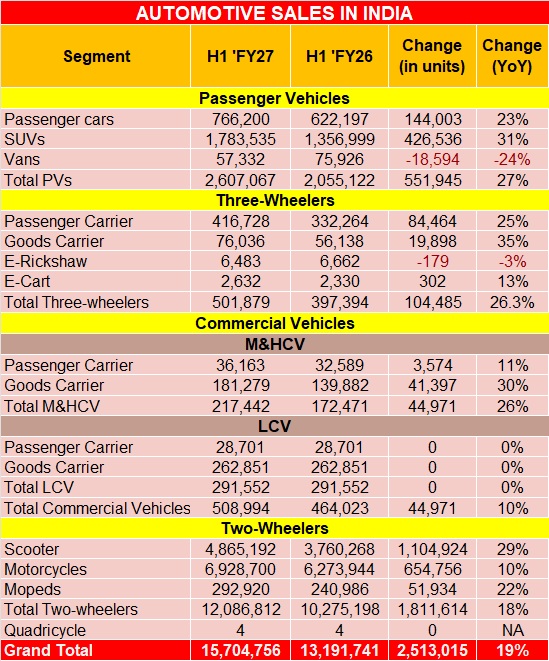
The Society of Indian Automobile Manufacturers, the apex body representing automakers across segments in the country, has released the wholesales data for Q2 FY2027, which saw record performance across passenger vehicles, commercial vehicles, three-wheelers and two-wheelers.
In Q2 FY2027, the passenger vehicle segment domestic sales reached 1.36 million units, up 30.7 percent YoY. Sports Utility Vehicles (SUVs) accounted for 68 percent of total passenger vehicle sales, recording a growth of 34.2 percent, while passenger car sales increased by 24.9 percent. Passenger vehicle exports declined by 5.2 percent to 229,087 units, impacted by logistics constraints in West Asia and higher baseline comparison figures.
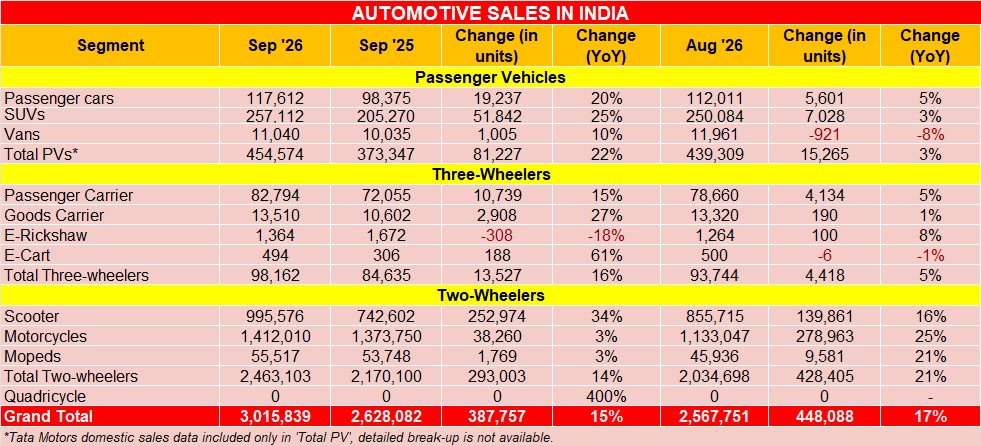
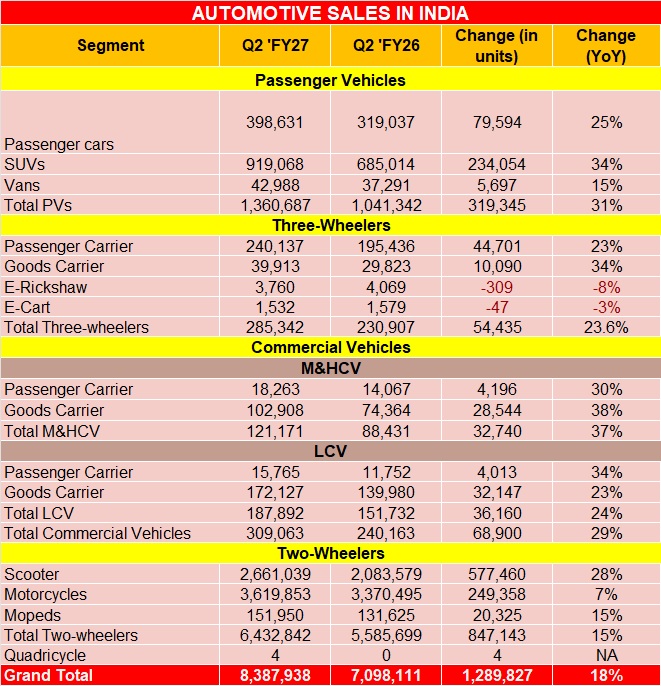
The two-wheeler segment posted domestic sales of 6.43 million units, registering a growth of 15.2 percent YoY. Scooter sales increased by 27.7 percent, while motorcycle sales rose by 7.4 percent. Two-wheeler exports reached a record Q2 total of 1.65 million units, marking an increase of 27.7 percent over the same period last year.
In the three-wheeler category, domestic sales grew by 23.6 percent to 285,342 units, driven by demand for cargo configurations and electric L5 vehicles. Three-wheeler exports reached a record Q2 total of 161,060 units, representing a 30.4 percent increase. The commercial vehicle segment recorded domestic sales of 309,063 units, marking a growth of 28.7 percent, while commercial vehicle exports rose by 72.5 percent to exceed 41,416 units, supported by infrastructure spending and fleet replacement demand.
Shenu Agarwal, President, SIAM, said, "The Indian automotive industry delivered a strong performance in the first half of FY2026-27, following a robust second quarter and a strong September 2026. This stellar performance across all segments of the automobile industry has been supported by improved affordability following GST 2.0, resilient rural and urban demand, healthy freight movement, infrastructure-led economic activity, and a gradual replacement cycle across vehicle segments. The electric vehicle ecosystem also continues to mature with multiple offerings, improving charging infrastructure and supportive policy measures. At the same time, alternative fuel technologies are witnessing increasing acceptance and are expected to play an important role in India's sustainable mobility transition. Industry looks forward to the festive season for the continued momentum while remaining cautiously optimistic due to prevailing geo-economic uncertainties. Continued investments in infrastructure, sustained economic growth, and rising adoption of cleaner and more efficient mobility solutions are expected to support industry growth through the second half of 2026-27."
- FADA Academy
- Automotive Skills Development Council
- ASDC
- Ashok Auto Sales
- Manoram Bajaj Group
- Autograd Regional Skill Development Centre
- C S Vigneshwar
FADA Academy, ASDC Open First Joint Training Centre In Agra
- By MT Bureau
- October 15, 2026
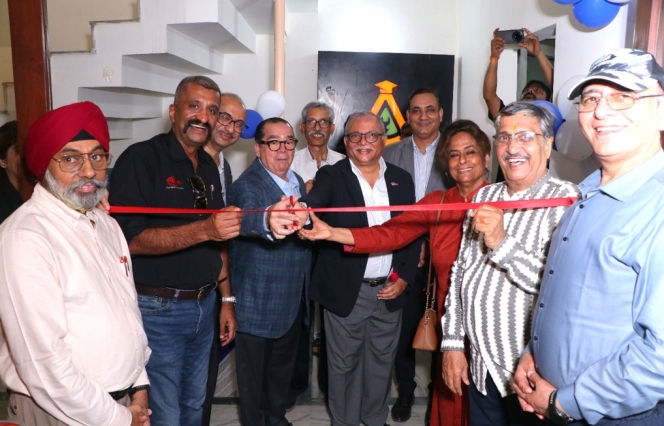
FADA Academy, in collaboration with the Automotive Skills Development Council (ASDC), has inaugurated its first joint skill development centre in Agra.
Located within the dealership facilities of Ashok Auto Sales and Manoram Bajaj Group, the Autograd Regional Skill Development Centre establishes a training framework situated directly inside automotive retail operations.
The facility aims to address workforce gaps in automotive retail by providing candidates with training matched to dealership job roles. The initial cohort at the centre consists of candidates undergoing instruction for the Service Advisor role, supported by participating dealerships representing brands including Bajaj Auto, TVS Motor Co, India Yamaha Motor and Tata Motors.
C S Vigneshwar, Chairman of FADA Academy & Research, said, "FADA Academy is committed to strengthening the capabilities of India's automotive retail workforce through industry-relevant education and training. The establishment of our first joint training centre with ASDC at Agra is an important milestone in this journey. By bringing training into the dealership environment, we can create a stronger connection between learning and actual workplace requirements. Our vision is to create local employment opportunities, support the talent requirements of dealerships and provide aspiring professionals with a foundation for long-term career progression within the automotive sector. We also want to ensure that candidates are not merely trained to secure a job, but are equipped to perform with confidence, deliver value to their employers and build long-term careers in the automotive industry. We hope this initiative will serve as a replicable model for dealership-led skill development across the country. The automotive sector is evolving rapidly, driven by new technologies, changing customer expectations and increasingly sophisticated dealership operations. This makes industry-aligned skill development more important than ever. The FADA Academy–ASDC joint training centre at Agra is a progressive initiative that brings structured training closer to the workplace and enables candidates to develop competencies relevant to their designated job roles."
The inauguration event was attended by Union Minister of State Prof. S. P. Singh Baghel, ASDC Chief Executive Officer Prasanna Pahade, FADA Uttar Pradesh Chairperson Sandeep Narain and leadership representatives from local dealer groups. The initiative forms part of a broader framework intended to be replicated across other regions to train dealership personnel.

Comments (0)
ADD COMMENT