

- Tata Motors Passenger Vehicles
- TMPV
- N Chandrasekaran
- Tata Motors Commercial Vehicles
- PB Balaji
- Jaguar Land Rover
- JLR
Tata Motors Passenger Vehicles Targets 20% Market Share By FY2031
- By MT Bureau
- July 08, 2026
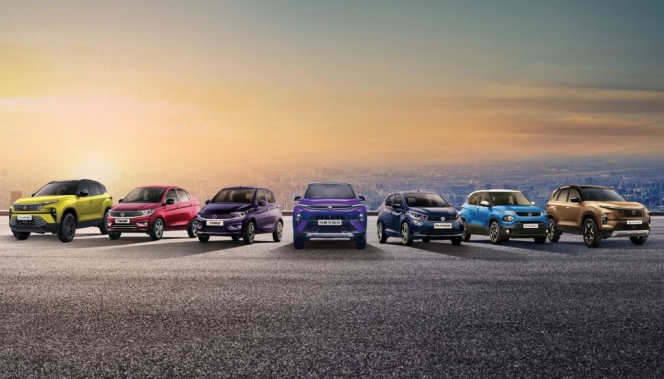
Tata Motors Passenger Vehicles has marked FY2026 as a pivotal year of transformation, emerging as an independent, pure-play personal mobility company following the successful demerger of its Commercial Vehicles business.
With Tata Motors split, the company renamed Tata Motors Passenger Vehicles, a move Chairman N Chandrasekaran described as ‘more than a structural milestone’ that positions it to build a differentiated, future-ready enterprise with a strong presence in India and a global footprint through Jaguar Land Rover.
In his address at the company’s 81st AGM on 8 July 2026, Chandrasekaran highlighted resilient performance amid global headwinds, including supply chain disruptions and geopolitical tensions in West Asia, as well as a temporary production pause at JLR due to a cyber incident. Despite these challenges, the India passenger vehicles business delivered robust results.
The domestic PV business achieved record sales of approximately 642,000 vehicles in FY2026, representing 15.3 percent growth – nearly double the industry average. India business revenue reached a record INR 584.65 billion, up 20.7 percent YoY, with EBITDA margins holding steady at around 7 percent and profit before tax (before exceptional items) rising approximately 33 percent. The company maintained a strong balance sheet with a net cash position of INR671 billion.
Over the past six years, the business has grown nearly 5x in volume and 6x in revenue, swinging from significant cash burn to a free cash flow surplus while elevating its market position from 4.8 percent share in FY2020 to 14.2 percent in Q1 FY2027, securing the No. 2 rank in the Indian passenger vehicle market. The company has sustained EV market leadership for seven consecutive years and surpassed 300,000 cumulative electric vehicle sales.
Chandrasekaran emphasised the success of the multi-powertrain strategy, noting strong demand for models such as the Nexon and Punch, the reintroduction of the iconic Sierra and outperformance in CNG vehicles. The company also re-entered the South African market as part of its international expansion.
Looking ahead, Tata Motors Passenger Vehicles has set clear ambitions for the decade to FY2031. The company aims to grow the business 10x, scaling to over 1.2 million annual sales, achieving 20 percent market share and attaining double-digit EBITDA margins. Plans include the launch of 6 new nameplates and more than 20 product refreshes, with EVs expected to contribute over 30 percent of sales volumes.
On the JLR front, despite a 21 percent revenue decline to GBP 22,911 million due to external disruptions, the business demonstrated operational resilience and progress on next-generation models.
A leadership transition saw PB Balaji take over as CEO. For the year ahead, JLR is focusing on modern luxury, North American growth and customer personalisation, supported by new vehicle launches.
On a consolidated basis, the company reported revenue of INR 3,355 billion and PBT (before exceptional items) of INR 25.19 billion.
Beyond financials, the company continues to advance sustainability and community initiatives, reaching over 1.8 million citizens through CSR efforts and aligning with the Tata Group’s Project Aalingana to achieve Net Zero by 2040, with electrification central to its strategy.
Chandrasekaran concluded with confidence for FY2027, citing a strong product pipeline, enhanced collaboration between TMPVL and JLR – including the new facility in Panapakkam, Tamil Nadu – and greater use of digital technologies and AI.
“Our ambition remains clear. To build trusted, aspirational and globally competitive mobility brands that connect meaningfully with customers,” he concluded.
Stellantis Reaffirms India Plans With INR 40 Billion Investment, 12 Product Launches
- By MT Bureau
- October 15, 2026
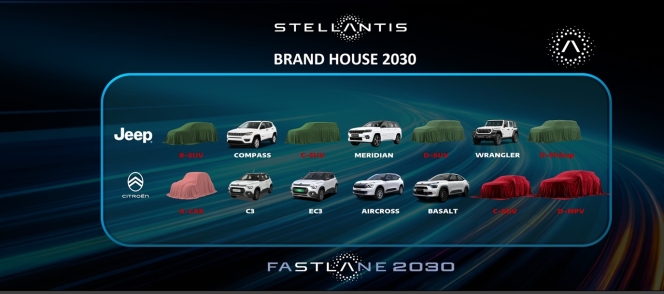
European automotive group Stellantis has announced an investment of approximately INR 40 billion (EUR 400 million) to scale its Indian operations under its FaSTLAne 2030 strategy. The commitment brings the manufacturer's cumulative capital deployment in India to INR 150 billion by 2030.
The roadmap outlines 12 vehicle introductions over the next three years across its Jeep and Citroen brands, comprising 7 new models and 5 major product upgrades. The releases will span the B, C and D SUV segments, alongside a multi-purpose vehicle, an A-segment car and a pickup truck.
The initial product under the expanded plan is scheduled for commercial launch in Q2 of 2027. Powertrain options will include internal combustion engines, hybrid, plug-in hybrid and battery-electric platforms, supported by a target local component sourcing level of 90 percent across its manufacturing plants in Ranjangaon, Thiruvallur and Hosur.
Tianshu Xin, COO, Stellantis Asia-Pacific Region, said, "India has a dual role for Stellantis: it is an important market that we intend to grow in, and an increasingly significant capability base for the region and the wider Group. India is a long-term commitment for us, not just a volume chase. Under FaSTLAne 2030, our region-led model gives the India team greater ownership of decisions, and the roadmap we are announcing today reflects our long-term conviction in this market. A stronger product cadence, a multi-energy technology approach and India’s capabilities across manufacturing, engineering, software and sourcing give us the foundation to build a larger and more competitive business here through 2030."
Shailesh Hazela, CEO & MD, Stellantis India, said, "Our commitment to India will be measured by what we put on the road. Having built a strong foundation over the years, our focus now shifts to scaling the business. Twelve launches across Jeep and Citroën over the next three years will significantly broaden our market participation and give Indian customers more choice across segments and powertrains, supported by deeper localisation and a stronger sales and service network. With fresh investment of approximately ₹5,000 crore, we are building greater scale, relevance and competitiveness in this market, while strengthening India’s role in Stellantis’ global operations."
The investment phase expands on the INR 110 billion previously deployed by Stellantis in India for manufacturing facilities, software development centres in Bengaluru, ICT hubs in Hyderabad and regional component export channels.
Indian Auto Sales See Record Growth Across Segments In Q2 FY2027
- By MT Bureau
- October 15, 2026

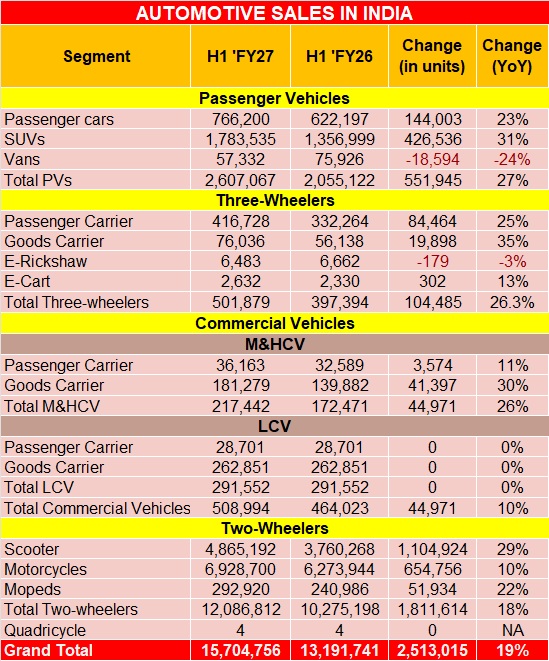
The Society of Indian Automobile Manufacturers, the apex body representing automakers across segments in the country, has released the wholesales data for Q2 FY2027, which saw record performance across passenger vehicles, commercial vehicles, three-wheelers and two-wheelers.
In Q2 FY2027, the passenger vehicle segment domestic sales reached 1.36 million units, up 30.7 percent YoY. Sports Utility Vehicles (SUVs) accounted for 68 percent of total passenger vehicle sales, recording a growth of 34.2 percent, while passenger car sales increased by 24.9 percent. Passenger vehicle exports declined by 5.2 percent to 229,087 units, impacted by logistics constraints in West Asia and higher baseline comparison figures.
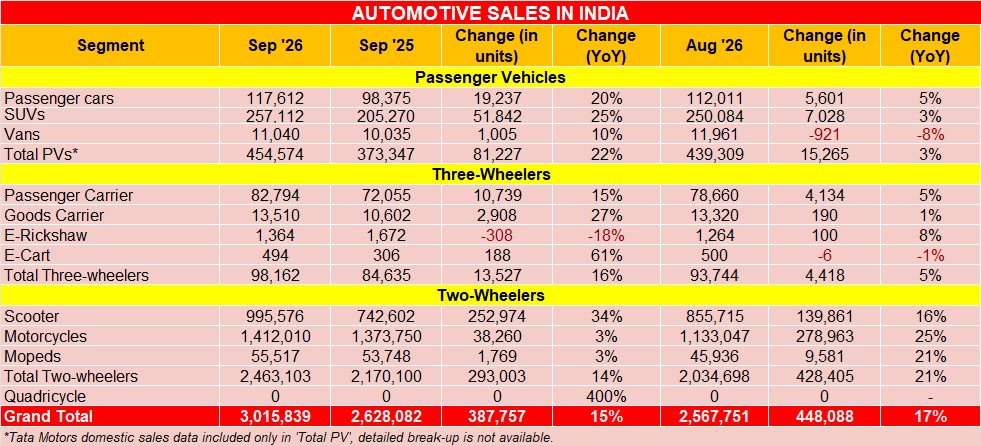
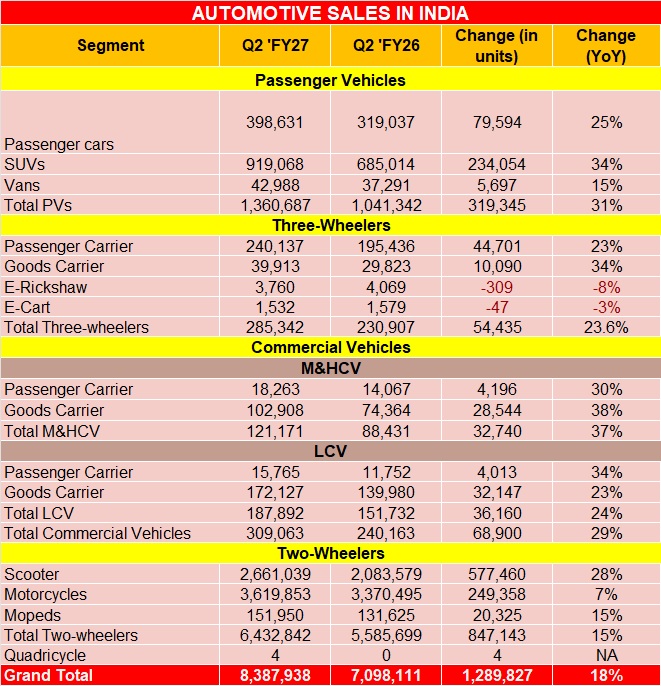
The two-wheeler segment posted domestic sales of 6.43 million units, registering a growth of 15.2 percent YoY. Scooter sales increased by 27.7 percent, while motorcycle sales rose by 7.4 percent. Two-wheeler exports reached a record Q2 total of 1.65 million units, marking an increase of 27.7 percent over the same period last year.
In the three-wheeler category, domestic sales grew by 23.6 percent to 285,342 units, driven by demand for cargo configurations and electric L5 vehicles. Three-wheeler exports reached a record Q2 total of 161,060 units, representing a 30.4 percent increase. The commercial vehicle segment recorded domestic sales of 309,063 units, marking a growth of 28.7 percent, while commercial vehicle exports rose by 72.5 percent to exceed 41,416 units, supported by infrastructure spending and fleet replacement demand.
Shenu Agarwal, President, SIAM, said, "The Indian automotive industry delivered a strong performance in the first half of FY2026-27, following a robust second quarter and a strong September 2026. This stellar performance across all segments of the automobile industry has been supported by improved affordability following GST 2.0, resilient rural and urban demand, healthy freight movement, infrastructure-led economic activity, and a gradual replacement cycle across vehicle segments. The electric vehicle ecosystem also continues to mature with multiple offerings, improving charging infrastructure and supportive policy measures. At the same time, alternative fuel technologies are witnessing increasing acceptance and are expected to play an important role in India's sustainable mobility transition. Industry looks forward to the festive season for the continued momentum while remaining cautiously optimistic due to prevailing geo-economic uncertainties. Continued investments in infrastructure, sustained economic growth, and rising adoption of cleaner and more efficient mobility solutions are expected to support industry growth through the second half of 2026-27."
- FADA Academy
- Automotive Skills Development Council
- ASDC
- Ashok Auto Sales
- Manoram Bajaj Group
- Autograd Regional Skill Development Centre
- C S Vigneshwar
FADA Academy, ASDC Open First Joint Training Centre In Agra
- By MT Bureau
- October 15, 2026
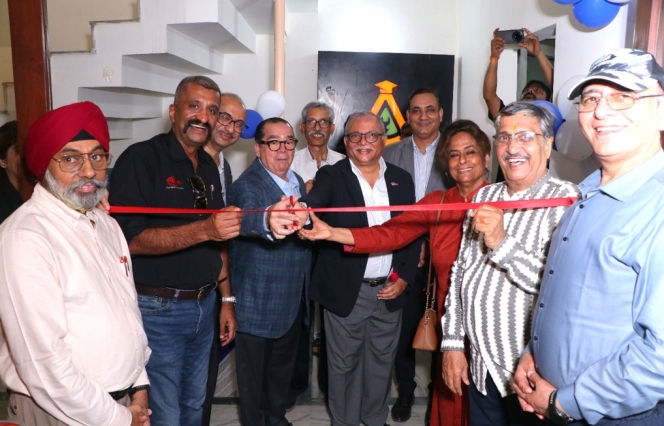
FADA Academy, in collaboration with the Automotive Skills Development Council (ASDC), has inaugurated its first joint skill development centre in Agra.
Located within the dealership facilities of Ashok Auto Sales and Manoram Bajaj Group, the Autograd Regional Skill Development Centre establishes a training framework situated directly inside automotive retail operations.
The facility aims to address workforce gaps in automotive retail by providing candidates with training matched to dealership job roles. The initial cohort at the centre consists of candidates undergoing instruction for the Service Advisor role, supported by participating dealerships representing brands including Bajaj Auto, TVS Motor Co, India Yamaha Motor and Tata Motors.
C S Vigneshwar, Chairman of FADA Academy & Research, said, "FADA Academy is committed to strengthening the capabilities of India's automotive retail workforce through industry-relevant education and training. The establishment of our first joint training centre with ASDC at Agra is an important milestone in this journey. By bringing training into the dealership environment, we can create a stronger connection between learning and actual workplace requirements. Our vision is to create local employment opportunities, support the talent requirements of dealerships and provide aspiring professionals with a foundation for long-term career progression within the automotive sector. We also want to ensure that candidates are not merely trained to secure a job, but are equipped to perform with confidence, deliver value to their employers and build long-term careers in the automotive industry. We hope this initiative will serve as a replicable model for dealership-led skill development across the country. The automotive sector is evolving rapidly, driven by new technologies, changing customer expectations and increasingly sophisticated dealership operations. This makes industry-aligned skill development more important than ever. The FADA Academy–ASDC joint training centre at Agra is a progressive initiative that brings structured training closer to the workplace and enables candidates to develop competencies relevant to their designated job roles."
The inauguration event was attended by Union Minister of State Prof. S. P. Singh Baghel, ASDC Chief Executive Officer Prasanna Pahade, FADA Uttar Pradesh Chairperson Sandeep Narain and leadership representatives from local dealer groups. The initiative forms part of a broader framework intended to be replicated across other regions to train dealership personnel.
- Larsen & Toubro
- L&T
- TuTr Hyperloop
- IIT Madras
- S V Desai
- Prof. Satya Chakravarthy
- Dr Aravind S Bharadwaj
L&T Inks Agreement With TuTr Hyperloop To Develop Next-Generation Mobility Systems
- By MT Bureau
- October 14, 2026
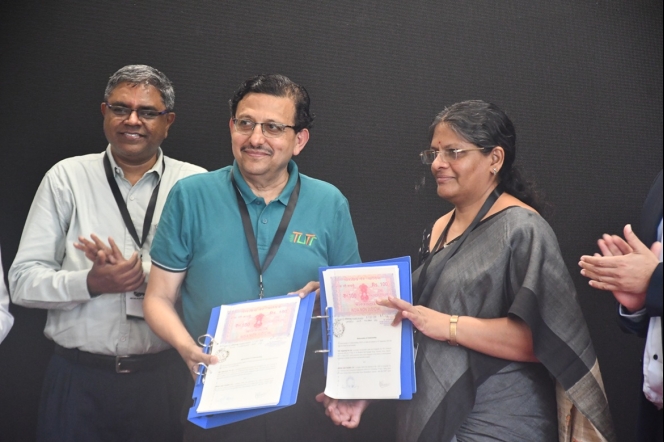
Larsen & Toubro (L&T) has signed a Memorandum of Understanding with TuTr Hyperloop, an IIT Madras-incubated deep-tech startup, to develop and deploy next-generation mobility infrastructure in India.
The agreement creates a framework for L&T and TuTr Hyperloop to collaborate on Linear Induction Motor-based propulsion systems, vacuum tube structures, pressure management systems, civil engineering works, electrical infrastructure, signalling and telecommunications integration.
Project-specific agreements will follow to define execution terms across freight logistics, port connectivity and industrial transit applications. The technical roadmap aims to progress from linear induction systems toward magnetic levitation and vacuum-based transportation networks.
The partnership combines L&T's engineering, procurement and construction capabilities with TuTr Hyperloop's electromagnetic propulsion research to assess commercial viability, conduct technical feasibility studies and engage prospective customers for hyperloop transit projects in India.
S V Desai, Whole-Time Director and Senior Executive VP of Infrastructure, L&T, said, "Hyperloop represents an exciting frontier in next-generation mobility, with the potential to redefine the movement of people and goods. Its innovative propulsion technology and low-friction environment enable faster transit, improved logistics efficiency, reduced energy consumption and lower emissions. Translating such technological innovation into practical deployment requires robust engineering, scalable infrastructure and close collaboration across the ecosystem. Our partnership with TuTr Hyperloop is a step in that direction."
Prof. Satya Chakravarthy, Professor, IIT Madras, said, "The transition of advanced mobility technologies from research and development to real-world deployment requires strong collaboration between academia, technology developers and industry. This partnership between TuTr Hyperloop and L&T brings together complementary strengths that can help address the engineering and infrastructure challenges involved in scaling next-generation transportation systems. It is an encouraging step towards translating indigenous innovation into practical, deployable solutions for India."
Dr Aravind S Bharadwaj, Co-Founder and CEO, TuTr Hyperloop, said, "At TuTr Hyperloop, our focus is on developing indigenous mobility technologies that can address real-world transportation and logistics challenges. Our collaboration with L&T brings together our capabilities in electromagnetic propulsion, advanced mobility systems and technology development with L&T’s extensive engineering and infrastructure execution expertise. Together, we aim to work on commercialisation these technologies."

Comments (0)
ADD COMMENT