

- Bharat Mobility Global Expo 2025
- Tata Motors Passenger Vehicles
- Tata Passenger Electric Mobility
- Tata Motors
- Better Always
Tata Motors Unveils ‘Future Of Mobility’ At Bharat Mobility Global Expo 2025
- By MT Bureau
- January 17, 2025
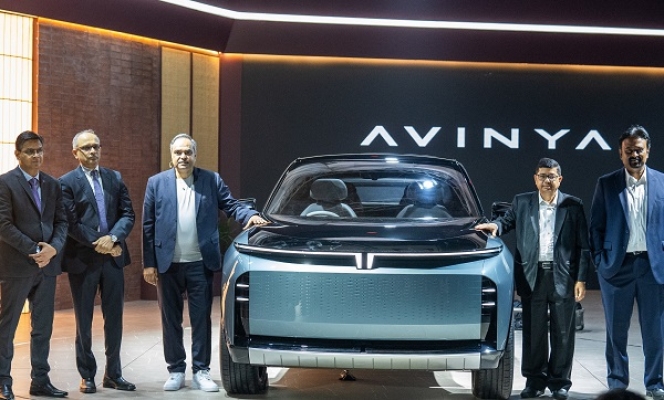
Tata Motors, India’s largest auto and mobility solutions company, displayed its range of ultra-modern vehicles, cutting-edge concepts advanced aggregates and intelligent digital solutions at the Bharat Mobility Global Expo 2025, setting new benchmarks in innovation, connectivity and sustainability. These exhibits are on display up to 22 January 2025, in Hall No 1 at the Bharat Mandapam (Pragati Maidan), New Delhi.
Tata Motors presented its ambition for revolutionising every aspect of personal mobility and business transportation with the largest exhibition of more than 50 displays, which included 32 aspirational, future-ready passenger and commercial vehicles. Tata Motors unveiled its next-generation green mobility solutions, which range from small cars and strong SUVs to agile micro trucks and tough heavy-duty carriers. These solutions are intended to improve safety, provide outstanding performance and completely transform the customer experience. In addition to providing visitors with 18 immersive experiences and interactive displays, the organisation showcased 20 intelligent, cutting-edge solutions to improve safety, productivity and customer experience. The company also unveiled 'Better Always' as a new motto for Tata Motors Commercial Vehicles, signifying the company's dedication to ongoing development and enhancement.
N Chandrasekaran, Executive Chairman, Tata Sons and Chairman, Tata Motors said, “For eight decades, Tata Motors has been at the forefront of shaping the future of mobility, pioneering advancements in safety, design, connectivity and sustainability. Our relentless pursuit of excellence is fuelled by a deep commitment to creating value for customers, communities and our nation. The rapid shift toward green energy and mobility, an irreversible global megatrend, has made the need for clean, zero-emission vehicles more urgent than ever. We are leading this revolution in India with smart, holistic solutions delivering exceptional performance, reliability and convenience. Our customers have ready access to an expansive range of cleaner, greener mobility options for both personal and commercial use. At the Bharat Mobility Global Expo 2025, we are proud to unveil more than 50 next-generation vehicles, visionary concepts and intelligent solutions that redefine the future of mobility across segments and applications. Rooted in our legacy of trust, innovation and responsibility, we will continue to lead the way – creating value for customers, driving the automotive industry and advancing our nation's progress with purpose and determination."
Girish Wagh, Executive Director, Tata Motors, said, “Today marks a defining moment in Tata Motors Commercial Vehicles' journey as we introduce our new mantra, 'Better Always’, embodying our unwavering dedication to driving growth and success, for our customers and for our nation. At the Expo, we are unveiling a bold new era in mobility, showcasing 14 smart vehicles, all integrated with ADAS, alongside six cutting-edge intelligent solutions that provide real-time performance insights, and four advanced aggregates. Accelerating our aspiration towards a greener future, we are presenting four zero-emission electric vehicles, ranging from mini trucks and pickups to intermediate and heavy trucks, alongside buses designed for comfortable, long-distance travel. We are redefining last-mile mobility with the launch of the all-new Tata Ace Pro, available in multiple powertrain options, and the Intra EV, India’s most advanced electric pickup, setting new benchmarks for performance and sustainability. Our next-generation hydrogen-powered Prima Truck is set to revolutionise long-haul trucking. We’re showcasing the Prima deep mining tipper with state-of-the-art technologies. In addition, on display are an array of green mobility solutions powered by a variety of decarbonising technologies – Hydrogen, Electric, Natural gas and Flex-fuel. With relentless innovation and agility, we will continue to redefine the future of mobility with sustainable, intelligent and cutting-edge solutions – setting new industry standards and creating a lasting, positive impact on the environment.”
Shailesh Chandra, Managing Director, Tata Motors Passenger Vehicles and Tata Passenger Electric Mobility, said, "We are honoured to spearhead India’s journey toward zero-emission mobility. With over 200,000 Tata EVs already covering more than 5 billion kilometres on Indian roads, we’ve cut down 700,000 tonnes of CO2 emission. Tata Motors has also crossed the remarkable milestone of 6 million car sales, a testament to the success of our customer centric, multi-powertrain strategy. But this is just the beginning. With relentless innovation and a deep commitment to sustainability, Tata Motors is determined to accelerate the transformation towards a future that is greener, safer and full of boundless opportunities for all. At the Bharat Mobility Global Expo 2025, we are proud to unveil our ‘Future of Mobility’ portfolio, showcasing the greenest, smartest and most advanced suite of mobility solutions. Our display embodies a holistic approach blending innovative design and smart engineering, with a profound understanding of customer needs. Today, we are thrilled to announce the return of a legend – the All-New Tata Sierra – reimagined for a new era, ready to inspire and lead once again. Alongside, in a nation first gesture, we ‘summoned remotely’ the Harrier.ev, the most powerful and technologically advanced SUV from the Tata Motors stable. Furthermore, we presented the next chapter of automotive excellence with the Avinya X concept— a bold leap into the future of luxury mobility that expands on Avinya’s commitment to sustainability, innovation and well-being. These reveals mark not just milestones, but the beginning of a boundless journey towards a future driven by lifestyle, safety, sustainability and cutting-edge technology.”
- JSW MG Motor India
- MG Developer Program
- Nayan Technologies
- Technod8.AI
- LiveNSense
- LW3
- Smaartbrand by Acquink Solutions
- Fitsol
- Cautio
- Meta Materials Circular Market
- Anurag Mehrotra
- DPIIT
- Startup India
- JSW
- NCPI BHIM
- Jio
- Gulf Oil India
- TiE Delhi NCR
- iCreate
- Allianz Partners India
- TERI
- BSES Rajdhani Power Limited
- LICO Materials
- Pulse Energy
JSW MG Motor India Announces Winners Of 6th Edition Of MG Developer Program
- By MT Bureau
- October 09, 2026
JSW MG Motor India, one of the leading passenger vehicle manufacturers, has announced the eight winning startups selected for the 6th edition of the MG Developer Program.
The startup engagement initiative, centred on the theme 'Innovation in Automotive', evaluated over 130 applications before selecting the finalists for pilot deployment consideration.
The selected startups comprise Nayan Technologies, Technod8.AI, LiveNSense, LW3, Smaartbrand by Acquink Solutions, Fitsol, Cautio and Meta Materials Circular Market.
The chosen entities specialise in artificial intelligence (AI) platforms, industrial software, battery supply chain tracking, mobility intelligence, supply chain decarbonisation and automotive circular economy systems.
The winners will collaborate with the vehicle manufacturer and program partners to test and implement pilot projects across industrial operations, manufacturing, customer experience and mobility services.
Anurag Mehrotra, Managing Director, JSW MG Motor India, said, "We are entering an era where the boundaries between mobility, data, and artificial intelligence are rapidly converging. The next wave of transformation in the automotive industry will be driven by innovators who can connect these ecosystems and create solutions with real-world impact. Through the MG Developer Program, we are committed to providing startups with a platform to collaborate, experiment and scale breakthrough ideas. The winning startups of Season 6.0 represent some of the most promising innovations across automotive technology, sustainability, industrial intelligence, and mobility services. We look forward to partnering with them to explore pilot deployments and unlock new possibilities for the future of mobility."
The sixth season was conducted in partnership with DPIIT, Startup India, JSW, NCPI BHIM, Jio, Gulf Oil India, TiE Delhi NCR, iCreate, Allianz Partners India, TERI, BSES Rajdhani Power Limited, LICO Materials and Pulse Energy.
The program saw more than 40 startups shortlisted for presentations, with 18 reaching the final jury stage. Since its launch in 2019, the program has evaluated over 1,680 startup applications covering connected vehicles, electric mobility, artificial intelligence, and manufacturing technologies.
Cummins India Appoints Gbile Adewunmi As Managing Director
- By MT Bureau
- October 08, 2026

Cummins India has announced the appointment of Gbile Adewunmi as Managing Director and India Regional Leader, effective 1 November 2026. Adewunmi will assume the position alongside his current role as leader of Industrial Markets within Power Systems, where he will continue to direct business operations for the division.
In his current role as Vice-President, Power Systems Industrial Markets, Adewunmi oversees customer and partner operations across industrial segments, including mining. His work in the division has focused on hybrid-electric retrofit systems, mining technologies, and power solutions aimed at operational efficiency and emissions reduction.
Jenny Bush, President of Power Systems, Cummins, said, “Gbile is a respected global leader with deep experience across Cummins and a strong track record of delivering customer-focused growth and business performance. His enterprise perspective, ability to build high-performing teams and commitment to our customers make him exceptionally well positioned to lead Cummins India Limited and the India region while continuing to advance our Industrial Markets strategy.”
Adewunmi said, “I am honoured to take on this expanded role and to work alongside the talented teams across Cummins India, the India region and Industrial Markets. “India is a critical market for Cummins, and I look forward to partnering with our employees, customers and stakeholders to build on our strong foundation and continue powering a more prosperous world.”
Birla Carbon To Showcase Conductive Carbon Portfolio At Battery Show North America 2026
- By MT Bureau
- October 08, 2026
Birla Carbon is pushing deeper into speciality materials, positioning a suite of conductive carbon solutions aimed at tough applications that include next-generation batteries and other high-value conductive uses.
Within battery electrodes, conductive carbon creates the electron pathways that keep performance steady. Selecting the correct conductive additive can translate into quicker charging, stronger high-rate capability and a longer cycle life, while also making battery manufacturing more efficient. At The Battery Show North America 2026, Birla Carbon will put this portfolio on display. The event runs 12–15 October at Huntington Place in Detroit, Michigan, with the company located at Booth 3029.
Showcased products will include Conductex i conductive carbon black grades, Nanocyl carbon nanotubes and blend formulations combining carbon black with CNTs, all built for a broad spread of conductive applications. They offer high purity, leading conductivity and consistent dispersibility, while Conductex i grades additionally cut solvent and energy use during electrode production, bringing down customer costs. The additives address industry priorities such as charge acceptance, battery capacity, dry coating and solid-state, helping manufacturers keep pace with rising demands without giving up quality, consistency or dependable supply.
Shashank Awasthi, President, Speciality Materials, Birla Carbon, said, “Electrification is creating new performance demands across the materials value chain, and advanced carbon materials have an important role to play in meeting them. At Birla Carbon, we are combining our expertise in carbon materials with an expanding specialty portfolio to help customers address these evolving requirements. Established lithium-ion battery manufacturers need to showcase supply chain resilience, extended cycle life and ever-increasing fast charging requirements, which Birla Carbon’s portfolio enables. Next-generation cell technologies, like LMFP, sodium-ion, solid-state and metal-air, are rapidly improving by incorporating ConductexTM i carbon blacks and NanocylTM carbon nanotubes into their formulations.”
- FORVIA
- Anand Group
- Gabriel India
- Faurecia ANand Seating India
- Jaisal Singh
- Anjali Singh
- Martin Fischer
FORVIA, Anand Group Form JV For Automotive Seating In India
- By MT Bureau
- October 07, 2026
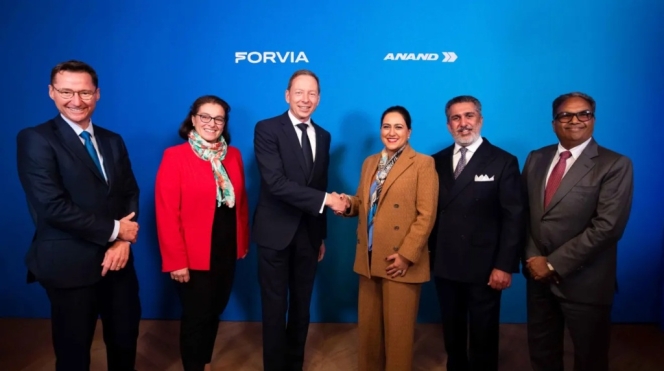
Automotive tier 1 suppliers FORVIA and Anand Group have established a new joint venture to manufacture seat frames and complete seats for the Indian automotive market.
The new entity, named Faurecia Anand Seating India, will be controlled by FORVIA with a 50 percent plus one share stake, while Gabriel India, Anand Group’s flagship listed firm, will hold 50 percent less one share.
The partnership aims to combine FORVIA’s seating technologies and engineering portfolio with Anand Group’s operational network and customer relationships with domestic automotive manufacturers.
The JV aims for a 10 percent market share in India over the next five years as part of its regional expansion strategy. The collaboration expands on an existing relationship between the two companies that began in 1991 in the clean mobility segment.
The joint venture will utilise localised manufacturing footprints to support supply chain, industrial and talent capabilities for supply contracts across Indian vehicle manufacturers.
Jaisal Singh, Vice-Chairman, Anand Group, said, "This partnership is a natural extension of Gabriel India’s transformation into a broader mobility solutions enterprise. As vehicle systems become more integrated and technology-intensive, the ability to participate across a wider spectrum of the automotive value chain assumes strategic importance. The venture strengthens our portfolio with a globally proven capability, while reinforcing our commitment to building scalable, technology-led businesses that create enduring value."
Anjali Singh, Executive Chairperson, Anand Group and Gabriel India, said, "At Anand, we have always believed that long-term relevance is built through thoughtful partnerships, technological excellence, and a deep understanding of customer needs. This venture strengthens our longstanding partnership with FORVIA, building on complementary strengths and a shared commitment to innovation. By bringing together FORVIA’s global expertise and Gabriel India’s strong market presence, it creates a platform that is both strategically significant and future-ready."
Martin Fischer, CEO, FORVIA, said, "When we unveiled our IGNITE strategy earlier this year, we highlighted India as a key growth driver for FORVIA. Following the award of our first complete-seat program a few months ago, today’s agreement marks another important milestone in our development in the country. Building on our long-standing relationship with Anand Group, the joint venture will help accelerate FORVIA Seating’s growth in India."
Comments (0)
ADD COMMENT