

- Tata Motors
- Tata Motors Passenger Vehicles
- Shailesh Chandra
- electric vehicles
- Sierra
- Richard Molyneux
Tata Motors Passenger Vehicles Targets 40% EV Market Share In FY2027
- By Nilesh Wadhwa
- August 13, 2026
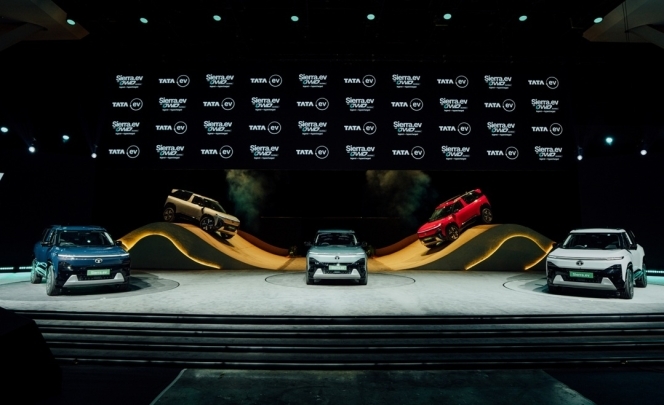
Tata Motors Passenger Vehicles, one of the leading automakers in the country, is charting a confident course for FY2027. The company is sees its multi-powertrain leadership, capacity flexibility and industry-outperformance ambitions to drive a strong H2 for fiscal 2027.
Shailesh Chandra, Managing Director and CEO, of Tata Motors Passenger Vehicles, struck a distinctly forward-looking tone in the company’s Q1 FY27 virtual conference, outlining a strategy built on sustained demand for alternative-energy vehicles, flexible manufacturing, product intensity and disciplined capital allocation even as the broader industry navigates inflationary and commodity headwinds.
He characterised the remainder of FY2027 as a period of continued outperformance relative to the passenger-vehicle industry. Tata Motors at 14.1 percent had already delivered growth roughly twice the industry average of 7.9 percent in FY2026 and a robust 45 percent in Q1 FY2027 as against the industry average of 25.9 percent.
The management expects this momentum to persist. Industry volumes are projected in the mid-double-digit range of 15-20 percent for the remainder of the year in some scenarios.
Tata Motors, on the other hand, is targeting sustained growth even if overall industry expansion moderates to single digits in the second half because of a high base effect from strong H2 FY2026 demand.
Inventory levels are meaningfully lower than a year earlier, creating scope for healthier retail offtake. Q2 is expected to be more challenging for the industry as a whole due to cost pressures, with the second half potentially tighter still for conventional passenger vehicles.
Chandra, however, intends to defend and expand market share through timely product refreshes, facelifts and new nameplates across both ICE and electric portfolios, while prioritising supply-side capacity increases. Waiting periods across the Tata Motors range currently stand at 4-6 weeks, reflecting healthy demand.
Hatchbacks continue to contribute around 15-20 percent of the mix, while SUVs remain the structural growth engine. Export plans include opening a significant new market next year, with a dual focus on ICE and EV products; recent export growth has been driven primarily by South Africa.
Alternative Energy Mix
The shift toward alternative powertrains is central to Chandra’s vision. Industry EV penetration has reached approximately 8 percent – the highest among passenger-vehicle markets – and is expected to climb toward 10 percent by end-FY2027.
Tata Motors’ own EV share of its portfolio has risen from around 38 percent and is targeted at upwards of 40 percent (for the remainder of the year), supported by strong customer acceptance. EV demand has jumped sharply (management noted a 3-4 times increase relative to February levels for the company), but supply remains the binding constraint rather than underlying demand. Chandra revealed that the strong demand for EVs versus supply-side constraints has led to waiting periods for EVs of around 4-6 weeks.
CNG demand is robust: industry CNG share stands near 22 percent, while Tata Motors’ mix is higher at around 27 percent. The outlook remains positive as the CNG station network expands from roughly 8,500 to 15,000-16,000 stations in the coming year. CAFÉ norms (particularly CAFÉ 3 and CAFÉ 4) will further accelerate the push toward alternative-energy vehicles; for OEMs with credible EV offerings, electrification is the most powerful compliance lever.
Sharing his perspective on hybrid technology, Chandra stated that its share in the overall PV segment has stabilised at a modest 2-2.5 percent share. Tata Motors remains ready to introduce hybrids if market conditions warrant, but current emphasis is clearly on CNG and pure electric.
In Q1 the combined CNG-plus-electric mix rose from 19-21 percent to 24 percent. Management is optimistic that EV volumes for the company could grow 70 percent in FY2027, even allowing for some high-base effects in the second half, with overall company growth of 10-15 percent still feasible.
Capacity, Cost Pressures and Capital Plans
For Tata Motors internal EV capacity is not a bottleneck since production systems are fungible and flexible; capacity has already been stepped up from 9,000 to 13,000-14,000 units and reached more than 15,000 units last month, with further increases planned.
Responding to lower-than-anticipated sales for the popular Sierra SUV, the company attributed the temporary production impact to constraints from casting and sheet-metal suppliers plus a five-day production loss at the Sanand plant due to heavy rains, but corrective actions are under way.
Profitability in the recent period was pressured primarily by commodity-price inflation (approximately 4-4.5 percent impact) plus roughly 1 percent from other factors. Cost-reduction initiatives have partially offset these headwinds; in a normalised quarter, margins would have expanded more significantly. Certain PLI benefits were deferred because of new-product launches but will be reapplied in due course.
However, it is important to note that Chandra has emphasised that CAPEX plans remain unchanged at around 6-8 percent of revenue, which will continue to be directed toward new products, technologies and capacity expansion. Management sees no need to revise the programme despite margin pressure.
On the E20 contamination issue raised in the market, Tata Motors has not experienced customer reports and was not among the OEMs that submitted data on the matter.
Jaguar Land Rover Perspective
Richard Molyneux, CFO of JLR, noted that the luxury brand is a truly global business with only a small percentage of sales in India. China remains challenging, production of legacy products (including Jaguar) has been wound down, and a fire plus broader global slowdown affected Range Rover output. Q1 is seasonally soft for JLR, but the team is optimistic about sequential improvement. India is viewed as a significant growth market going forward, supported by existing domestic assembly and imports, with plans to expand the brand’s presence rapidly.
Chandra’s message is one of controlled confidence. Tata Motors Passenger Vehicles enters the balance of FY2027 with lower inventories, a flexible multi-powertrain portfolio that is already capturing rising CNG and EV demand, fungible capacity that can scale with the market, and an intact investment programme focused on product and technology. While the industry faces near-term cost and base-effect challenges, the company’s leadership in alternative energy, combined with ongoing product intensity and supply-side focus, positions it to continue outgrowing the market and to deepen its role in India’s evolving mobility landscape.
- Renault India
- Renault Triber
- Renault Engine Management System
- R-EMS
- Francisco Hidalgo
- Renault Group Entry Platform
- RGEP
- Dr. Vikraman Vellandi
Renault India Launches Triber 100PS Starting From INR 784,900
- By MT Bureau
- September 28, 2026
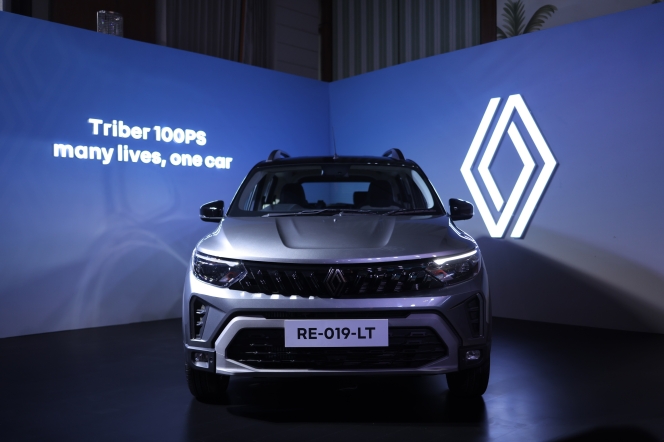
French automotive major Renault India has launched the new Triber 100PS, with a turbocharged engine option and updated chassis architecture, marking the Indian debut of the Renault Group Entry Platform (RGEP). The sub-four-metre seven-seater lineup is available for prices ranging between INR 784,900 and INR 899,000 ex-showroom.
It is the first vehicle in India constructed on the RGEP platform, designed to support multiple powertrain solutions and vehicle configurations.
The Triber 100PS incorporates a 1.0-litre TCe 100 turbocharged petrol engine producing 100 PS of power and 180 Nm of torque, managed by the new Renault Engine Management System (R-EMS). Engineering modifications include a Brushless Direct Current (BLDC) cooling fan within the thermal management system, revised suspension geometry with front and rear anti-roll bars, MTV damper technology, updated braking system calibration and structural reinforcements for crash performance. The company claims a certified fuel efficiency of 21 km per litre.
Francisco Hidalgo, Vice-President – Sales & Marketing, Renault India, said, “The Triber 100PS is an important step in Renault India’s product roadmap and a strong expression of what our brand stands for: innovation that is practical, accessible and relevant to Indian customers. Following the recent introductions of the Kwid and Duster Adventure, it marks another milestone in our programme of 12 product interventions over 18 months, demonstrating the pace and intent behind Renault’s renewed momentum in India. With 100 PS of power, 180 Nm of torque, flexible seven-seat modularity, certified fuel efficiency of 21 kmpl and prices starting at INR 784,000, the Triber 100PS brings together the qualities Indian families value in one car: performance that gives confidence, practicality, efficiency and value. We believe it will strengthen the Triber’s position and broaden the appeal of the Renault brand.”
Dr. Vikraman Vellandi, Head - Renault Engineering, Renault Group India, said, “Developing the Triber 100PS required much more than integrating a new powertrain. Delivering 100 PS and 180 Nm of torque while retaining the Triber’s modularity, comfort and efficiency required the engine, thermal-management, structural, suspension, braking and vehicle-dynamics systems to work together as one package. The result is a responsive, stable and refined driving experience that preserves the practicality and accessibility customers value in the Triber.”
The Triber maintains its modular interior configuration, offering five, six, or seven-seat arrangements with removable third-row seats, sliding and reclining second-row seats and 625 litres of luggage capacity in five-seat mode.
Ground clearance stands at 182 mm, while roof rails support a load capacity of up to 50kg. Available features across variants include six standard airbags, 21 safety systems, an eight-inch touchscreen infotainment system with wireless Apple CarPlay and Android Auto, automatic climate control with second and third-row air-conditioning vents, rain-sensing wipers, automatic headlamps and a tyre pressure monitoring system.
The Triber 100PS turbo manual range opens with the Evolution variant at INR 784,900, progressing to INR 853,900 for the Techno trim and topping out at INR 899,900 for the Emotion variant. The naturally aspirated Energy engine line-up continues alongside, priced from INR 580,875 for the Authentic trim to INR 852,950 for the Emotion AMT model. Till date, the company has sold over 250,000 units of the Triber in India since its initial release.
Honda Cars India Partners CSB Bank For Vehicle Financing Schemes
- By MT Bureau
- September 26, 2026

Honda Cars India has partnered with CSB Bank to provide vehicle financing schemes for customers across India. The agreement enables buyers to access car loans with interest rate options on purchases of the Honda City, Honda Amaze, Honda Elevate and Honda ZR-V through participating Honda dealerships and CSB Bank branches.
The partnership encompasses financial products including loans for new vehicles, pre-owned car financing, refinancing options and future electric vehicle financing support, subject to lending criteria and customer eligibility. The initiative targets buyers in semi-urban and rural markets ahead of the festive season.
As per the agreement, CSB Bank has been empanelled as a preferred financing partner for Honda Cars India. The two organisations will execute joint promotional campaigns across dealership locations, bank branches, and digital platforms, overseen by a joint coordination team.
Kunal Behl, Vice President, Marketing & Sales, Honda Cars India, said, “With this partnership, we aim to make vehicle ownership more accessible and affordable for our customers right from day one. By combining Honda’s strong dealership network with CSB Bank’s convenient financing solutions, we can offer a simple, quick and hassle-free car-buying experience. This collaboration is an extension of our efforts to provide easy and accessible finance options while enhancing the overall purchase and ownership experience for our customers. We look forward to enabling more customers to bring home their dream Honda this festive season, while expanding access to finance across semi-urban and rural markets.”
Narendra Dixit, Head - Retail Banking, CSB Bank, said, “Finance plays a critical role in enabling customers to turn their aspiration of owning a vehicle into reality. As an important component of the automotive ecosystem, financing needs to be convenient, accessible and tailored to the diverse needs of customers. At CSB Bank, we see significant potential in building strong partnerships across the automotive value chain and leveraging our financing capabilities to make vehicle ownership more accessible. Our partnership with Honda Cars India is an important step in that direction, enabling us to bring our customer-centric financing solutions closer to customers across markets, including semi-urban and rural India.”
Tata Motors Launches Aeris Compact Sedan At INR 529,000
- By MT Bureau
- September 26, 2026
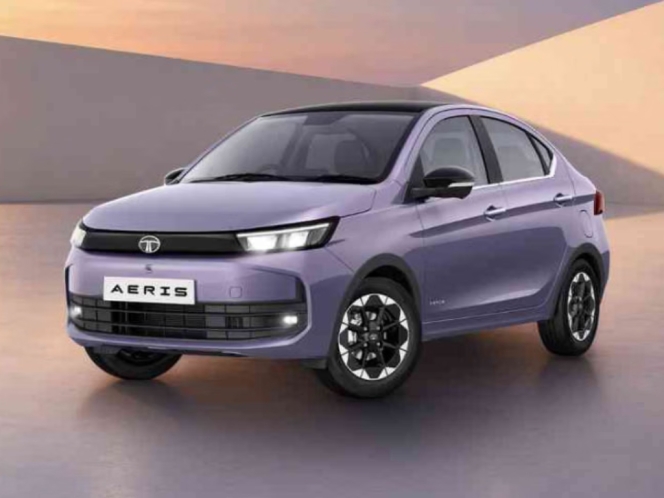
Tata Motors, one of the leading passenger vehicle manufacturers, has launched the Aeris, a replacement for its Tigor sub-four-metre compact sedan, with introductory prices starting from INR 529,000 for petrol variants and INR 629,000 for CNG variants. The Aeris will be available in five trim levels comprising Smart, Pure, Pure+, Creative and Accomplished.
Tata Motors stated that the Aeris will be sold to retail consumers, while fleet operators will continue to receive the older Tigor model under the Xpres brand name.
The exterior of the Aeris maintains a notchback roofline, accompanied by a lower grille, LED headlamps with integrated daytime running lights, LED tail-lamps, wheel arch cladding, chrome door handles, a dual-tone roof and a shark fin antenna. The car is available in six paint options: Nitro Crimson, Dandeli Drizzle, Pure Grey, Daytona Grey, Dune Glow, and Pristine White.
The sedan retains a 1.2-litre, three-cylinder Revotron engine in petrol and CNG formats. In petrol specification, the engine generates 86 PS of power and 113 Nm of torque, mated to a five-speed manual or a five-speed automated manual transmission (AMT). The CNG variant produces 75.5 PS and 96.5 Nm of torque, offered with the same transmission options. The CNG configuration employs a twin-cylinder tank design to preserve 419 litres of boot space. The petrol tank capacity measures 35 litres, while the CNG system features a 70-litre water-capacity tank.
Cabin equipment includes ventilated front leatherette seats, a digital video recorder dashcam, a blind-view monitor, a dual smartphone deck with wireless charging, and an AMT rotary gear selector with paddle shifters. Infotainment is delivered through a 26.03 cm touchscreen paired with a 12.7 cm digital instrument display, wireless Apple CarPlay and Android Auto compatibility, and a six-speaker audio setup. Additional interior features consist of automatic climate control, rear air-conditioning vents, and 65-watt USB Type-C charging ports.
The Aeris measures 3,995 mm in length, 1,684 mm in width, and 1,532 mm in height, with a 2,450 mm wheelbase. The chassis uses an independent MacPherson strut front suspension with coil springs and a semi-independent closed-profile twist beam with dual-path struts at the rear. Braking systems consist of front discs and rear drums, with wheel sizes ranging from 14-inch steel wheels on base models to 15-inch alloy wheels on higher trims.
Safety equipment fitted across all variants includes six airbags, an Electronic Stability Program suite, ABS, hill-hold assist, a 360-degree camera, a tyre pressure monitoring system and Isofix child-seat anchors. The CNG variants incorporate an electronic control unit, direct CNG ignition startup, leak detection sensors, and reinforced rear crash structures around the fuel cylinders.
Lucid Group Announces French Pricing For Gravity SUV And Air Sedan Ahead Of Paris Motor Show
- By MT Bureau
- September 25, 2026
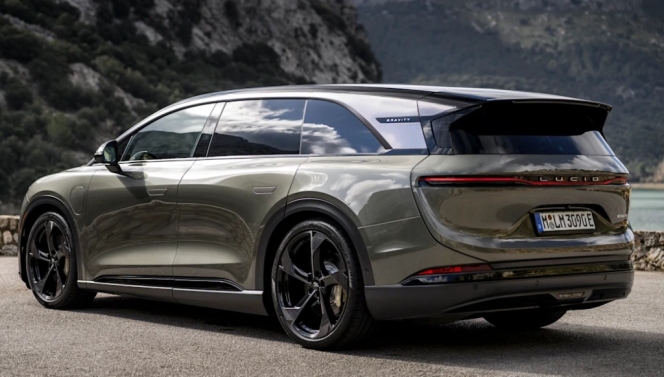
American electric vehicle and software company Lucid Group has announced French market pricing for its Gravity SUV and Air sedan models prior to their debut at the Paris Motor Show, scheduled for 12–18 October in Hall 7.1.
The company outlines four trim configurations for the Lucid Gravity SUV in France. The entry-level Gravity Touring features a 568 PS powertrain, an 89 kWh battery pack providing a WLTP range of up to 545 kilometres, and a starting price of EUR 95,900 including VAT.
The Gravity Touring Plus incorporates seven-seat capacity along with soft-close doors and acoustic glazing, priced from EUR 99,900 including VAT. The Gravity Grand Touring, priced from EUR 120,900 including VAT, utilises a 123 kWh battery pack and an 839 PS output, reaching 100 kmph in 3.6 seconds with a WLTP range of up to 739 kilometres.
The flagship Gravity Grand Touring Ultimate trim includes three-chamber air suspension, rear-wheel steering, a 22-speaker audio system, and driver assistance features, priced from EUR 148,900 including VAT.
The Lucid Air sedan range in France comprises four variants. The Air Pure model, priced from EUR 86,900 including VAT, uses an 88 kWh battery pack delivering up to 831 kilometres of WLTP range with energy consumption rated at 11.8 kWh per 100 km. The dual-motor all-wheel drive Air Touring offers up to 780 kilometres of range and starts at EUR 100,900 including VAT. The Air Grand Touring model provides a range of up to 960 kilometres, with pricing starting at EUR 131,900 including VAT. The range-topping Air Sapphire features a three-motor powertrain producing 1,251 PS, reaching 100 km/h in 2.0 seconds with a top speed of 330 kmph and a range of up to 694 kilometres, priced from EUR 252,900 including VAT.
Lawrence Hamilton, President of Europe, Lucid, said, "Lucid prioritises the customer journey as it enters the French market at the Paris Motor Show. French customers will be able to experience Lucid Gravity and Lucid Air firsthand and see how our technology delivers exceptional range, efficiency, performance and space."
Lucid plans to display the Gravity Grand Touring and Air Grand Touring models at the trade show, with ordering and availability details to be released separately. The company will conduct a press conference on 12 October with Lawrence Hamilton and Pierre Guignot, General Manager of the Emil Frey France Import Division, following a partnership agreement with Emil Frey France to manage import and operational activities across the country.

Comments (0)
ADD COMMENT