

- Montra Electric
- Murugappa Group
- Montra Rhine 5538 EV 4x2
- battery swapping
- Jalaj Gupta
- TI Clean Mobility
- M A M Arunachalam
- Arun Murgappan
Montra Electric Launches 55-Tonne Rhino E-Truck, Unveils Battery Swap Technology Too
- By MT Bureau
- September 28, 2025
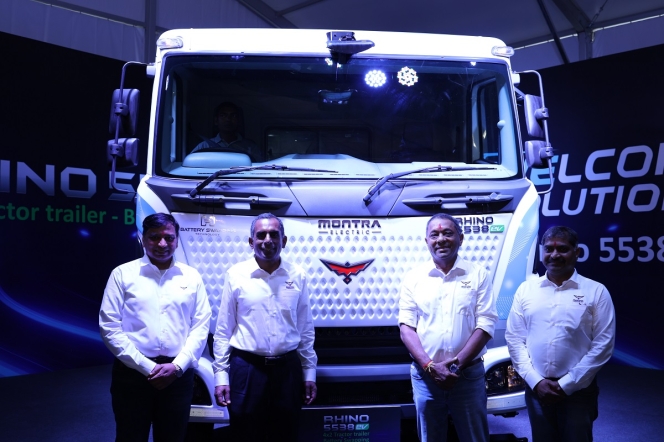
Montra Electric eM&HCV, the electric commercial vehicle brand of the Murugappa Group, made a significant stride in India’s clean mobility transition today with the launch of its new 55-tonne electric truck – the Rhino 5538 EV 4x2 TT.
The unveiling took place at the company’s new eM&HCV manufacturing facility in Manesar, Haryana. The event also marked the inauguration of India's first all-women monitored, fully Automated Battery Plant and a new eM&HCV conveyor line equipped with Automated Guided Vehicles (AGVs).
The new Rhino 5538 EV 4x2 TT is designed for long-haul freight and will be available in two variants: one with a standard fixed battery pack and another offering a battery-swapping option. The fixed-battery variant is priced at INR 11.5 million (ex-factory).
The most crucial announcement was the commercial launch of the 'Battery Swap' solution for the Rhino 5538 EV 4x2 TT and the existing 6x4 TT models. This technology aims to tackle one of the primary hurdles in commercial EV adoption: charging downtime. The company claims the swap process takes less than 6 minutes, a stark contrast to the over one hour required for conventional fast charging.
The battery swap station boasts a 7+1 configuration and advanced automation, built to handle over 160 swaps per day at peak utilisation. Its drive-through design allows tractor-trailers to move in and out seamlessly, enhancing operational efficiency for large fleets.
The new 55-tonne e-truck is powered by a 282 kWh LFP battery, delivering 380 HP and 2000 Nm torque, with a claimed range of nearly 198 km on a single charge under standard test conditions. The vehicle features a 6-speed AMT transmission and is backed by an extended 10-year/900,000 km AMC contract, including a 95 percent uptime guarantee.
M A M Arunachalam (Arun Murugappan), Chairman, Montra Electric (TI Clean Mobility), said, "At Montra Electric, we are building products and services that directly address the biggest hurdles in commercial EV adoption. With innovations like battery swapping for heavy-duty trucks and purpose-built platforms across segments, we are making clean mobility seamless, reliable and economically viable for fleet operators. This approach strengthens our vision of building a full-spectrum sustainable mobility ecosystem. Each step we take is designed to accelerate India’s shift towards cleaner logistics, ensuring that sustainable mobility becomes the norm rather than the exception."
The expansion builds on the success of Montra Electric’s first heavy-duty electric truck, the 6x4 TT, which has already clocked over 12 million kilometres in two years.
Jalaj Gupta, Managing Director, Montra Electric (TI Clean Mobility), said, “It is a milestone in Montra Electric’s journey of putting India firmly on the global map of sustainable mobility with the introduction of battery swapping technology. Launch of the Rhino 5538 EV 4x2 TT, in one of the largest industry segments, demonstrates our commitment to innovation, localisation and sustainability.”
“All the new additions to our manufacturing facility, automated battery plant, battery swap technology and the conveyor line integrated with Automated Guided Vehicles (AGVs), will collectively unlock greater efficiency, reliability and localization. These advancements position India to take significant strides in driving innovative, technology-led, clean freight solutions. With the government’s thrust through initiatives like the PM E-DRIVE scheme, the adoption of e-trucks is set to accelerate rapidly,” added Gupta.
SWITCH Mobility, PURPLE BUS Launch Vidarbha's First Electric Intercity Bus Service On Nagpur–Chandrapur Route
- By MT Bureau
- October 20, 2026
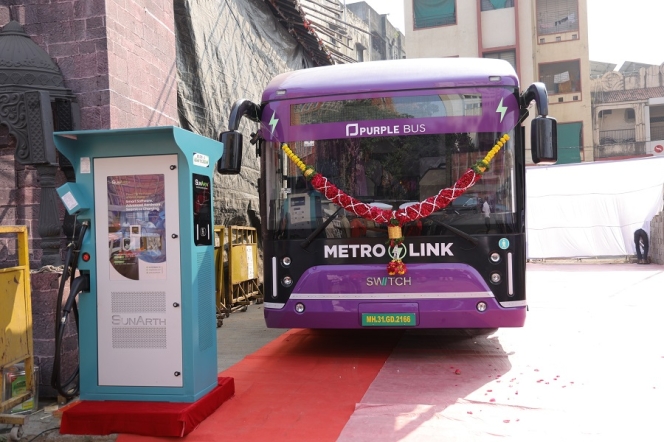
SWITCH Mobility Ltd, a global leader in electric buses and light commercial vehicles and part of the Hinduja Group, has joined forces with intercity operator PURPLE BUS to roll out the region's first electric bus service linking Nagpur and Chandrapur, widening the operator's Vidarbha footprint. Union Minister of Road Transport and Highways Nitin Gadkari oversaw the ceremonial dispatch of the inaugural six units, drawn from a 50-bus EiV12m intercity electric order placed by Purple Bus for deployments across Vidarbha.
Organisers chose Dussehra, a festival traditionally viewed as favourable for fresh ventures, as the launch date, a nod to the manufacturer's continuing push for safe, dependable and sustainable public transport in the region. Travellers between the two cities stand to gain better connectivity along with a safe, comfortable and eco-friendly way to travel.
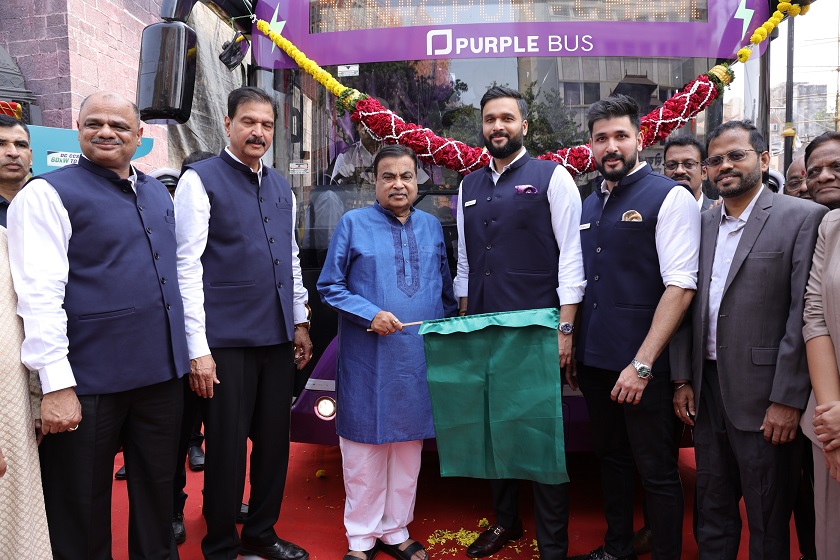
The Nagpur–Chandrapur service is the third intercity project this year between SWITCH Mobility and Prasanna Purple Mobility Solutions, building on electric coach launches along the Mumbai–Pune and Dombivli–Pune corridors in April 2026 and October 2026, respectively. The recurring tie-up points to rising operator confidence in electric buses for high-frequency intercity routes and to SWITCH Mobility's growing part in India's shift towards sustainable intercity travel.
The new route strengthens the partnership with Prasanna Purple Mobility Solutions and furthers the company's wider aim of making zero-emission public transport accessible in Indian cities and towns. Linking key Vidarbha centres, the service is expected to ease daily commutes, boost local economic activity and speed the move towards cleaner intercity mobility. The EiV12m coach, engineered for long-distance journeys, pairs 45 pushback seats and a 350 km per-charge range with fast-charging capability, advanced safety systems, a quiet ride and SWITCH iON connected technology for real-time monitoring.
Ganesh Mani, Chief Executive Officer, SWITCH Mobility, said, “Nagpur and Chandrapur share a close economic and cultural relationship, and strengthening this corridor with our partner Prasanna Purple Mobility Solutions is an important step in our mission to build future-ready public transport across India. Following our deployment on the Mumbai–Pune route earlier this year, we are glad to extend this partnership to Vidarbha and to contribute to the region’s growth by supporting the everyday movement of the people who depend on it. This launch reaffirms our commitment to sustainable, people-first mobility solutions in Maharashtra and beyond.”
Saurabh Patwadhan, Director, PURPLE BUS, said, “At PURPLE BUS, our goal is to make electric the default way people travel between cities, not the exception. We are building that future route by route, from Mumbai–Pune, one of India’s busiest corridors, to Nagpur–Chandrapur, where we now bring Vidarbha its first electric bus service. Our fleet has already covered more than one million kilometres (1,000,000 km) in electric intercity operations, and the data shows what many operators doubted: electric coaches deliver a lower total cost of ownership and a lower cost per passenger-kilometre than diesel. Our partnership with SWITCH Mobility has been central to proving that, and it gives us the confidence to scale sustainable intercity mobility across Maharashtra.”
Scania Opens New SEK 975 Million R&D Proving Ground In Södertälje
- By MT Bureau
- October 20, 2026
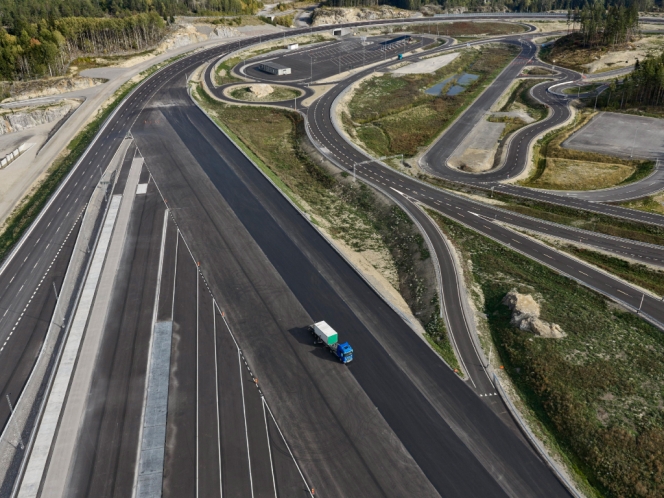
European commercial vehicle major Scania has inaugurated its research and development proving ground in Södertälje, representing an investment of SEK 975 million. The 85-hectare site includes 13 kilometres of paved road and 4 kilometres of gravel road to support testing across electrification, autonomous driving, safety systems and vehicle dynamics.
The facility incorporates three irrigated braking tracks constructed from asphalt, concrete and basalt tiles, enabling testing across varied friction surfaces and cornering conditions. The site also features specialised environments for evaluating driver assistance technology, including automatic emergency braking, lane support and blind-spot warning systems, alongside scenarios for autonomous vehicle development. The construction project integrated environmental measures, including ECO asphalt and renewable HVO100 fuel for logistics, avoiding approximately 30,900 tonnes of carbon dioxide equivalent emissions.
Christian Levin, President and CEO, TRATON GROUP and Scania, said, "The transformation of transport requires us to continuously strengthen the way we develop and validate new technologies. This investment is about building the capabilities we need for the future while ensuring that the solutions we bring to our customers have the safety, quality and performance they expect."
Sara Forsberg, CTO and Head of Brand Identity Development at Scania, said, "New technology only creates value when it performs in the real world. The R&D proving ground gives our engineers greater possibilities to test, learn and validate solutions under demanding conditions. It strengthens our ability to turn innovation into solutions that deliver real value for our customers."
Niklas Klingenberg, Head of Group R&D, TRATON GROUP, said, "Advanced testing and validation capabilities become increasingly necessary as we develop the next generation of transport solutions. The R&D Proving Ground is an important addition to our landscape and strengthens our ability to turn new technologies into proven solutions."
Eicher Trucks & Buses Opens Pro X Small Commercial Vehicle Dealership In Noida
- By MT Bureau
- October 19, 2026
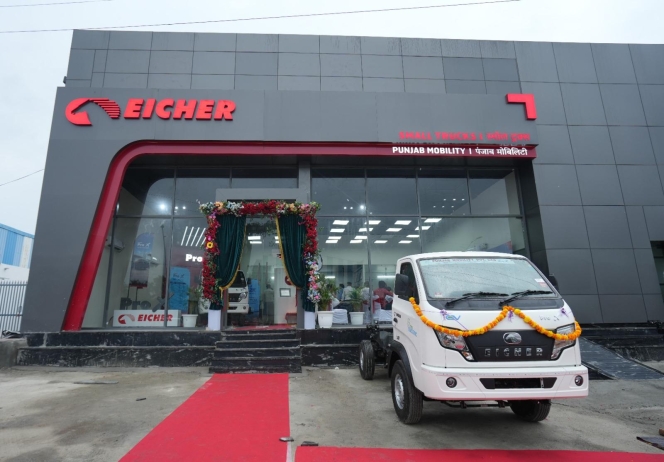
Eicher Trucks & Buses, a division of VE Commercial Vehicles, has inaugurated a 3S dealership facility in Noida for its Eicher Pro X small truck range. Operated by Punjab Mobility, the 7,000-square-foot facility is located on NH-34 at Dadri in Gautam Buddh Nagar, providing integrated sales, service and spare parts support.
The showroom will sell the 3-tonne and 3.5-tonne Gross Vehicle Weight range of small commercial vehicles across electric, diesel and compressed natural gas powertrain options.
The location provides access to industrial and logistics hubs across Noida, Greater Noida and the Dadri region, including the Multi-Modal Logistics Hub and the Dadri-Noida-Ghaziabad Industrial Region, with transport connectivity via the Eastern Peripheral Expressway, the Delhi-Meerut Expressway and the Yamuna Expressway.
Abhishek Chaudhary, Senior Vice-President of SCV Sales & Marketing, VE Commercial Vehicles, said, "The Eicher Pro X range is designed for the evolving needs of last-mile logistics, with a strong focus on efficiency, connectivity, driver comfort and uptime. With three energy-efficient powertrains, 100% connected technology and multiple configuration options, it is engineered for applications including e-commerce, parcel courier, FMCG and industrial goods movement. Punjab Mobility Private Limited’s presence strengthens our presence in Noida and brings the Pro X range and enhanced ownership support closer to customers across the Delhi-NCR region. Born electric-first, the Eicher Pro X offers customers in the NCR the opportunity to switch to electric trucks that are approved under the PARIVARTAN scheme."
The dealership infrastructure features digital vehicle configurators, dedicated workshop bays, electric vehicle charging infrastructure and EV-trained service personnel. To support vehicle uptime across the National Capital Region, the facility operates mobile service vans and breakdown assistance units alongside power backup systems.
- ASHOK LEYLAND
- MANAGED MOBILITY
- CONNECTED VEHICLES
- MOBILITY-AS-A-SERVICE
- COMMERCIAL VEHICLES
- ELECTRIC MOBILITY
- PREDICTIVE MAINTENANCE
- FLEET MANAGEMENT
- VEHICLE TELEMATICS
- ARTIFICIAL INTELLIGENCE
Managed Mobility, Connected Vehicles Running On Course
- By Gaurav Nandi
- October 16, 2026
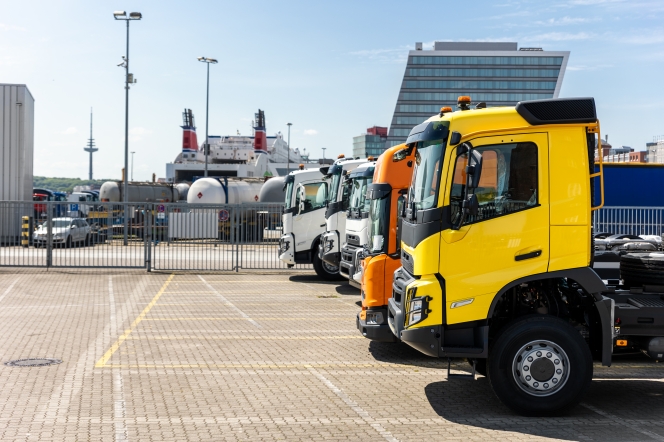
The commercial vehicle industry has predominantly seen full scape ownership by fleet operators as the preferred business model. But as electrification presses on the accelerator and discussion on costs around vehicle maintenance and increasing profitability become core topics, the ownership landscape within the commercial vehicle segment is embracing a new trend of mobility-as-a-service.
Speaking to Motoring Trends in an exclusive interaction, Head Product Portfolio Management and CIDO at Ashok Leyland Vinod Gopinathan noted, “Both business models have existed in the commercial vehicle industry for some time. However, with electrification, we are seeing a growing shift towards managed mobility models, where vehicles are operated or managed by aggregators or OEMs.”
“While this is not an entirely new concept as the internal combustion engine segment have operated both models, electrification is accelerating this transition,” he added.
Government tenders and the increasing interest of major companies in mobility-as-a-service arrangements are contributing to this shift. And in the electric commercial vehicle segment, there is a clear movement away from purely product-based ownership towards integrated mobility platforms.
While the executive expects this trend to continue as electrification expands, he also underscores the trend of connected vehicle technology. Ashok Leyland’s connected vehicle technology has evolved from basic tracking and tracing to real-time monitoring of vehicle performance, productivity and safety.
Now in its fourth generation, the company’s connected vehicle programme supports nearly 250,000 live vehicles with diesel models transmitting approximately 120 parameters and electric vehicles generating substantially more data.
This information helps improve product design, accelerate validation and enhance customer operations through better fuel efficiency, fleet utilisation, vehicle health monitoring, driver performance assessment and driving safety.
Rising above
According to Gopinathan, fleet operators are increasingly willing to pay for connected vehicle technologies as their benefits become measurable through improved fuel efficiency, vehicle uptime and lower operating costs.
“We have witnessed more than a twofold increase in multi-year subscription renewals over approximately the past year with some customers committing to five-year plans,” he stated.
Adoption spans small, medium and large fleets, while growing demand from e-commerce companies, cement manufacturers and load aggregators for greater operational visibility is further accelerating uptake.
The company is leveraging connected vehicle data to reduce total cost of ownership through fuel efficiency monitoring, fuel pilferage detection and driver behaviour analysis.
Its round-the-clock Uptime Solution Centre continuously monitors engine health, gearboxes and after-treatment systems, enabling remote diagnostics, guided troubleshooting and faster service turnaround.
Artificial intelligence-driven predictive maintenance helps identify potential failures before breakdowns, improving fleet uptime and shifting maintenance towards preventive intervention.
“When the system identifies a potential issue, the appropriate response depends on its nature. Some minor issues can be addressed directly by drivers or customers, while others require intervention at a service station. On the diagnostics side, we provide do-it-yourself alerts and guided troubleshooting for issues that customers can resolve independently,” explained Gopinathan.
The company operates a dual connected vehicle business model through its iAlert platform and customised data-sharing solutions. The subscription-based iAlert application provides fleet managers, drivers and owners with real-time insights into fuel efficiency, vehicle health, driving behaviour, safety, fault diagnostics and fuel pilferage.
Its driving score feature helps optimise fleet performance. Additionally, the company supplies vehicle data directly to operators seeking multi-OEM integration, advanced analytics or dedicated command centres, enabling customised fleet monitoring and operational management.
“We are witnessing strong adoption of connected vehicle subscriptions among truck owners, not just mobility-as-a-service operators. While continuous monitoring is integral to service-based mobility models, vehicle owners are independently recognising the benefits of preventive maintenance, do-it-yourself diagnostics and guided troubleshooting,” contended a confident Gopinathan.
He added that the increasing multi-year subscription renewals demonstrate willingness to invest in technologies that improve operational efficiency, minimise breakdowns and reduce ownership costs.
Updating technology
Digitalisation within the larger automobile industry draws into discussion the premise of safety features. “ADAS adoption in India's commercial vehicle industry remains less mature than in passenger cars, where advanced safety features are increasingly standard,” noted the executive.
He added that commercial vehicle applications currently focus on basic technologies such as driver drowsiness detection. However, evolving government regulations with several ADAS features expected to become mandatory from 2027 could accelerate adoption.
He anticipates significant progress over the next four to five years with regulatory compliance driving wider deployment and improvements in commercial vehicle safety.
Nonetheless, India's connected and electric commercial vehicle ecosystem requires improvements in telecommunications coverage, charging infrastructure and domestic battery technology.
“Inconsistent 4G connectivity, particularly in border regions and hilly terrain, continues to constrain seamless vehicle monitoring,” stated Gopinathan.
Commercial EV charging networks also need expansion with Ashok Leyland collaborating with ecosystem partners on infrastructure development. Reducing dependence on external battery technologies through stronger domestic capabilities will be equally important for supporting wider electrification.
Bullish future
Electrification is increasing the importance of connected intelligence as electric commercial vehicles generate substantially more data than conventional diesel vehicles. Ashok Leyland leverages this information for range optimisation, battery thermal management, state-of-charge monitoring and predictive maintenance.
Given the high capital costs and relatively limited adoption of electric commercial vehicles in India, advanced analytics are critical for both vehicle ownership and mobility-as-a-service models.
These capabilities enable deeper operational insights, improved battery performance and greater efficiency as electrification expands.
Alluding to how commercial vehicle manufacturers will differentiate themselves within this growing market, Gopinathan explained, “Commercial vehicle manufacturers will increasingly differentiate themselves through integrated mobility ecosystems combining vehicle efficiency, reliable charging, service support and actionable data analytics by 2030.”
“In per-kilometre mobility-as-a-service models, competitive total cost of ownership will depend on minimising breakdowns, improving uptime and optimising the entire operating value chain,” he added.
The executive also emphasised that converting growing volumes of vehicle data into meaningful insights that improve fleet utilisation and reduce maintenance costs will become a decisive competitive advantage, alongside product performance and service quality.

Comments (0)
ADD COMMENT