

Tata Motors To Acquire Iveco Group’s CV Business For EUR 3.8 Billion
- By MT Bureau
- July 30, 2025
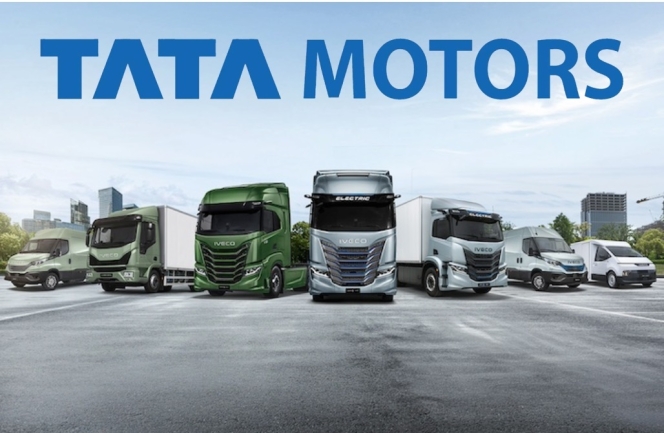
In what comes as a major announcement in the commercial vehicle industry, Tata Motors, one of India’s leading CV player, is set to acquire Europe’s Iveco Group’s CV business for EUR 3.8 billion. The transaction, if approved, is expected to close in the first half of 2026.
The deal once through will create a ‘force majeure’ in the global CV industry, combining Tata Motors’ frugal engineering strength with Iveco Group’s strength in electrification and the alternative energy domain.
The offer, made by Tata Motors CV Holdings (a Tata Motors affiliate), aims to acquire 100 percent of Iveco’s common shares post the separation of Iveco’s defence business. The tender offer price is set at EUR 14.1 per share, with an additional estimated EUR 5.5–6.0 per share dividend to be distributed from the proceeds of the defence business sale.
Exor N.V., Iveco's largest shareholder, has agreed to tender its 27.06 percent stake and support the proposed resolutions at Iveco’s upcoming extraordinary general meeting (EGM). The deal has the unanimous backing of Iveco's board, which has recommended the offer to its shareholders.
The combined group will operate across key markets including Europe (50 percent), India (35 percent) and the Americas (15 percent), with annual sales of approximately 540,000 units and combined revenue of around EUR 22 billion. Tata Motors and Iveco expect the partnership to enhance their ability to invest in zero-emission transport, optimise global supply chains and expand product innovation.
Subject to regulatory approvals and shareholder support, the parties plan to finalise the separation of Iveco’s defence business by March 2026. Should this not occur through a sale, the business will be spun off into a newly listed entity by April 2026 to allow the main offer to proceed.
As part of the understanding, Tata Motors has also committed to a two-year non-financial covenant period post-settlement, including no direct workforce reductions or plant closures and preserving Iveco’s identity, brands and headquarters in Turin, Italy.
Both companies emphasised that the move will establish a globally competitive platform equipped to address shifting mobility trends and create long-term value for stakeholders.
The combined group will be better positioned to invest in and deliver innovative, sustainable mobility solutions by leveraging both supplier networks to serve customers globally. It will also unlock superior growth opportunities and create significant value for all stakeholders in a dynamic marketplace. By preserving each group’s industrial footprint and employee communities, this complementarity is also expected to foster a smooth and successful integration process. It will also enable the capabilities of Iveco Group’s successful powertrain business, FPT, to be further enhanced.
Natarajan Chandrasekaran, Chairman, Tata Motors, said, “This is a logical next step following the demerger of the Tata Motors Commercial Vehicle business and will allow the combined group to compete on a truly global basis with two strategic home markets in India and Europe. The combined group's complementary businesses and greater reach will enhance our ability to invest boldly. I look forward to securing the necessary approvals and concluding the transaction in the coming months.”
Suzanne Heywood, Chair, Iveco Group, said, "We are proud to announce this strategically significant combination, which brings together two businesses with a shared vision for sustainable mobility. Moreover, the reinforced prospects of the new combination are strongly positive in terms of the security of employment and industrial footprint of Iveco Group as a whole.”
Girish Wagh, Executive Director, Tata Motors, said, "This combination is a strategic leap forward in our ambition to build a future-ready commercial vehicle ecosystem. By integrating the strengths of both organisations we are unlocking new avenues for operational excellence, product innovation and customer-centric solutions. This partnership not only enhances our ability to serve diverse mobility needs across markets, but also reinforces our commitment to delivering sustainable transport solutions that are aligned with global megatrends. Together, we are shaping a resilient and agile enterprise, equipped to lead in times of transformative change."
Olof Persson, CEO, Iveco Group, said, “By joining forces with Tata Motors, we are unlocking new potential to further enhance our industrial capabilities, accelerate innovation in zero-emission transport, and expand our reach in key global markets. This combination will allow us to better serve our customers with a broader, more advanced product portfolio and deliver long-term value to all stakeholders.”
Blue Energy Motors Joins PARIVARTAN Scheme To Deploy Electric Heavy-Duty Trucks
- By MT Bureau
- October 23, 2026
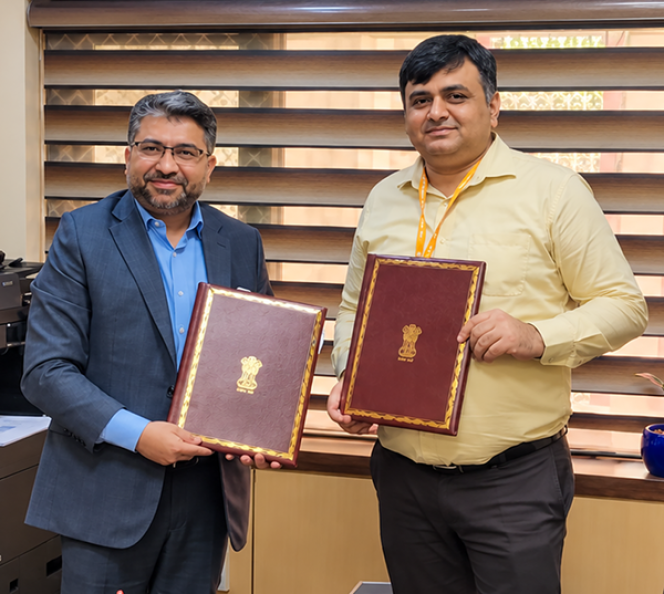
Pune-headquartered alternative commercial vehicle maker Blue Energy Motors has signed a Memorandum of Understanding (MoU) with the Ministry of Road Transport and Highways (MoRTH) under the PARIVARTAN Scheme. The partnership aims to facilitate the replacement of commercial vehicles with electric trucks within the Delhi-National Capital Region.
The initiative supports the transition to freight mobility options by incentivising the replacement of transport units. Blue Energy Motors deploys electric and liquefied natural gas truck platforms across freight routes, accumulating operational distance and reducing emissions.
Anirudh Bhuwalka, Founder & Managing Director, Blue Energy Motors, said, "The PARIVARTAN Scheme is an important step towards accelerating the transition to cleaner freight mobility in India. Our participation reflects Blue Energy Motors’ commitment to supporting the Government’s vision for sustainable transportation and enabling wider adoption of electric heavy-duty trucks. We believe that the right policy support, coupled with advanced technology and a strong domestic manufacturing ecosystem, can play a pivotal role in accelerating India’s transition towards zero-emission freight transportation."
SWITCH Mobility, PURPLE BUS Launch Vidarbha's First Electric Intercity Bus Service On Nagpur–Chandrapur Route
- By MT Bureau
- October 20, 2026
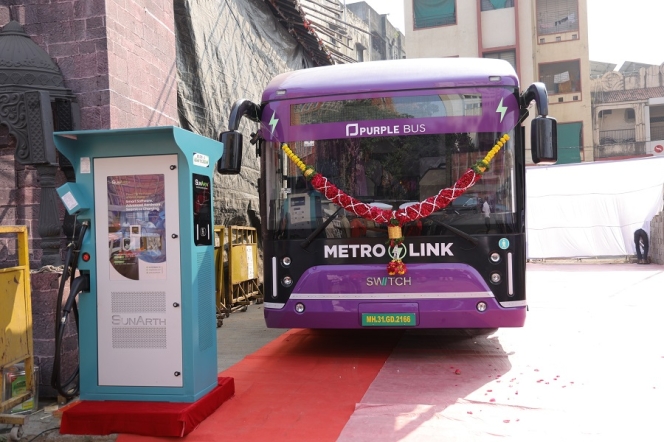
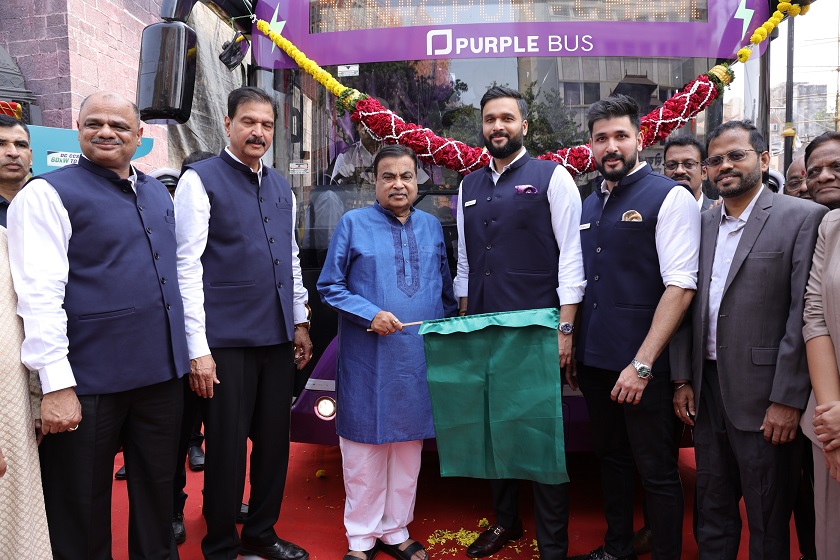
SWITCH Mobility Ltd, a global leader in electric buses and light commercial vehicles and part of the Hinduja Group, has joined forces with intercity operator PURPLE BUS to roll out the region's first electric bus service linking Nagpur and Chandrapur, widening the operator's Vidarbha footprint. Union Minister of Road Transport and Highways Nitin Gadkari oversaw the ceremonial dispatch of the inaugural six units, drawn from a 50-bus EiV12m intercity electric order placed by Purple Bus for deployments across Vidarbha.
Organisers chose Dussehra, a festival traditionally viewed as favourable for fresh ventures, as the launch date, a nod to the manufacturer's continuing push for safe, dependable and sustainable public transport in the region. Travellers between the two cities stand to gain better connectivity along with a safe, comfortable and eco-friendly way to travel.
The Nagpur–Chandrapur service is the third intercity project this year between SWITCH Mobility and Prasanna Purple Mobility Solutions, building on electric coach launches along the Mumbai–Pune and Dombivli–Pune corridors in April 2026 and October 2026, respectively. The recurring tie-up points to rising operator confidence in electric buses for high-frequency intercity routes and to SWITCH Mobility's growing part in India's shift towards sustainable intercity travel.
The new route strengthens the partnership with Prasanna Purple Mobility Solutions and furthers the company's wider aim of making zero-emission public transport accessible in Indian cities and towns. Linking key Vidarbha centres, the service is expected to ease daily commutes, boost local economic activity and speed the move towards cleaner intercity mobility. The EiV12m coach, engineered for long-distance journeys, pairs 45 pushback seats and a 350 km per-charge range with fast-charging capability, advanced safety systems, a quiet ride and SWITCH iON connected technology for real-time monitoring.
Ganesh Mani, Chief Executive Officer, SWITCH Mobility, said, “Nagpur and Chandrapur share a close economic and cultural relationship, and strengthening this corridor with our partner Prasanna Purple Mobility Solutions is an important step in our mission to build future-ready public transport across India. Following our deployment on the Mumbai–Pune route earlier this year, we are glad to extend this partnership to Vidarbha and to contribute to the region’s growth by supporting the everyday movement of the people who depend on it. This launch reaffirms our commitment to sustainable, people-first mobility solutions in Maharashtra and beyond.”
Saurabh Patwadhan, Director, PURPLE BUS, said, “At PURPLE BUS, our goal is to make electric the default way people travel between cities, not the exception. We are building that future route by route, from Mumbai–Pune, one of India’s busiest corridors, to Nagpur–Chandrapur, where we now bring Vidarbha its first electric bus service. Our fleet has already covered more than one million kilometres (1,000,000 km) in electric intercity operations, and the data shows what many operators doubted: electric coaches deliver a lower total cost of ownership and a lower cost per passenger-kilometre than diesel. Our partnership with SWITCH Mobility has been central to proving that, and it gives us the confidence to scale sustainable intercity mobility across Maharashtra.”
Scania Opens New SEK 975 Million R&D Proving Ground In Södertälje
- By MT Bureau
- October 20, 2026
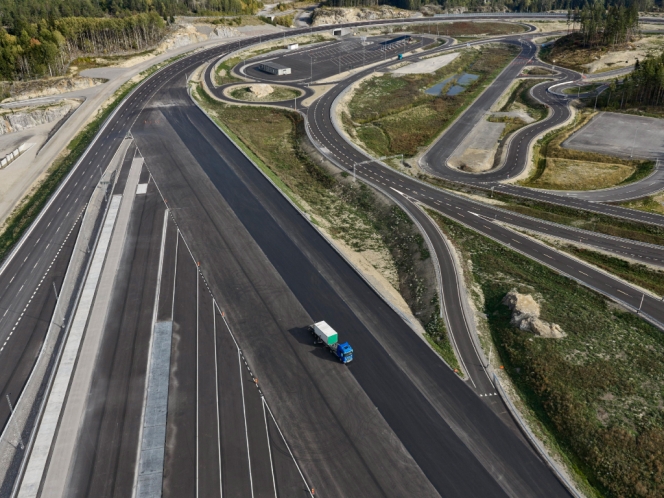
European commercial vehicle major Scania has inaugurated its research and development proving ground in Södertälje, representing an investment of SEK 975 million. The 85-hectare site includes 13 kilometres of paved road and 4 kilometres of gravel road to support testing across electrification, autonomous driving, safety systems and vehicle dynamics.
The facility incorporates three irrigated braking tracks constructed from asphalt, concrete and basalt tiles, enabling testing across varied friction surfaces and cornering conditions. The site also features specialised environments for evaluating driver assistance technology, including automatic emergency braking, lane support and blind-spot warning systems, alongside scenarios for autonomous vehicle development. The construction project integrated environmental measures, including ECO asphalt and renewable HVO100 fuel for logistics, avoiding approximately 30,900 tonnes of carbon dioxide equivalent emissions.
Christian Levin, President and CEO, TRATON GROUP and Scania, said, "The transformation of transport requires us to continuously strengthen the way we develop and validate new technologies. This investment is about building the capabilities we need for the future while ensuring that the solutions we bring to our customers have the safety, quality and performance they expect."
Sara Forsberg, CTO and Head of Brand Identity Development at Scania, said, "New technology only creates value when it performs in the real world. The R&D proving ground gives our engineers greater possibilities to test, learn and validate solutions under demanding conditions. It strengthens our ability to turn innovation into solutions that deliver real value for our customers."
Niklas Klingenberg, Head of Group R&D, TRATON GROUP, said, "Advanced testing and validation capabilities become increasingly necessary as we develop the next generation of transport solutions. The R&D Proving Ground is an important addition to our landscape and strengthens our ability to turn new technologies into proven solutions."
Eicher Trucks & Buses Opens Pro X Small Commercial Vehicle Dealership In Noida
- By MT Bureau
- October 19, 2026
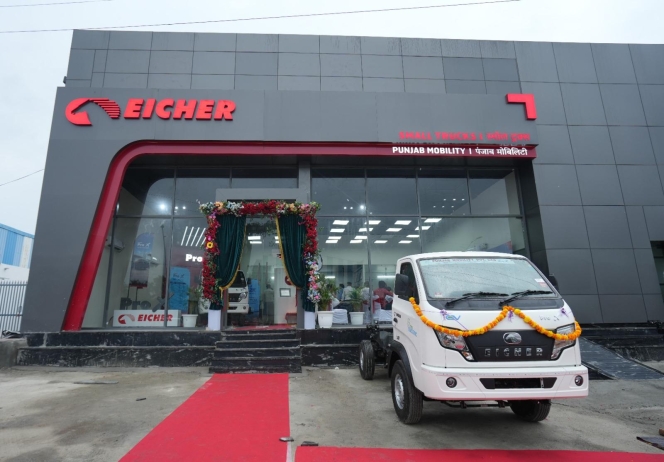
Eicher Trucks & Buses, a division of VE Commercial Vehicles, has inaugurated a 3S dealership facility in Noida for its Eicher Pro X small truck range. Operated by Punjab Mobility, the 7,000-square-foot facility is located on NH-34 at Dadri in Gautam Buddh Nagar, providing integrated sales, service and spare parts support.
The showroom will sell the 3-tonne and 3.5-tonne Gross Vehicle Weight range of small commercial vehicles across electric, diesel and compressed natural gas powertrain options.
The location provides access to industrial and logistics hubs across Noida, Greater Noida and the Dadri region, including the Multi-Modal Logistics Hub and the Dadri-Noida-Ghaziabad Industrial Region, with transport connectivity via the Eastern Peripheral Expressway, the Delhi-Meerut Expressway and the Yamuna Expressway.
Abhishek Chaudhary, Senior Vice-President of SCV Sales & Marketing, VE Commercial Vehicles, said, "The Eicher Pro X range is designed for the evolving needs of last-mile logistics, with a strong focus on efficiency, connectivity, driver comfort and uptime. With three energy-efficient powertrains, 100% connected technology and multiple configuration options, it is engineered for applications including e-commerce, parcel courier, FMCG and industrial goods movement. Punjab Mobility Private Limited’s presence strengthens our presence in Noida and brings the Pro X range and enhanced ownership support closer to customers across the Delhi-NCR region. Born electric-first, the Eicher Pro X offers customers in the NCR the opportunity to switch to electric trucks that are approved under the PARIVARTAN scheme."
The dealership infrastructure features digital vehicle configurators, dedicated workshop bays, electric vehicle charging infrastructure and EV-trained service personnel. To support vehicle uptime across the National Capital Region, the facility operates mobile service vans and breakdown assistance units alongside power backup systems.
Comments (0)
ADD COMMENT