

Namma Yatri And EnAble India Join Hands With True Assistive Technology To Enhance Purple Rides
- By MT Bureau
- January 22, 2025

Namma Yatri and EnAble India have joined hands with True Assistive Technology to enhance Purple Rides by introducing the TurnPlus swivel seat feature, which makes it easier for individuals with mobility challenges to enter and exit vehicles. The aim of this partnership is to make urban travel more inclusive.
TurnPlus is an award-winning, simple-to-install seat mechanism that was introduced in 2017 and makes getting in and out of automobiles easier for persons with impairments or medical issues. It has undergone extensive testing and certification, guaranteeing comfort and safety. By March 2025, 300 cars will have TurnPlus seats installed in Bengaluru as part of a test effort to launch this function. With ambitions to shortly extend to additional locations, the business hopes to add 1,000 accessible vehicles over the course of the next six months.
In order to make travel safe, comfortable and accessible for those with mobility impairments, visual impairments and deaf people, Namma Yatri established Purple Rides in October 2023 in partnership with EnAble India, a knowledge partner. Sensitised drivers who have received training to help passengers with impairments are offered by Purple Rides. Additionally, with features like ride preferences and driver assistance, the Purple Rides app is intended to be user-friendly for those with a variety of requirements.
Tejas Cargo Deploys Blue Energy Motors Electric Trucks
- By MT Bureau
- September 17, 2026
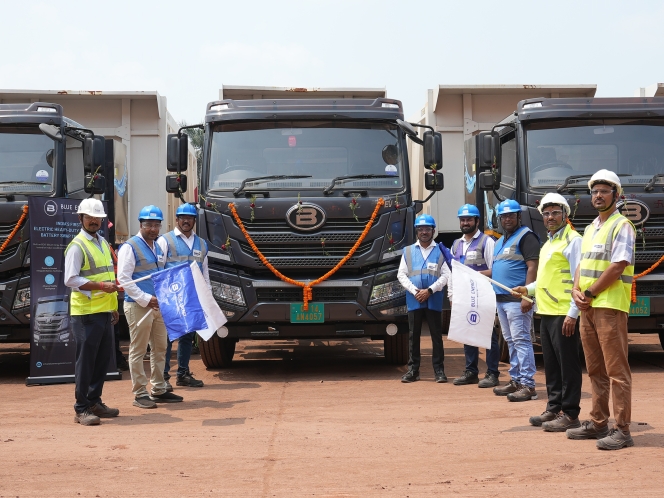
Tejas Cargo has added a Blue Energy electric heavy-duty trucks to its fleet. The e-trucks will cater to the needs of Dalmia Cement logistics requirements with an eye on reducing the carbon footprint. The deployment underlines the growing need of various industrial sectors such as cement, e-commerce etc. to reduce transportation-related emissions and build a more sustainable supply chain.
As businesses across different industrial sectors look beyond their manufacturing operations to reduce emissions, freight transportation is visited in terms of how it can contribute positively to Scope 3 norms. It makes an important area for action.
This association between Blue Energy Motors and Tejas Cargo marks a new arrangement that is emerging in the logistics space where vehicle OEMs, logistics providers and end customers look at a sustainable and carbon footprint reducing means to transport the produce. To build an efficient supply chain that is robust and risk averse for the various shifts that are taking place.
"The logistics sector is undergoing a significant transformation, and sustainable transportation will play a defining role in its future. We are pleased to deploy Blue Energy Motors' electric heavy-duty truck for Dalmia Cement's operations and look forward to contributing to the adoption of cleaner and more efficient freight solutions across the industry," said hander Bindal, Chairman & Managing Director, Tejas Cargo India Limited.
Anand Mimani, CEO – EV & New Energy Business, Blue Energy Motors, said, "As India accelerates its transition towards a lower-carbon future, decarbonizing freight transportation will be critical to achieving meaningful emissions reductions. Electric heavy-duty trucks are increasingly proving their ability to deliver the performance, reliability and economics required for commercial operations. This deployment is a strong example of how clean mobility solutions can help industries reduce transportation-related emissions while advancing their broader sustainability ambitions."
AIFI’s 2nd Annual Conference Focuses On ‘China Plus One’ Opportunity For Indian Forging Sector
- By MT Bureau
- September 16, 2026
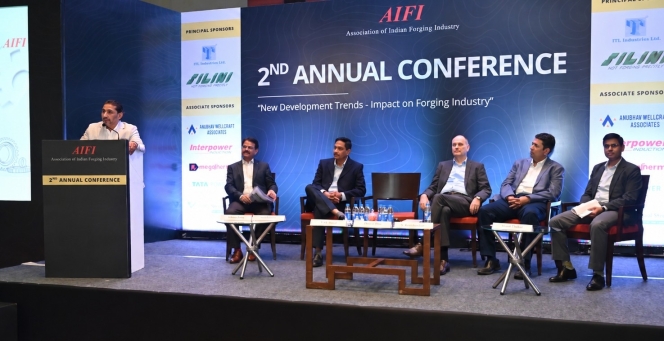
The Association of Indian Forging Industry (AIFI), the apex body of the Indian forging sector, hosted its 2nd Annual Conference on ‘New Development Trends – Impact on Forging Industry’. The event gathered leading stakeholders to discuss the evolving business environment, the China Plus One opportunity, technology and automation, productivity, manpower, rising input costs and the need for greater resilience and competitiveness.
Discussions stressed that the industry stands at a pivotal moment to strengthen its place in global value chains as companies diversify supply sources. However, it must move beyond traditional manufacturing models by investing in technology, automation, engineering, R&D, skilled manpower, productivity and sustainability. The consensus was that while India has the base, talent and market opportunity, forging firms must build capability to manage uncertainty and deliver higher-value solutions.
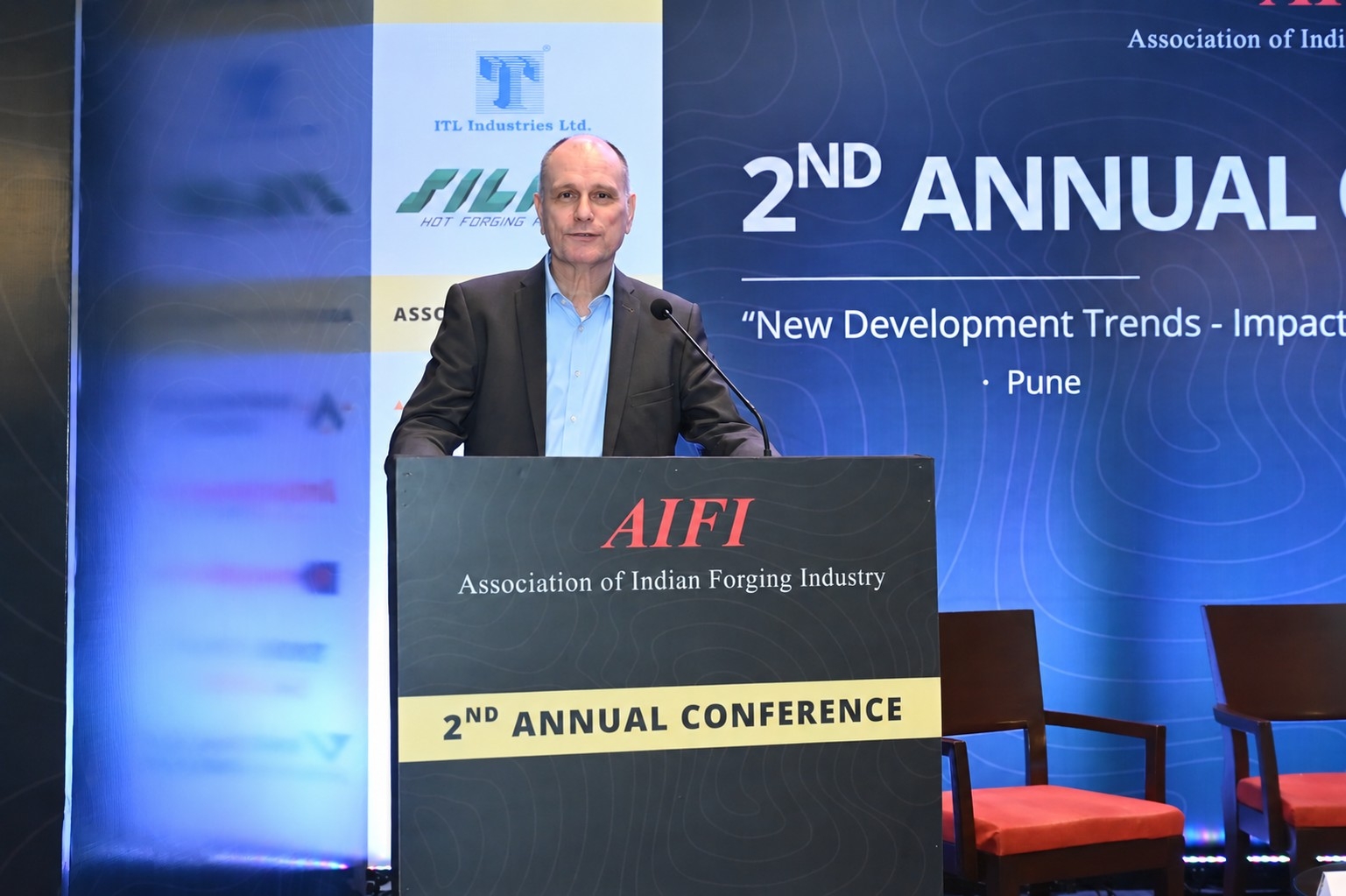
Chief Guest Thomas Dose, Managing Director, BMW Group Plant Chennai, highlighted India’s growing global relevance under the China Plus One strategy. He noted that geopolitical turbulence and single-supplier risks are pushing global companies to diversify, giving India a strong chance to become the preferred destination, with customers seeking greater engineering and end-to-end responsibility.
Sunil Javalekar, Chairman, Western Region, AIFI & CEO, S. B. Forgetech Pvt. Ltd., gave the welcome address. Yogesh Thakar, Executive Director, PwC, presented ‘Indian Forging Industry – Next Global Edge’. The memento presentation and vote of thanks were delivered by S Ravishankar, Vice President, AIFI & MD, Super Auto Forge Pvt. Ltd.
A panel on ‘Managing Uncertainty / Challenges to Capitalize on Demand Surge’ was moderated by S Ravishankar, with Vidyashankar Krishnan, CMD, M.M. Forgings Ltd.; Vikas Bajaj, MD, Bajaj Motors Ltd. and Sahil Jain, CEO, Hirschvogel Components India Private Limited. Discussions covered GST, manpower, automation, technology upgrades, investments, training, contingency planning, R&D, productivity, demand management and rising input costs.
The conference reinforced the industry’s significant opportunity as global supply chains evolve. AIFI continues to unite stakeholders, facilitate knowledge exchange and represent the forging fraternity, with a renewed commitment to competitiveness and growth in domestic and global markets.
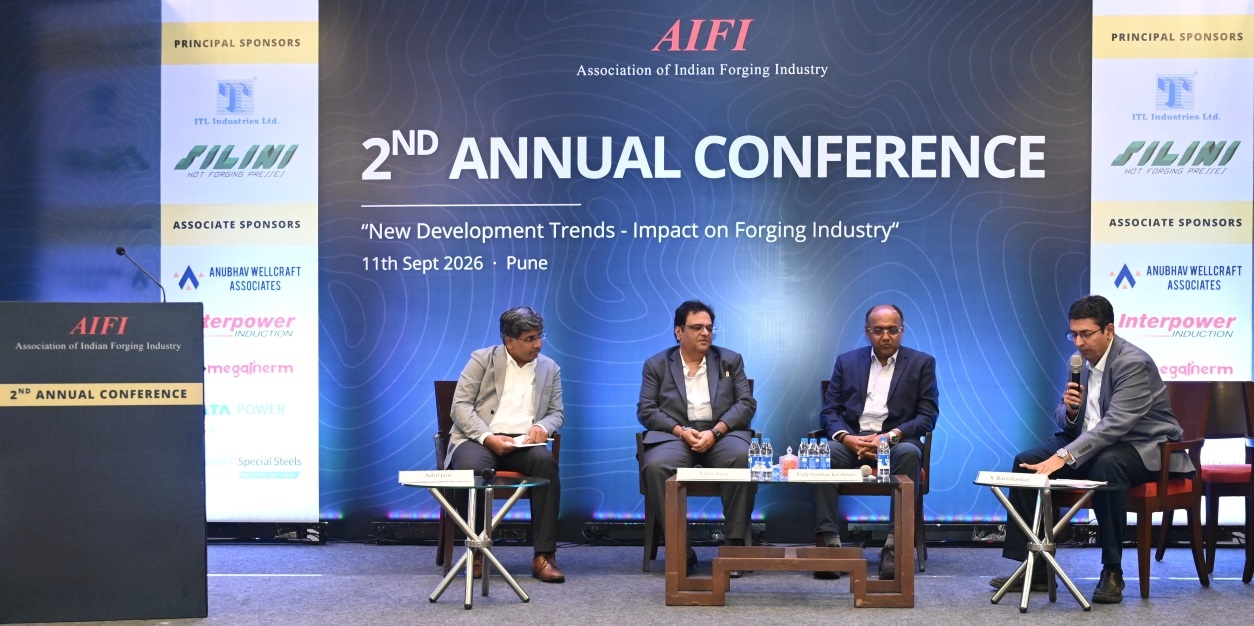
Addressing the gathering, Yash Munot, President, AIFI & CEO, Varsha Forgings Pvt. Ltd., said, “The Indian forging industry is at an important juncture, with global supply-chain realignments creating significant opportunities for India. At the same time, we must remain prepared to navigate geopolitical uncertainty, rising input costs, technology disruption and changing customer requirements. Our focus must be on increasing productivity, accelerating technology adoption, developing our people and strengthening innovation and sustainability. The opportunity before the Indian forging industry is significant, but we must build the capabilities and competitiveness required to become a stronger and more valuable partner to global customers.”
Thomas Dose, Managing Director, BMW Group Plant Chennai, said, “We believe India should be the Plus One. India has engineering talent, a large market and a very capable forging industry. But China Plus One is not only about supply; we want to see much more partnership from India. Customers are looking for capable partners who can take responsibility, contribute to engineering and development and become part of the development process. India is no longer just a supply chain; Indian companies need to be part of our development. The challenge is to connect the capabilities that are already there, and AIFI has a major role to play in this.”
High-Octane Drama And Teenage Brilliance Light Up Kari Motor Speedway
- By MT Bureau
- September 15, 2026
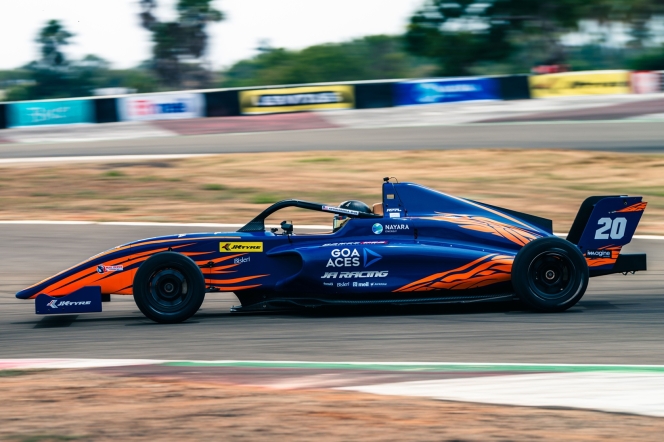
Powered by JK Tyre, the Indian Racing Festival 2026 got off to a thrilling start at the Kari Motor Speedway (KMS) in Coimbatore, recently, with the opening round of the F4 Indian Championship delivering three action-packed races and a closely contested battle for the top honours.
Aris Kyriakou emerged as the standout performer of the weekend, combining two runner-up finishes with a Race 3 victory to finish Round 1 with a dominant display.
With the opening round producing seven different drivers on the podium across the three races, the championship has already underlined the depth of competition on the grid. The F4 Indian Championship will now remain at Kari Motor Speedway for Round 2, giving the drivers another opportunity to challenge for crucial championship points at the same venue before the six-round season moves on to its other racing destinations.
South African Luviwe Sambudla stole the spotlight as the opener didn't unfold the way the grid sheet suggested it might. Sambudla, lining up eighth for Goa Aces JA Racing, tore through traffic almost immediately and had himself in podium contention within the first four opening laps in the first battle.
A mid-race safety car briefly closed up the field and threatened to undo his hard work, but it barely slowed him down as he crossed the line first in 31 minutes and 05.808 seconds, edging Kyriakou by 2.245 seconds, with pole-sitter Aaron Mehta rounding out the podium in third.
Before any of that unfolded, though, it was Mehta who'd already made headlines. The fifteen-year-old Singaporean, racing for Kolkata Royal Tigers, put in a lap of 1:05.652 to become the youngest driver ever to take pole in this championship's history. He couldn't quite hold that pace deep into the race, dropping to third as his tyres wore thin, but for a debutant barely out of his mid-teens, a podium finish is nothing to sniff at.
Aryan Narola's pole-to-flag drive made him the second-youngest race winner in series history
Starting from pole in Race 2, Goa Aces JA Racing’s Aryan Narola fended off constant pressure from Kyriakou across the full 26-lap distance on the second day of the championship, eventually taking the flag just 0.624 seconds clear. Aris Kyriakou and Swarnav Das completed the podium behind them. The result makes Narola the second-youngest winner in the championship's history, a milestone which will be talked about in the lead-up to Round Two.
Race 3 belonged to Aris Kyriakou
Starting from pole for the third race running, Kyriakou didn't have things all his own way. He crossed the line first, but not before fending off relentless pressure from Mahlori Mabunda, who spent much of the race glued to his gearbox. Third went to Mehta, while Sambudla, the weekend's Race 1 winner, could only manage fourth this time round.
Mabunda displayed the pace to challenge for the win, but spent lap after lap fighting the effects of dirty air, the turbulent, disrupted airflow that trails a car ahead and robs the chasing driver of downforce through the corners.
Further back, the race delivered its share of chaos too. With the laps winding down, the leaders began lapping the rest of the field, sweeping up everyone from fourth to fourteenth during the final 90 seconds. Amid that scramble, Ntiyiso Mabunda came to a halt on track on the last lap, forcing race control to throw a yellow flag. The timing worked out well for Mehta, who'd been running fourth behind Kyriakou and the two South Africans, but Mabunda's misfortune opened the door, and he grabbed third as a result.
Round 1 threw up seven different names on the rostrum across its three races, but it's Kyriakou's name that stands tallest heading into the next stop. With the series set to return to the very same venue for its second round, all eyes will be on whether he can carry this form forward, or whether the chasing pack finally finds a way past.
Roland Berger Study Highlights EUR 20 Trillion Tech Market Potential By 2040
- By MT Bureau
- September 12, 2026
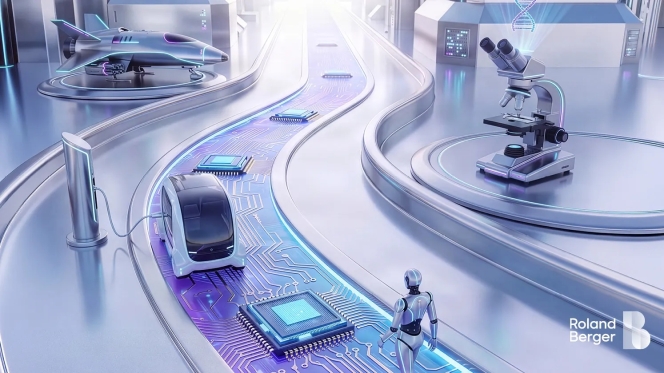
Thirty emerging technology fields will drive global economic growth over the next 15 years, with their total market value projected to expand from EUR 2.5 trillion to more than EUR 20 trillion by 2040 says a report by global consulting firm Roland Berger.
The research titled ‘The 2040 Technology Gameplan ’ finds that these sectors will account for 37 percent of global industrial value creation by 2040, up from 9 percent today.
The study identifies 14 core technology areas as critical for industrial growth, representing a market potential of EUR 16 trillion. Semiconductors, artificial intelligence (AI) systems and data centres are projected to constitute more than half of this total. Additional sectors highlighted include energy storage, quantum technologies and humanoid robotics.
Furthermore, the report points out that Europe could capture approximately 20 percent of the global market across these 14 primary technology sectors by 2040, equivalent to EUR 3 trillion in value creation. However, European industry has lost market share to the United States and China due to scaling constraints, capital limitations and institutional complexity.
To address these challenges, the analysis outlines three approaches tailored to specific technology fields: pursuing global leadership in areas such as quantum technology, medical technology, microgrids and carbon capture; leveraging domestic demand in sectors like autonomous defence, humanoid robotics and charging infrastructure; and attracting foreign technology providers to establish local operations for large language models and next-generation semiconductors.
Felix Mogge, Partner, Roland Berger, said, "Europe faces a clear mandate for action. Policymakers and industry leaders must work together to create the right conditions for investment and scaling. Otherwise, the value creation generated by the next wave of technology trends will take place elsewhere."
The study indicates that existing European regulatory frameworks, including the AI Act, the EU Battery Regulation, and the European Chips Act, have not fully achieved their targets. The findings call for EU-wide policies to support commercial scaling, capital availability, and industrial strategy across member states.
Stefan Riederle, Partner, Roland Berger, said, "Europe has the technologies and the talent to compete for global leadership in a number of fields. The challenge now is to choose the right strategy for each technology area and secure Europe’s long-term competitiveness."
Comments (0)
ADD COMMENT