

- Carlos Tavares
- Stellantis
- resignation
- differences
- board
- US
- Jeep
- Citroen
- India
- criticism
- performance
- drop
- sales drop
- lean
Stellantis CEO Carlos Tavares Has Stepped Down
- By MT Bureau
- December 02, 2024

Stellantis CEO Carlos Tavares has stepped down due to differences with the board, a news report in the CNN.com (Business) has mentioned. It has also mentioned that Tavares faced criticism for the lack lustre performance of the Group brands – formed with the coming together of FCA and PSA Groups – during the nine months of the current calendar year in the US.
The announcement of Tavares’ departure comes at a time when popular group brands such as Jeep, Chrysler and Dodge have seen sales drop as the ‘affordable’ models are discontinued under the wake of a ‘lean’ strategy and in what looks like an attempt to elevate the brands to offer premium luxury vehicles.
In India too, the Jeep vehicles are priced much higher than they may be worthy of. It is no surprise therefore that they are being undercut by Jeep-like vehicles from brands like Mahindra, which costs many million Rupees less.
Beginning its journey in Mumbai after Independence by assembling Willys CJ3 Jeep under license from Willys Corporation, Mahindra has grown to be a leading utility and SUV vehicles manufacture in India. It has also found a strong footing in export markets of US, Australia and South Africa with its 4x4 vehicles.
Also failing to extensively refresh or introduce next generation models such as the Compass in India, Jeep is not doing great in India either, the figures indicate. The other brand, Citroen seems to be better positioned and more agile in its ability to learn and adapt to the market requirements in the country. It too is yet to show its prowess to set the sales charts on fire in India.
Criticised to have taken the lean strategy a bit too far to come back and bite the group where it hurts the most, Tavares’ stepping down comes at a time when dealers across many parts of the world struggle to move the inventory on their lots.
Several workers laid off at several plants of the group – particularly in the US – have also criticised Tavares for the situation Stellantis got into in that market.
The situation in other markets is claimed to be not very different either.
The process to appoint the new permanent CEO is underway with a Special Committee of the Board expected to announce one in the first half of 2025 calendar year, as per the report. A new Interim Executive Committee, chaired by John Elkann, will be established, the report further mentions.
Global sales volume for the first half of this year fell 10 percent in the case of Stellantis. In the third quarter, it plunged 20 percent.
With many loyal buyers of Dodge and Jeep vehicles keeping away as the prices have risen way beyond, sales in US have been down by 17 percent in the first nine months of the year.
- Good Business Lab
- Suman Mishra
- Mahindra Last Mile Mobility
- Viveka Bhandari
- Padmini VNA Mechatronics
- Sunil Arora
- Abilities India Pistons & Rings
- Satyaprakash Patil
- Honda Motorcycle & Scooter India
- Vinkesh Gulati
- Automotive Skills Development Council
- Asahi India Glass
- Sansera Engineering
- Nirmal Deshpande
Automotive Leaders And Shopfloor Workers Convene In New Delhi To Address Gender Inclusion
- By MT Bureau
- October 09, 2026
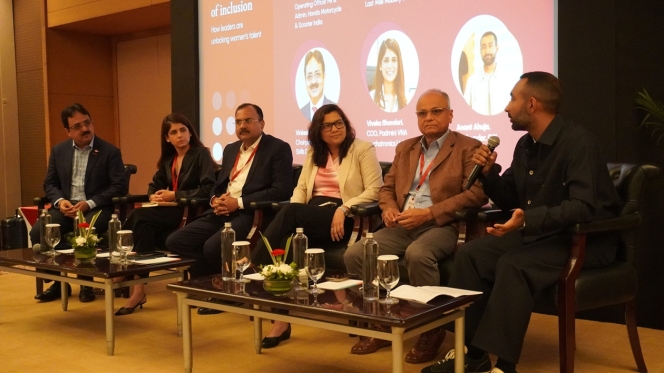
Good Business Lab brought together senior automotive executives, industry actors and shopfloor workers at a leadership conference in New Delhi to discuss strategies for increasing female workforce participation across India's automotive manufacturing sector.
The event followed the organisation's September research report, which revealed that women account for 8.7 percent of the combined original equipment manufacturer and component manufacturing workforce across the country.
The conference addressed findings from a three-year study by Good Business Lab spanning over 55 automotive firms, 400 stakeholders and 1,900 individuals. Discussions focused on practical shopfloor interventions to improve recruitment and retention, including talent supply chains, night-shift operational frameworks, last-mile transportation solutions and childcare infrastructure.
Industry panels examined career progression pathways, performance metrics for middle management retention, and workplace safety conditions required to support long-term employment.
The event featured three panel sessions covering business metrics, worker perspectives, and sector-wide operational scalability. Executives participating in the discussions included Suman Mishra, Chief Executive Officer and Managing Director of Mahindra Last Mile Mobility; Viveka Bhandari, Chief Operating Officer of Padmini VNA Mechatronics; Sunil Arora, Managing Director of Abilities India Pistons & Rings; Satyaprakash Patil, Chief Human Resources Officer of Honda Motorcycle & Scooter India; and Vinkesh Gulati, Chairperson of the Automotive Skills Development Council.
A panel of female shopfloor associates from Abilities India Pistons & Rings, Asahi India Glass, Honda Motorcycle & Scooter India and Sansera Engineering detailed their career trajectories and operational experiences in vehicle assembly and component production.
Nirmal Deshpande, Managing Director of Good Business Lab, said, “The evidence increasingly mirrors what we are hearing from industry: women’s participation is no longer just an inclusion imperative, but a business necessity. Several leading firms are already showing what is possible; the challenge now is scale. We brought business leaders, women workers and the wider ecosystem together to chart the path ahead. The opportunity is clear: now we need to turn what works into action across the sector.”
Good Business Lab plans to collaborate with automotive manufacturers, philanthropic organisations and industry bodies to pilot shopfloor solutions and co-design workforce frameworks across the manufacturing sector.
- JSW MG Motor India
- MG Developer Program
- Nayan Technologies
- Technod8.AI
- LiveNSense
- LW3
- Smaartbrand by Acquink Solutions
- Fitsol
- Cautio
- Meta Materials Circular Market
- Anurag Mehrotra
- DPIIT
- Startup India
- JSW
- NCPI BHIM
- Jio
- Gulf Oil India
- TiE Delhi NCR
- iCreate
- Allianz Partners India
- TERI
- BSES Rajdhani Power Limited
- LICO Materials
- Pulse Energy
JSW MG Motor India Announces Winners Of 6th Edition Of MG Developer Program
- By MT Bureau
- October 09, 2026
JSW MG Motor India, one of the leading passenger vehicle manufacturers, has announced the eight winning startups selected for the 6th edition of the MG Developer Program.
The startup engagement initiative, centred on the theme 'Innovation in Automotive', evaluated over 130 applications before selecting the finalists for pilot deployment consideration.
The selected startups comprise Nayan Technologies, Technod8.AI, LiveNSense, LW3, Smaartbrand by Acquink Solutions, Fitsol, Cautio and Meta Materials Circular Market.
The chosen entities specialise in artificial intelligence (AI) platforms, industrial software, battery supply chain tracking, mobility intelligence, supply chain decarbonisation and automotive circular economy systems.
The winners will collaborate with the vehicle manufacturer and program partners to test and implement pilot projects across industrial operations, manufacturing, customer experience and mobility services.
Anurag Mehrotra, Managing Director, JSW MG Motor India, said, "We are entering an era where the boundaries between mobility, data, and artificial intelligence are rapidly converging. The next wave of transformation in the automotive industry will be driven by innovators who can connect these ecosystems and create solutions with real-world impact. Through the MG Developer Program, we are committed to providing startups with a platform to collaborate, experiment and scale breakthrough ideas. The winning startups of Season 6.0 represent some of the most promising innovations across automotive technology, sustainability, industrial intelligence, and mobility services. We look forward to partnering with them to explore pilot deployments and unlock new possibilities for the future of mobility."
The sixth season was conducted in partnership with DPIIT, Startup India, JSW, NCPI BHIM, Jio, Gulf Oil India, TiE Delhi NCR, iCreate, Allianz Partners India, TERI, BSES Rajdhani Power Limited, LICO Materials and Pulse Energy.
The program saw more than 40 startups shortlisted for presentations, with 18 reaching the final jury stage. Since its launch in 2019, the program has evaluated over 1,680 startup applications covering connected vehicles, electric mobility, artificial intelligence, and manufacturing technologies.
Cummins India Appoints Gbile Adewunmi As Managing Director
- By MT Bureau
- October 08, 2026

Cummins India has announced the appointment of Gbile Adewunmi as Managing Director and India Regional Leader, effective 1 November 2026. Adewunmi will assume the position alongside his current role as leader of Industrial Markets within Power Systems, where he will continue to direct business operations for the division.
In his current role as Vice-President, Power Systems Industrial Markets, Adewunmi oversees customer and partner operations across industrial segments, including mining. His work in the division has focused on hybrid-electric retrofit systems, mining technologies, and power solutions aimed at operational efficiency and emissions reduction.
Jenny Bush, President of Power Systems, Cummins, said, “Gbile is a respected global leader with deep experience across Cummins and a strong track record of delivering customer-focused growth and business performance. His enterprise perspective, ability to build high-performing teams and commitment to our customers make him exceptionally well positioned to lead Cummins India Limited and the India region while continuing to advance our Industrial Markets strategy.”
Adewunmi said, “I am honoured to take on this expanded role and to work alongside the talented teams across Cummins India, the India region and Industrial Markets. “India is a critical market for Cummins, and I look forward to partnering with our employees, customers and stakeholders to build on our strong foundation and continue powering a more prosperous world.”
Birla Carbon To Showcase Conductive Carbon Portfolio At Battery Show North America 2026
- By MT Bureau
- October 08, 2026
Birla Carbon is pushing deeper into speciality materials, positioning a suite of conductive carbon solutions aimed at tough applications that include next-generation batteries and other high-value conductive uses.
Within battery electrodes, conductive carbon creates the electron pathways that keep performance steady. Selecting the correct conductive additive can translate into quicker charging, stronger high-rate capability and a longer cycle life, while also making battery manufacturing more efficient. At The Battery Show North America 2026, Birla Carbon will put this portfolio on display. The event runs 12–15 October at Huntington Place in Detroit, Michigan, with the company located at Booth 3029.
Showcased products will include Conductex i conductive carbon black grades, Nanocyl carbon nanotubes and blend formulations combining carbon black with CNTs, all built for a broad spread of conductive applications. They offer high purity, leading conductivity and consistent dispersibility, while Conductex i grades additionally cut solvent and energy use during electrode production, bringing down customer costs. The additives address industry priorities such as charge acceptance, battery capacity, dry coating and solid-state, helping manufacturers keep pace with rising demands without giving up quality, consistency or dependable supply.
Shashank Awasthi, President, Speciality Materials, Birla Carbon, said, “Electrification is creating new performance demands across the materials value chain, and advanced carbon materials have an important role to play in meeting them. At Birla Carbon, we are combining our expertise in carbon materials with an expanding specialty portfolio to help customers address these evolving requirements. Established lithium-ion battery manufacturers need to showcase supply chain resilience, extended cycle life and ever-increasing fast charging requirements, which Birla Carbon’s portfolio enables. Next-generation cell technologies, like LMFP, sodium-ion, solid-state and metal-air, are rapidly improving by incorporating ConductexTM i carbon blacks and NanocylTM carbon nanotubes into their formulations.”
Comments (0)
ADD COMMENT