

Hyundai Motor India Net Profit Down 4% To INR 56 Billion In FY2025
- By MT Bureau
- May 16, 2025
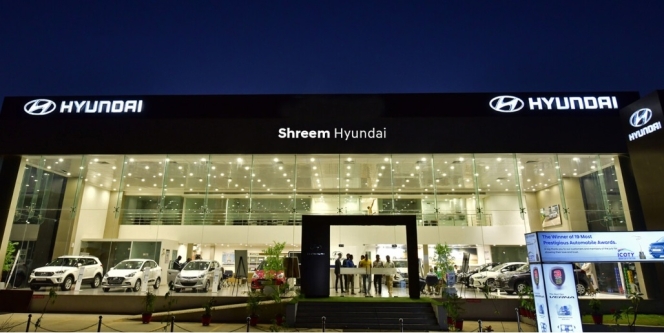
Hyundai Motor India, one of the leading passenger vehicles manufacturers in the country, has announced its financial results for FY2025.
The company reported revenue of INR 691 billion for FY2025, which was flat as compared to INR 698 billion last year. The EBITDA came at INR 89.53 billion, down 2 percent as compared to INR 91.32 billion last year. The profit after tax came at INR 56 billion, down 7 percent YoY.
For Q4 FY2025, the revenue grew by 2 percent at INR 179 billion, as against INR 176 billion last year. The EBITDA was flat at INR 25.32 billion, as compared to INR 25.21 billion for the same period last year, while EBITDA came at 14.1 percent and net profit at INR 16.14 billion, down 4 percent YoY.
The company stated that despite a turbulent market situation, it was able to sustain growth with SUVs now contributing almost 68.5 percent of its total sales across urban and rural markets. The Hyundai Creta continued to hold over 30 percent market share in the mid-size segment.
Unsoo Kim, Managing Director, Hyundai Motor India, said, “FY2025 business performance demonstrates our ability to navigate the tides by responding quickly to the ever-changing customer aspirations. Launch of products like Creta Electric and Alcazar FL along with seamless product refreshments across segments helped us in maintaining our competitive edge. Hyundai’s strong brand presence in key global emerging markets enabled us to endure headwinds and sustain export volumes during the year. The year gone by signifies our resilience in the financial performance by way of sustained revenues and healthy operating margins attributable to improved realisation and cost control measures.”
Amidst macroeconomic headwinds, the automaker stated its domestic strategy centered around premiumisation and the surging popularity of SUVs. The company’s focus on advanced safety and comfort features, like ADAS and sunroofs, is part of its ongoing effort to meet evolving consumer aspirations.
On the exports front, Kim stated that “We aspire to become Hyundai’s largest export hub outside South Korea. For FY2026, we anticipate the growth in export volumes to be around 7 to 8 percent, supported by robust demand for our products in the emerging markets.”
As part of its long-term strategy, Hyundai Motor India is investing in expanding manufacturing capacity and preparing for the future of mobility. “FY2026 will mark a significant milestone in our growth journey, with the commencement of our third plant at Talegaon. Designed with flexibility at its core, the facility will be capable of producing both internal combustion engine (ICE) and electric vehicles, enabling us to respond dynamically to market demand.”
“We also intend to deepen our localized supplier network by adopting an indigenisation strategy at the Pune plant, further reinforcing our ‘Make in India’ vision,” said Kim.
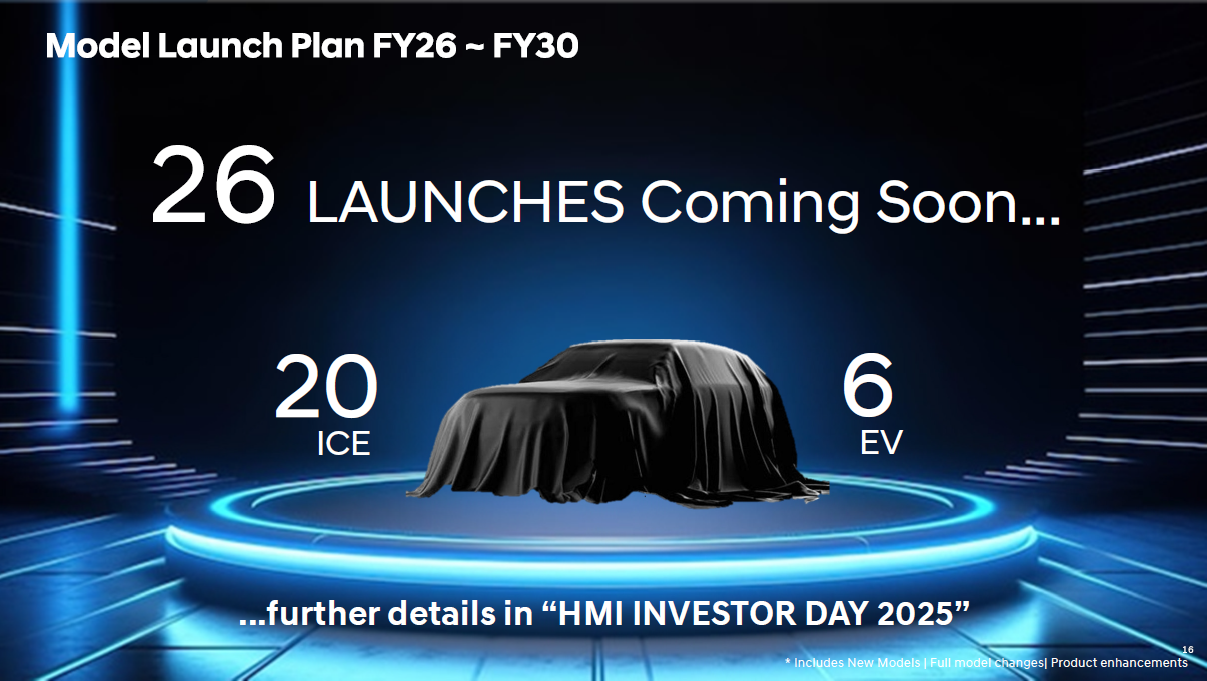
The company has also outlined an aggressive roadmap with 26 product launches planned by FY2030 – including 20 ICE, 6 EVs and new hybrid technologies.
On the other hand, he mentioned a cautious, optimistic outlook for domestic demand in near term amid prevailing macro-turbulences and weakening customer sentiments.
| HYUNDAI MOTOR INDIA | ||||||
| (all figures in INR million) | FY 2025 | FY 2024 | Change | Q4 FY'25 | Q4 FY'24 | Change |
| Revenue | 691,929 | 698,291 | -1% | 179,403 | 176,711 | 2% |
| EBITDA | 89,538 | 91,326 | -2% | 25,327 | 25,218 | 0% |
| EBITDA (%) | 12.9% | 13.1% | -2% | 14.1% | 14.3% | -1% |
| Profit After Tax | 56,402 | 60,600 | -7% | 16,143 | 16,772 | -4% |
- BMW India
- BMW 7 Series
- BMW i7 M70 xDrive
- BMW 740 M Sport
- BMW i7 eDrive50 xDrive M Sport
- Ranveer Singh
- Hardeep Singh Brar
BMW India Launches New 7 Series Range & i7 M70 xDrive Flagship At INR 19.5 Million
- By MT Bureau
- September 11, 2026

German luxury automotive brand BMW India has introduced the updated BMW 7 Series range, offering petrol and battery-electric powertrains across the lineup at prices starting at INR 19.5 million (ex-showroom).
The launch includes the BMW i7 M70 xDrive performance model, alongside the local production launch of the electric i7 at the BMW Group Plant in Chennai.
With local assembly of the i7 in Chennai, India becomes the second country after Germany to produce the electric model locally. The performance-focused i7 M70 xDrive will be imported into the country as a completely built-up unit (CBU) with deliveries across the 7 Series portfolio scheduled to begin in October 2026.
Furthermore, the company also introduced actor Ranveer Singh as the Brand Voice for BMW India at the launch.
Pricing for the petrol-powered 740 M Sport and all-electric i7 eDrive50 xDrive M Sport starts at INR 19.5 million, while the flagship i7 M70 xDrive is positioned at INR 26.5 million (all ex-showroom).
Hardeep Singh Brar, President and CEO of BMW Group India, said: "The new BMW 7 Series is more than our flagship sedan - it is our ultimate statement of modern luxury. It moves the leaders, changemakers and visionaries who are shaping tomorrow. Every detail has been crafted around one idea: those who have reached the pinnacle deserve an experience to match. The new 7 Series sets a benchmark, whether you choose to take the wheel or be driven. It is the new face of the BMW Luxury Class, while offering an early glimpse into technologies that will shape the Neue Klasse era. And with our Power of Choice philosophy, customers can choose from dynamic combustion engines to advanced electric mobility. Because true luxury is not about limiting choices - it is about expanding them. With the new 7, luxury doesn’t end with the drive; it begins there."
"The new BMW i7 M70 xDrive is the most powerful 7 Series ever created - where M performance meets first-class luxury, without compromise. It brings together exhilarating electric performance and the refinement expected from the pinnacle of the BMW portfolio. This is a car for someone who wants the thrill of taking the wheel and, equally, the luxury of being driven. Few cars can make the driver’s seat and the rear seat equally desirable. The i7 M70 does. It represents our belief that sustainability and performance are not competing choices. The future of luxury can be electric, exhilarating and extraordinary - all at once," added Brar.
Kia India Begins Pre-Bookings For Carens CNG And Hybrid Range
- By MT Bureau
- September 11, 2026

Kia India has opened pre-bookings for the Carens CNG, Carens Clavis CNG and Carnival Limousine Hybrid models across its authorised dealer network, expanding the company’s multi-powertrain portfolio in the Indian market.
The additions follow their display at Kia Inspiration Day and introduce alternative fuel options to the manufacturer's multi-purpose vehicle segment. The pricing for all three models is set to be announced at a later date.
Both the Carens CNG and Carens Clavis CNG are based on the G1.5 six-speed manual transmission platform and feature a factory-fitted CNG system with a 60-litre tank capacity. Technical modifications include engine calibration for CNG fuel, revised suspension setups, 16-inch wheels and 16-inch disc brakes. The driver interface incorporates a fuel change switch alongside a 4.2-inch colour TFT display with CNG distance-to-empty logic. Structural changes to the third-row seat-back frame have also been implemented to adjust the recline angle.
The CNG range will include Premium (O) trim for the Carens, while the Carens Clavis will be sold in HTE and HTE (O) trims for retail buyers.
For commercial and business-to-business fleet operations, Kia India has designated the M-Drive trim for the Carens CNG and the HTM trim for the Carens Clavis CNG.
The Carnival Limousine Hybrid introduces an electrified powertrain to the upper tier of the range, powered by a G1.6T HEV engine paired with a six-speed automatic transmission.
It is offered in the Limousine+ trim, which features 18-inch dual-tone aero alloy wheels, active air flaps and a virtual engine sound system. Interior equipment includes an air purifier with air quality index display, seat-back tables with integrated wireless charging, ambient lighting and leatherette door trims.
Hyundai Motor India Intros Lounge Edition Across Creta, Alcazar And Creta Electric
- By MT Bureau
- September 10, 2026
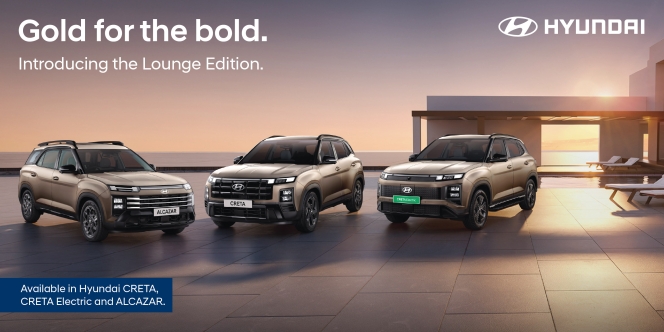
Hyundai Motor India, one of the leading passenger vehicle manufacturers, has introduced the Lounge Edition variant across its Creta, Alcazar and Creta Electric SUVs. The special edition trim updates interior cabin equipment, rear seat entertainment and exterior trim styling across the three vehicle lines.
The primary update across all Lounge Edition models is an integrated 29.46 cm rear seat entertainment system featuring streaming platform compatibility, interactive gaming, an app store and smartphone mirroring, operating alongside an eight-speaker Bose audio system.
On the inside, it features silver interior accents, white ambient lighting, revised seat patterns and branded headrest cushions. Exterior changes feature black trim on the skid plates, side sills, roof rails, rear spoiler and side mirrors, paired with black alloy wheels and a golden bronze paint option.
The Creta Lounge Edition, built on the King trim level, is available with a 1.5-litre petrol engine mated to an intelligent variable transmission or a 1.5-litre diesel engine with an automatic gearbox, with prices starting at INR 1.92 million ex-showroom.
The Alcazar Lounge Edition is offered in a five-seat layout based on the Signature variant, powered by a 1.5-litre diesel engine with an automatic transmission and equipped with a voice-activated panoramic sunroof, priced from INR 2.18 million. The Creta Electric Lounge Edition, based on the Long Range Excellence trim, adds a dashcam and rear wireless charging pad, with prices starting at INR 2.43 million.
Amit Dhaundiyal, Head of Product Strategy and Planning, Hyundai Motor India, said, "At Hyundai, we continuously strive to create products and experiences that resonate with the evolving aspirations of our customers. Customers today seek experiences that go beyond mobility, and the new Lounge Edition has been designed with this evolving aspiration in mind. From lounge-inspired interiors, engaging digital entertainment and on-the-go gaming experiences powered by rear seat entertainment, to distinctive styling enhancements, every element has been thoughtfully crafted to transform every journey into a more comfortable, connected and rewarding experience. The Lounge Edition reflects Hyundai's commitment to delivering meaningful innovations and greater value across our SUV portfolio, and we are confident it will appeal to customers seeking a unique blend of luxury, comfort, entertainment and exclusivity in their everyday journeys."
Audi Unveils A2 e-tron Compact EV With Upto 646km Range
- By MT Bureau
- September 08, 2026
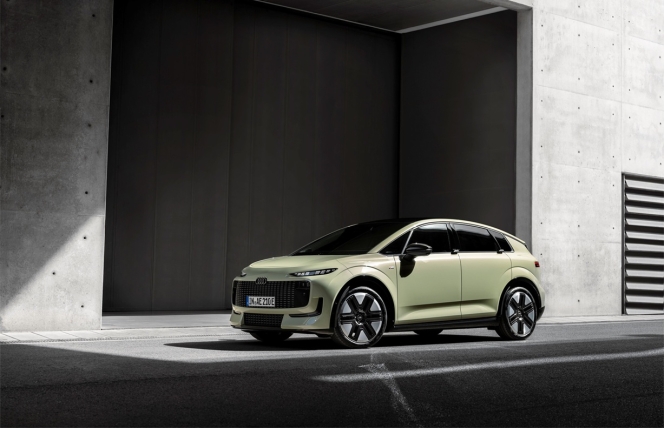
German automotive luxury brand Audi has unveiled the A2 e-tron electric compact model, which marks its most compact green offering, with prices starting EUR 38,200 in Germany.
Developed in Germany and produced at the manufacturer’s Ingolstadt facility, the EV has an energy consumption rating of 12.8 kWh per 100 kilometres under the WLTP test cycle.
The company will open bookings on 10 September, with European deliveries scheduled to begin in December.
The A2 e-tron is offered in four power outputs ranging from 125 kW and 350 Nm of torque in the base specification to 240 kW and 545 Nm in the top variant, paired with rear-wheel drive and permanently excited synchronous motors. Depending on the output, battery capacities are available in 52 kWh, 61 kWh, or 84 kWh gross options, achieving a maximum driving range of up to 646 kilometres under WLTP conditions.
The chassis design incorporates a drag coefficient of 0.24, utilising active cooling air intakes, aero wheels and wheel-arch gap reducers. Bidirectional charging capabilities support Vehicle-to-Load (V2L) external device powering and Vehicle-to-Home (V2H) energy transfer via compatible wall boxes.
On the inside, it features a curved MMI panoramic display housing a 12.3-inch instrument cluster and a 12.8-inch infotainment touchscreen with artificial intelligence assistant integration. Storage incorporates the Fidlock magnetic attachment system as standard equipment, alongside an optional 1.6-square-metre panoramic glass roof.
Audi states that around 300 components across the vehicle are constructed using recycled materials, including post-consumer plastics, aluminium and steel.
The EV assembly utilises 250 existing industrial robots and 1,200 reallocated production components at the Ingolstadt plant, using fixed-sequence manufacturing methods. Standard driver assistance systems include adaptive cruise control, emergency brake assist, evasive assist, attention assist and parking sensors with a rear-view camera.
Gernot Dollner, Chief Executive Officer, Audi, said, “The A2 e-tron is more than a new model: It represents Audi’s renewal. It shows how we are rethinking premium for Europe: using resources more intelligently without compromising on quality, technology, or customer experience. Developed for the needs of our European customers and built in Ingolstadt, it demonstrates our ambition to shape the future of premium mobility.”
Comments (0)
ADD COMMENT