

Indian Automotive Records Wholesales Peak Across Segments In FY 2025-26
- By MT Bureau
- April 14, 2026
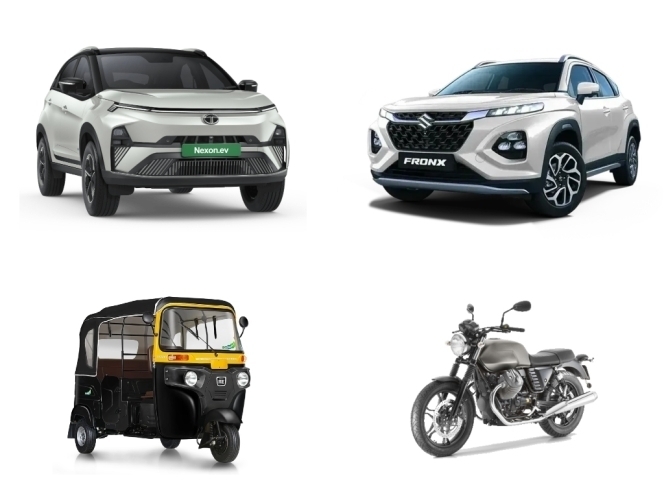
The Indian automotive industry concluded FY2025-26 with record-breaking results, with every vehicle category clocking its highest-ever annual sales, as per data released by the Society of Indian Automobile Manufacturers (SIAM).
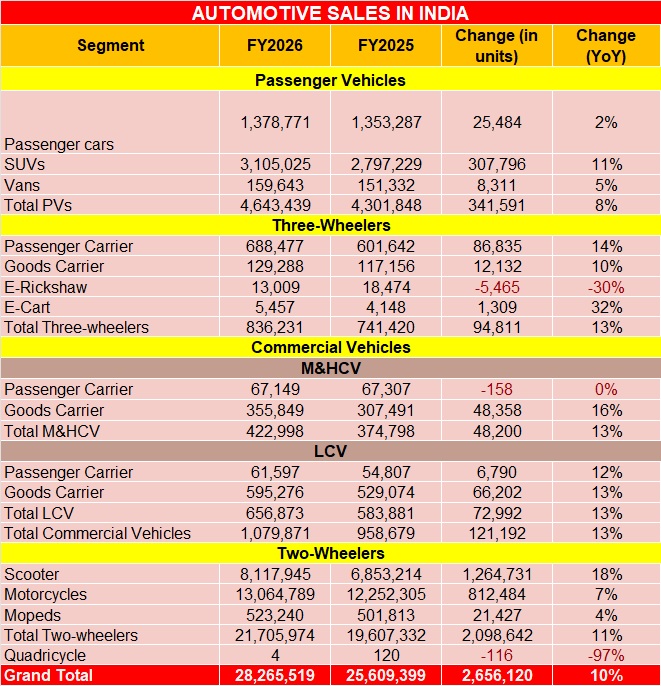
For FY2026, a total of 28 million vehicles were sold across segments in the country, clocking a 10 percent YoY growth, as compared to 26 million vehicles a year ago. The robust performance was seen in passenger vehicles, commercial vehicles, two-wheelers and three-wheelers, all achieving peak volumes, marking a definitive recovery 7 years after the previous industry high.
The passenger vehicle segment recorded sales of 4.64 million units for the full year, representing a growth of 7.9 percent. This performance was bolstered by a strong second half, which saw a 16.7 percent increase compared to the same period in the previous year. Growth was supported by GST rate reductions, personal income tax relief and lower financing costs resulting from repo rate cuts by the RBI.
Notably, electric passenger vehicle registrations rose by more than 80 percent. Exports in this segment reached 905,000 units, a 17.5 percent increase, with demand remaining steady in the Middle East, Africa and Latin America.
Commercial vehicles also reached a milestone with 1.08 million units sold, growing by 12.6 percent. The rollout of GST 2.0 reforms and increased capital expenditure provided the impetus for fleet operators to purchase new vehicles. In Q4 alone, the segment grew by 18.9 percent to 325,000 units.
Two and Three-Wheeler Momentum
The two-wheeler segment surpassed its previous peak from FY 2018-19, clocking 20.17 million units in FY2026, marking a 10.7 percent annual growth, primarily led by urban demand. Exports for two-wheelers reached a record 5.18 million units.
On the other hand, three-wheelers posted a growth of 12.8 percent with 836,000 units sold, driven by increased economic activity and the expansion of electric autorickshaws. Exports in the three-wheeler segment grew by 50.1 percent, largely due to increased volumes to Sri Lanka and African nations.
Market Outlook and Challenges
While the industry remains optimistic for FY2026-27, several global uncertainties persist. Fluctuations in crude oil and commodity prices, disruptions in shipping routes, and exchange rate volatility linked to the West Asia conflict remain primary concerns for manufacturers.
Shailesh Chandra, President, SIAM, said, “Though FY2025-26 started modestly, the Indian Auto industry has closed the year on a high note with every vehicle category viz. passenger vehicles, commercial vehicles, three-wheelers and two-wheelers, together posting their highest ever sales in a Financial Year, after seven years. The strong contributors to this growth have been the positive sentiments created through GST 2.0 reforms and multiple Repo Rate cuts during the year. Looking ahead, domestic demand and macroeconomic fundamentals remain robust as we step into FY2026-27, which should aid steady growth for the industry. However, uncertainties arising from the West Asia conflict need to be closely monitored, as it may have impacts on production, commodity prices, fuel prices, freight rates and the overall economy.”
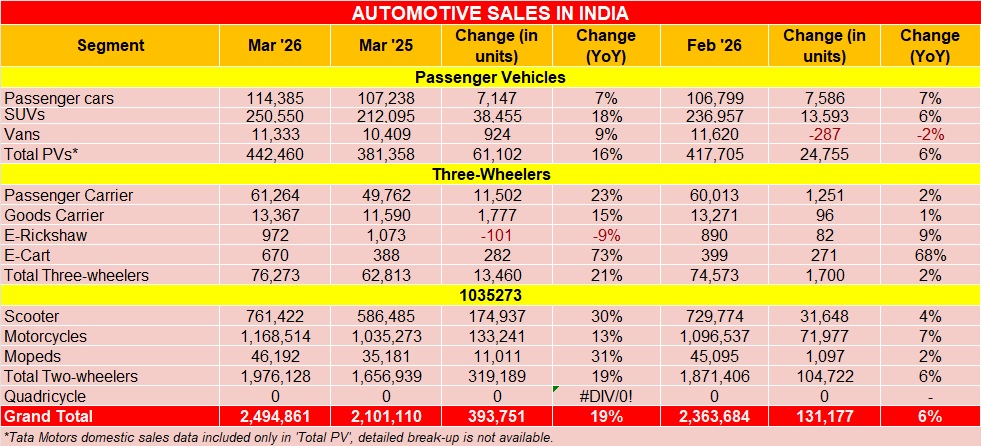
Rajesh Menon, Director General of SIAM, stated, “Each of the vehicle category, passenger vehicles, commercial vehicles, three wheelers and two wheelers posted their highest ever sales in the January to March Quarter with double digit growth compared to previous year’s quarter. In Q4 of 2025-26, passenger vehicles posted sales of 1.31 million units with a growth of 13.2 percent, commercial vehicles posted sales of 325,000 units with a growth of 18.9 percent, three-wheelers posted sales of 227,000 units with a growth of 26.7 percent and two-wheelers posted sales of 5.77 million units with a growth of 26.4 percent, compared to Q4 of 2024-25.”
Porsche Outlines 3 Key Pillars Of ‘Strategy 2035’ At Annual General Meeting
- By MT Bureau
- June 24, 2026
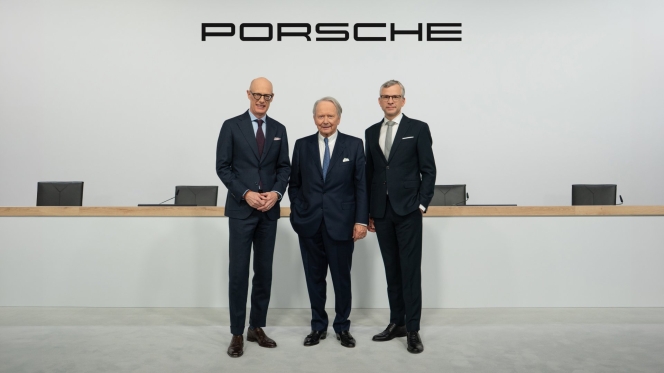
German luxury carmaker Porsche confirmed its financial forecast for the 2026 fiscal year and provided preliminary insights into its new ‘Strategy 2035’ at its 4th Annual General Meeting held on 23 June 2026.
The strategy is designed to enhance profitability and strategic resilience through three primary pillars as outlined by Dr. Michael Leiters, CEO, Porsche, with full details to be presented at a Capital Markets Day on 7 October 2026.
- Brand & Customer: Porsche will refocus on its sports car DNA, design and exclusivity. The strategy shifts away from volume maximisation toward a focus on desirability and value.
- Products & Technology: The company plans to reduce model complexity by cutting the number of variants. Porsche will continue to invest in combustion, hybrid and electric powertrains, noting that the 911 will remain combustion-hybrid and will not move to a fully electric powertrain.
- Company & Operations: Porsche is structurally streamlining its organisation at all levels and investigating increased use of Volkswagen Group modular platforms. Discussions are ongoing regarding workforce adjustments to ensure long-term competitiveness.
Despite a challenging market environment, Porsche confirmed the financial targets for 2026 including 5.5 percent to 7.5 percent (factoring in EUR 800–900 million in one-off expenses and EUR 700 million in tariff costs) operating group return on sales. Group sales revenue to come at EUR 35-36 billion with automotive net cash-flow margin of 3 percent to 5 percent.
Furthermore, the Board of Directors of Porsche have proposed a dividend of EUR 1.00 per ordinary share and EUR 1.01 per preferred share for FY2025. While this payout exceeds the target ratio of 50 percent of consolidated profit after tax, it represents a decrease compared to the previous year, reflecting a move to maintain financial flexibility during the current transformation phase.
Dr. Wolfgang Porsche, Chairman of the Supervisory Board, reaffirmed his backing of CEO Dr. Michael Leiters, emphasising that while the necessary restructuring measures may be ‘uncomfortable,’ but they are essential for the company's future success.
Ashok Leyland Foundation Bets On Local Talent To Transform Schools
- By Gaurav Nandi
- June 23, 2026
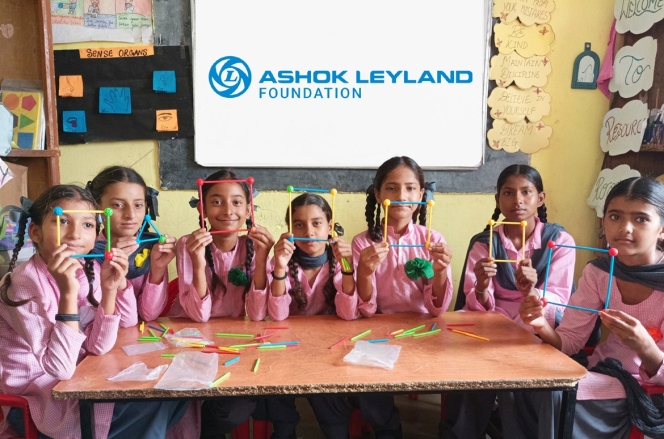
Ashok Leyland Foundation is expanding its education-focused corporate social responsibility (CSR) initiatives with an ambition to reach a million learners across India, betting that community-led implementation and teacher capacity building can help bridge persistent learning gaps in government schools.
The foundation, which has impacted more than 626,000 students in FY2025-26 and over 910,000 lives overall, is scaling its flagship Road-to-School and Road-to-Livelihood programmes across multiple states.
The initiatives focus on foundational literacy and numeracy, digital literacy, career guidance, sports, wellness and life skills primarily for students from underserved communities.
While India has made significant investments in school education, the biggest challenge lies not in curriculum design but in execution, according to T Sasikumar, Chief Operating Officer, Ashok Leyland Foundation.
“The government curriculum and the programme content are top class. Most governments have excellent curriculum. It is only the implementation part where the failure actually happens,” Sasikumar told Motoring Trends.
According to him, two structural issues continue to affect learning outcomes in many parts of the country viz-a-viz teacher availability and teacher commitment.
“The two gaps that we see today are the availability of qualified, competent teachers and the commitment levels in schools. Otherwise, the curriculum in the country for school children is excellent,” he said.
The challenge becomes more acute in remote districts, where sanctioned teaching positions often remain vacant in practice.
“When you move to Jharkhand or interior Uttar Pradesh, you'll find teachers are on the rolls but never come to the school," Sasikumar said.
The foundation has adopted a community-based model, recruiting resource persons from villages where the programmes operate instead of relying on external educators to address the problem.
The organisation hires local graduates, teacher-training candidates and in some cases Class XII pass-outs providing them with training before deploying them in government schools.
“After we exit the programme, these young people continue to live in the community and continue to serve it. That has been one of the major successes of our model,” Sasikumar said.
The strategy complements the foundation's Road-to-School programme, which has benefited nearly 492,339 students across 4,234 schools in nine states since 2015. The programme reports a 25-30 percent improvement in literacy and numeracy, a 98 percent transition rate from middle to high school and Grade 10 completion rates of 95 percent exceeding the national average of 85 percent.
Its Road-to-Livelihood initiative is operating across five states and has reached more than 133,700 students by providing career guidance, digital literacy, financial literacy and soft-skills training.
The programme reports that 85 percent of participating students enrolled in higher education of their choice, while more than half of female participants opted for STEM courses.
Beyond deploying community educators, the foundation is also exploring teacher capacity-building partnerships with state governments.
Sasikumar said discussions are underway with the Uttar Pradesh government to train government school teachers using the foundation's pedagogical model.
“The Principal Secretary asked us why we don't train government teachers using our model so that the sustainability part can be taken care of. We are working on teacher capacity-building programmes in states where regulations permit,” he said.
Apart from education, the foundation has expanded its CSR interventions into healthcare and environmental sustainability, supporting children with Type-I diabetes, operating 13 mobile medical units, planting more than one lakh trees and implementing water conservation projects in water-scarce regions.
Tsuyo Manufacturing Appoints Prashant Ranjan As Director In-Charge – Sales & Service
- By MT Bureau
- June 23, 2026
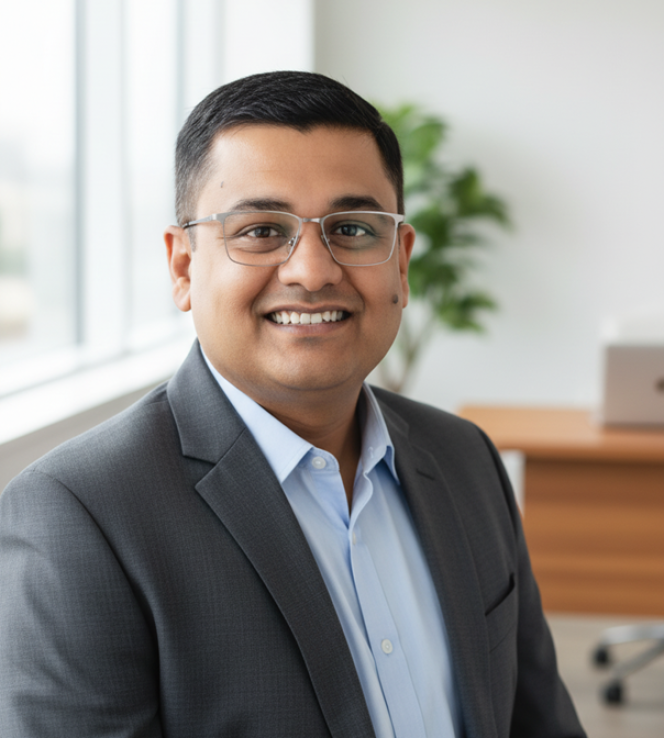
Tsuyo Manufacturing, an e-mobility component manufacturer, has appointed Prashant Ranjan as Director In-Charge – Sales & Service. The appointment is intended to strengthen the company’s leadership team and accelerate growth within India's electric mobility sector.
In his new role, Ranjan will lead domestic business operations, focusing on market expansion, business development, customer engagement and the creation of a service excellence network.
Ranjan brings experience from organisations including Saint-Gobain, Wipro and Godrej, where he led business transformation and revenue growth initiatives.
Prashant Ranjan, said, "India's electric mobility sector is entering a transformative phase, driven by innovation, policy support, and increasing consumer adoption. Tsuyo has established itself as a key player in the e-mobility component ecosystem through its strong manufacturing capabilities and technology-led approach. I am excited to join the organisation at this important stage of growth and look forward to working closely with the team to contribute to the company's long-term vision of accelerating India's transition towards sustainable mobility."
Maruti Suzuki Partners With Gujarat Government To Establish Advanced Manufacturing Labs At Five ITIs
- By MT Bureau
- June 22, 2026
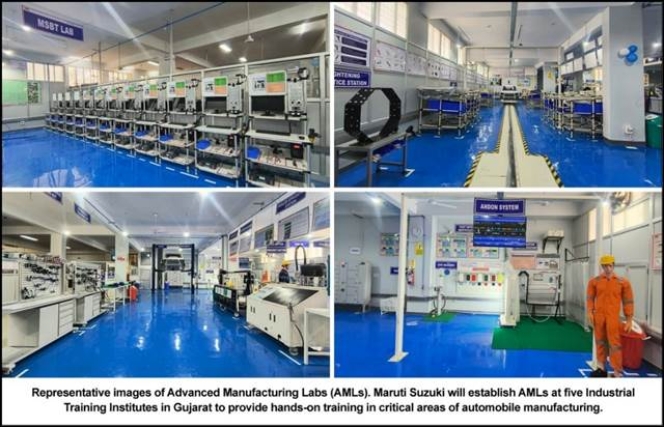
Maruti Suzuki India Limited has formalised an agreement with Gujarat’s Directorate of Employment and Training to establish Advanced Manufacturing Labs within five Industrial Training Institutes located in Palanpur, Bhavnagar, Surendranagar, Godhra and Dahod. This partnership is structured under the company’s corporate social responsibility framework and directly supports the national Skill India mission.
These specialised labs are engineered to mirror actual shop-floor conditions, offering trainees practical exposure to critical automotive processes including assembly, welding, painting, machining, mechatronics and safety protocols. The overarching goal is to elevate the employability of ITI graduates and cultivate a workforce that is immediately adaptable to the demands of modern manufacturing.
This educational initiative coincides with a massive production scale-up in Gujarat. Maruti Suzuki is preparing to activate a fourth production line at its Hansalpur facility this year, which will boost annual capacity to one million units from the current 750,000. Concurrently, a new manufacturing plant with an additional one-million-unit capacity is under construction in Sanand, positioning the state to eventually host a total annual production volume of two million vehicles.
The company’s commitment to skill development is already extensive, supporting 31 ITIs nationwide in manufacturing trades. The addition of the five Gujarat labs will increase the total count of Advanced Manufacturing Labs to 23 across seven states and union territories. Furthermore, the automaker sustains four Japan-India Institutes for Manufacturing in Gujarat and Haryana, a bilateral initiative designed to generate a robust talent pipeline for the industry.
Rahul Bharti, Senior Executive Officer, Corporate Affairs, Maruti Suzuki India Limited, said, “Maruti Suzuki aligns with the Government of India’s flagship Skill India mission to impart the relevant skill training to create livelihood opportunities for the youth. Through Advanced Manufacturing Labs, we are equipping students with experiential learning and confidence in modern equipment, nurturing professionals who can seamlessly integrate into the evolving automotive ecosystem. We have a robust plan to expand manufacturing operations in the State. Each expansion brings with it a new industrial ecosystem, one that demands skilled and future-ready workforce. The Advanced Manufacturing Labs will play a pivotal role in meeting this latent need and ensuring that talent is ready to meet the industry demands.”
Stuti Charan, IAS, Director, DET, Government of Gujarat, said, “Maruti Suzuki, while being the market leader, has consistently demonstrated its commitment to skill development in India. By setting up Advanced Manufacturing Labs in Gujarat’s ITIs, Maruti Suzuki is bridging the gap between classroom learning and industry requirements. This initiative will empower our youth and strengthen Gujarat’s position as a hub for the automotive sector, in line with Hon’ble Prime Minister Shri Narendra Modi’s vision of Viksit Bharat and Hon’ble Chief Minister of Gujarat Shri Bhupendrabhai Patel’s guidance toward Viksit Gujarat 2047. The momentum and support from Hon’ble Cabinet Minister Shri Kunwarjibhai Mohanbhai Bavaliya, Labour, Skill Development & Employment, Hon’ble State Minister Shri Kantibhai Amrutiya Labour, Skill Development and Hon'ble Secretary Shri Lochan Sahera, Labour, Skill Development are paving the way for future-ready learning skills that match the pace of global development.”
Comments (0)
ADD COMMENT